By Ray Birch
LAKE FOREST, Ill.—If a credit union employee contracts COVID-19 as the result of working in a reopened office, who is responsible—the employee or financial institution?
It’s a difficult and intricate question to answer, according to one economist who has also studied pandemics, and who is now outlining several steps financial institutions should take to address the potential for any lawsuits from employees as credit unions restart operations.
The potential risk to credit unions and other businesses from reopening also has the attention of Congress, which is mulling legislation to provide protections. But that legislation has yet to pass.
“There is coronavirus legal risk in addition to health and economic hazards,” said Michael Moebs, economist and CEO at Moebs $ervices. “Employees are the chief resource or assets of financial institutions and constitute half of all expenses.”
Moebs outlined four areas of labor law that could present risks as the pandemic continues:
- Occupational Safety and Health Administration Act (OSHA) rules and regulations
- The Americans with Disabilities Act (ADA)
- Health Insurance Portability and Accountability Act (HIPAA) rules
- Workers Compensation Act (WCA) rules
The Specifics
Specifically, Moebs noted OSHA states (29 USC 654): “Each employer shall furnish to each of his employees employment and a place of employment which are free from recognized hazards that are causing or are likely to cause death or serious physical harm to his employees . . .”
The ADA prohibits an employer from making disability-related inquires and requiring a medical examination unless they are job-related and consistent with business necessity, Moebs explained.
“HIPAA basically protects the privacy of workers and others. WCA requires employers to compensate employees for harm to employees,” stated Moebs. “These acts place the COVID-19 risk mainly on the employer for a worker catching the coronavirus.”
Ultimately, Moebs acknowledged, it would fall on the worker to prove COVID-19 was contracted at work.
“Be aware current legislation is being designed to protect the workers as much as possible, though,” Moebs added.
How can financial institutions mitigate their COVID-19- related legal risk?
Moebs advised financial institutions establish a labor or human resource plan as soon as possible.
“Banks, credit unions, and thrifts are classified as essential businesses by state and federal governments. Yet, these depositories, so far during the pandemic, have had limited physical interaction with consumers, using drive-up, walk-up, and safe deposit box facilities,” explained Moebs. “Many financial institution employees who do not interact with consumers daily are working from home or not working at all.”
Plan Components
Moebs emphasized the human resource plan should encompass the following:
- Incorporate COVID-19 guidelines into work rules and employee manuals. Consider the following:
- What to do if an employee who is symptomatic refuses to go home? Establish a work rule enforcing them to go.
- Must a CU close down a branch or facility if an employee tests positive? “Maybe. Open and free movement could require closing the entire facility. Restricting movement of the employees can limit exposure to others in the event one contracts COVID-19,” said Moebs. “At a minimum, you would need to send home the infected individual plus any others with whom he/she had contact for 14 days and sanitize areas in the facility within which they came in contact.”
- Can an employer require temperature tests? “Yes, but make sure this testing is done privately and with permission, and no results are shared with others. This testing is prohibited by the ADA, yet this is temporarily being suspended during the pandemic. This is not like using a temperature gun at an airport,” Moebs said.

Michael Moebs
- Can a CU require masks and latex gloves be worn? “Yes, but make sure this is in the work rules,” he advised.
- Consider permanently requiring some employees to work at home. “This disease may have opened a way to increase productivity and reduce expenses,” said Moebs. “Now is the time to consider how many employees are necessary to operate efficiently. Moebs $ervices research has found the most efficient financial institutions run with $12 million in assets per full-time equivalent employee.”
The Big Question
When can FIs become fully operational and consider business back to normal, with reduced pandemic concerns?
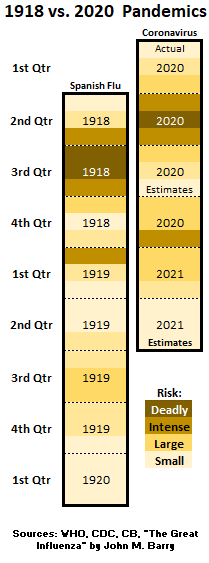
“This can only be known by how long will it take to get therapeutic drugs and eventually a vaccine,” concluded Moebs. “The 1918 Spanish flu took almost two years to run its course and get under control. The coronavirus time estimates from the WHO, CDC and others appear to be less, but timing with an infectious disease is unknown and can be measured only at your own risk. A Nobel Prize was won by a scientist who concluded estimates beyond six months are very uncertain. Risk is often about uncertainty. Having a plan helps contain risk. Putting your plan on the risk of coronavirus means adjusting your work rules and letting all employees know these rules and getting them to sign off on the new work rules.”
A full-blown pandemic is a new experience for just about most people living today, reminded Moebs.
“Knowing what happened in the Spanish Flu of 1918 gives some insight to how to control the risk of this deadly disease. The Spanish flu killed over 660,000 Americans. Losses so far in this pandemic are less than 20% of what occurred in 1918. Putting a plan in place quickly and adjusting to changes helps control risk and leads us to success in coping with this disease,” Moebs said.