

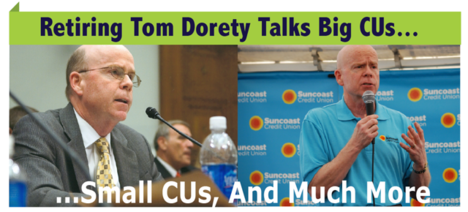
TAMPA, Fla.—The credit union community can no longer afford two national trade associations, and small credit unions need help from their larger counterparts in order to survive.
As long-time CU leader Tom Dorety prepares to retire from the $7.5-billion Suncoast CU at the end of the year, he emphasized those points and others regarding the future of credit unions.
The widely respected CEO and former CUNA chair, known for not shying away from taking a stand on controversial issues, spoke with CUToday.info about not only what’s ahead for CUs, but issues today that are affecting CUs’ ability to grow and compete.
CUToday.info: You are a big credit union. Do you think some small credit unions fear their larger counterparts?
Dorety: I think that is true and sometimes they have the right to do so. But there are also a number of large credit unions, and I would include Suncoast among them, that want to help small credit unions move forward. I don’t think there are any credit unions in our footprint that fear us.
I think the large credit unions should help the small ones. And you don’t have to take over a small credit union to help them. We have tried to do that with credit cards, and have not been successful (in getting other CUs to sign on). We have a program where any small CU can offer credit cards to their members—we run the program together. It’s our program, but we do not go after their members and we share in the expenses and income.
I have never run a small credit union, but I suspect it is very hard, much harder than running a large credit union. Small credit unions need to be able to provide more services to their members and sometimes because of their size, they can’t do that. So it just seems that large credit unions, either individually or in combination, can put things together for the small credit union—whether that is compliance, accounting, collections—without small credit unions feeling threatened. But that is something we can’t get past.
CUToday.info: What is the future of small credit unions?
Dorety: It would be presumptuous of me to make that kind of call. But if small credit unions can figure out how to efficiently provide services that members want and are going to want—whether that be with help from large credit unions or through a CUSO—they know their members well and can be successful and viable. If they are not able to do that, then their future may be a difficult one.
CUToday.info: And the future for all credit unions?
Dorety: There is no reason we cannot be wildly successful based on our sophistication today, on our ability to offer products and services to members, and on our not-for-profit status. Not for profit gives us a tremendous advantage, especially from a branding standpoint. People still care about that aspect of credit unions. Our members certainly do. They consider Suncoast not to just be better because of the value we provide, they trust us more than they do the banks.
CUToday.info: You have seen a great deal of change within credit unions in your years within the movement. What stands out?
Dorety: We have become far more sophisticated, far more data driven and analytical with great technology. With those things, combined with our member ownership distinction, we have a tremendous advantage over banks.
CUToday.info: As a former CUNA chair and head of the CUNA System Structure and Government Task Force, what is ahead for the trade association?
Dorety: In hindsight I would tell you as a former CUNA chair that the thing I most regret is that I was not able to bring the two major credit union trade associations together. I tried to do that and it is well known that I tried. I am disappointed. I think it is harmful to credit unions (to have two national trade associations). This situation continues to waste resources. Even though NAFCU is much smaller than CUNA, they get treated as an equal. And because of that there is constant competition between the two. I don’t think a lot of people understand that point well. Who says we need two trade groups? Credit unions are wasting money and resources from this situation.
I wish back in the day we would have had some success with (combining NAFCU and CUNA). But we failed miserably. If I had to say there is one thing I look back on in my career and wish I could have done better, it would be this.
Going forward, there are gaps not only between CUNA and NAFCU but also gaps between big and small credit unions. I think the movement wastes a lot of time and resources paying attention to these differences and trying to compete with each other as opposed to just being focused on what we all can do.
CUToday.info: You have stated that you are pleased CUNA finally decided to adopt the task force’s recommendation for membership choice, and that the trade association will be stronger as a result. But you also feel that CUNA initially not accepting the task force’s recommendation then reversing itself has had some impact on the trade association?
Dorety: Unfortunately, we made some errors and probably did not handle the situation as well as we could have. And we were very transparent about what we did, and that gave others the opportunity to take advantage of what we did. NAFCU picked up members, going after state charters and giving away half-price offers. And because of the way the system is structured, with the two trade groups competing, you would expect that.
CUToday.info: Why did you come to Suncoast?
Dorety: I came to Suncoast 28 years ago from State Employees’ Credit Union in Raleigh (N.C.). I had worked there 13 years, starting as a loan officer and then ending up as a senior VP. At the time, I knew my boss, Jim Blaine, was not moving on, so I had to look elsewhere. Jim was supportive and helpful in that. When I came to Suncoast 28 years ago, I was VP of member services and I took a cut in pay from my previous job. But I took a leap of faith, hoped it all would work out, and it has.
CUToday.info: When you were named Suncoast CEO in 1996, the credit union had just over $1 billion in assets. Today it has $7.5 billion. How much has scale helped your credit union compete?
Dorety: The biggest advantage of scale is that members receive more and better services. Growth is not a goal. It’s not what you strive for. You strive every day to do a better job and then members are attracted by that. Members should absolutely get a better deal from scale—better convenience better value.
From an employee standpoint, we see huge advantages from scale, particularly when a credit union does a lot of promoting from within. Employees have so much more opportunity within a credit union that is growing. We learned that lesson clearly during the four years of the Great Recession when we were not growing. You see the side effects from lack of growth—not many opportunities for staff.
CUToday.info: Is there any point in time when you have seen the benefits of scale level off?
Dorety: We have never looked at growth as the bigger we get the more efficient we become, and the lower our expenses get. How you get more efficient is a process. So as you get bigger, and you stair-step this, you get to a point when you become pretty efficient. But then efficiency becomes a factor of technology, how you branch, how you deliver services. Those things ultimately make the numbers improve or not improve, more than size itself. So I say a billion-dollar credit union can be just as efficient as a $5-billion CU.

CUToday.info: You are approaching $10 billion in assets, the point when an FI falls under CFPB supervision and face the teeth of the Durbin rules.
Dorety: The magic number is $10 billion, and that changes a lot of things. We are spending a lot of time looking at that now, and obviously we will continue to do that. At our growth rate we should reach $10 billion in about three years. We will have to be prepared for that. But when you are looking well ahead, passing $10 billion should not feel like a shock to the credit union. You understand what it is—it’s a cost of doing business, but you plan for it.
The biggest consequence is the Durbin Amendment, which we figure will cost us $18 to $20 million annually. You also have to make sure you have the necessary systems, data and analytics in place because that is what the regulators want. Regulators are pretty demanding once you reach $10 billion and we need to be prepared for that.
CUToday.info: Anything you do differently today than you did when you started as Suncoast CEO?
Dorety: I listen a lot better than I used to—to other CEOs as much as anything, and to my senior team here. I think we learn a lot from other people, and not just credit union people. The longer you do this the job the more you learn you don’t have all the answers. We went through the Great Recession. I did not think we needed to be humbled. I thought we were humble already. But the recession taught us that you don’t control everything, you can’t take anything for granted, you can’t take yourself too seriously. You really need to pay attention to what is going on around you, listen and learn, and get as much data as you can.
CUToday.info: Why are you retiring?
Tom Dorety: It’s just time. Time for me and time for the credit union. I am prepared to move on and figure out what I want to do with the rest of my life. The credit union is in as good of shape as it has ever been in, staff are phenomenal, we have a terrific board. It’s just the perfect time to move on and I am looking forward to it.
CUToday.info: Do you plan to stay in Tampa?
Dorety: My wife, Glenda, and our 10-year-old son, Michael, are already in Bristol, Va. We found a great school for him, and he is our focus now. Michael is adopted. We will move up there, figure out the communities, and figure out where to live.