

MADISON, Wis.–Just how much the United States is lagging some countries when it comes to “open banking” was plainly evident during a webinar hosted by the World Council of Credit Unions.

Open banking is the term for the practice that provides third-party financial service providers open access to consumers’ banking, transaction, and other financial data from banks and non-banks through the use of application programming interfaces, or APIs.
Perhaps no country is more advanced when it comes to open banking than Australia, which is several years into its open banking initiative and which stands as one of the most advanced open banking markets in the world. But it hasn’t been easy to get to where it is, and the complexities and the challenges are many, according to Michael Lawrence CEO of the Customer Owned Banking Association, to which most credit unions in the country belong.

As Lawrence explained to the “Challenge 2025 Webinar: Open Banking: the Opportunities and Challenges Facing Credit Unions,” open banking has strong backing from the government, with the country’s prime minister, Scott Morrison, a former treasury minister who strongly supports the transition.
“Open banking needs to be efficient and fair without being complex and costly, and now that is arguably debatable, as it is complex and costly,” observed Lawrence of the challenges the country has faced.
There are 66 customer banks in Australia, including credit unions, representing a collective $145 billion in assets and 4.5 million members/customers. Lawrence called those customer-owned banks/CUs Australia’s fifth-largest bank,” a reference to a market in which four big banks dominate, with 80% marketshare between them.
“The four major banks in Australia are significantly better resourced than smaller players,” he observed.
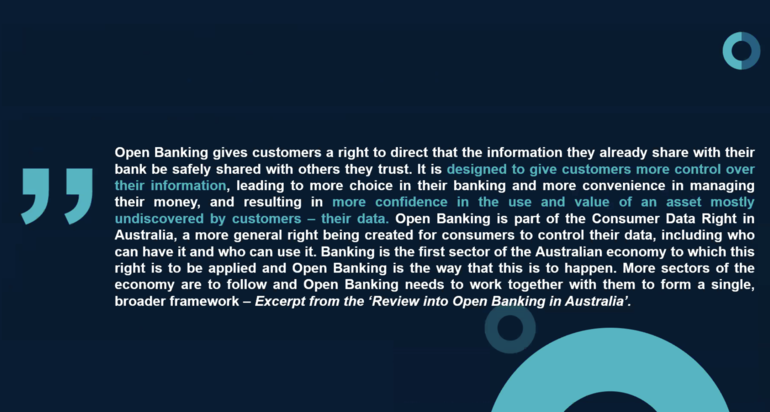
A key issue in open banking in Australia is consumer control over their data, known as customer data rights, or CDR. Responsibility for overseeing CDR recently shifted from the Australian Competition & Consumer Commission to the Australian Treasury. There are multiple regulators with a hand in open banking and CDR, including the Office of the Australian Information Commissioner.
The government is seeking to expand CDR, according to Lawrence, while its Treasury is looking at expanding and widening access to open banking.

Michael Lawrence
According to Lawrence, the objective is to create a future for CDR that will provide greater everyday benefits to Australian consumers as they will be able to safely use online services or apps to:
- Be notified when bills are due
- Arrange for bills to be paid at the best times
- Move money between accounts
- Be advised in real time which services are best, and then switch into those services
- Provide reports on money saved
- Be provided with up-to-date dashboards showing who consumers are sharing data with and how it is being used, and given the power to change those things and even stop the sharing
Pretty Scary
“It's really putting things into the hands of the consumers, which is pretty scary from the bankers’ perspective, when you’ve always been in charge of the data,” said Lawrence. “It is a highly complex regime for consumers to understand and leverage.”
Under open banking, explained Lawrence, a consumer can request to send information from their existing FI to a new FI with just a click of a couple of buttons. This ability provides authorized providers, such as comparison services and budgeting apps, access to the consumers’ data so they can see options and budgeting tools.
“This is where you’re going to have third-party providers and fintechs coming into the space and controlling some of the data of consumers,” said Lawrence. “I must emphasize that the data is at the control of the consumer.”
Australia’s largest bank, Commonwealth Bank, recently became an Accredited Data Recipient (ADR) under the CDR regime. It’s the first of the big four to ingest data under the CDR scheme and it’s looking to boost its mobile presence, said Lawrence.
“This is going to change the competitive landscape,” he said. “It’s not all doom and gloom, because arguably, they also have the most to lose.”
Regional Australia Bank, a mutual bank that is part of the Customer Owned Banking Association, came to the market first and did the first transaction. The bank received 3,000 pieces of data on one consumer n a matter of two minutes from the largest bank and a personal loan was approved in two minutes.
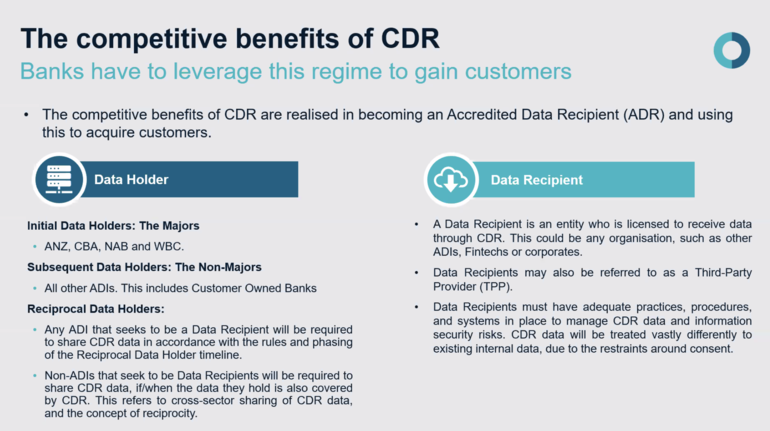
Not surprisingly, Lawrence said many of the smaller financial institutions are struggling to become Accredited Data Recipients due to the complexity involved.
“The regime is forcing digital transformation on institutions that would prefer more time to implement and more choice about the investment priorities,” he said.
As a result, non-major banks, including credit unions, have received an additional year to implement the data standards, but even having this extra time the implementation process has proved challenging for many, according to Lawrence.
“There has been a real mismatch between rule changes and related changes to technical standards that have put the timelines at risk,” he said. “It has also created a complex ecosystem of third-party providers, which has added to the challenge. Policy is being done on the run here. When you think about the security side of things and the importance of security, it is problematic.
“The competitive impacts of open banking have yet to be realized in the banking market,” continued Lawrence. “It’s impossible right now to tell how it will change the market in Australia for customer-owned banks and credit unions.
There are standards for data, but there have been changes. One small change to any standard can mean, from a technical perspective, it can be messy.”
Open Banking in Canada
Trailing Australia but looking to move forward on Open Banking is Canada, which is also several years into its initiative, according to Patrick Barr, policy advisor-open banking, with the Canadian CU Association (CCUA). The CCUA has 223 member CUs serving 5.9 million members and representing, at $266 billion in assets, about 20% of the market.

Patrick Barr
Canada’s journey toward open banking started in September 2018 with an advisory committee, Barr told the WOCCU webinar. In January 2019, input was gathered on the merits of open banking through public consultation, the results of which were published in January of 2020.
The three key takeaways from those consultations, according to Barr, were:
- Recommendation for development of a framework for open banking in Canada
- An ambitious timeline of two years
- In November 2020, the government recognized COVID had led to the digitization of much of society. An advisory committee relaunched the second phase as a result and shared proposals with stakeholders.
The goal now is to form the Canadian Open Banking Framework.
Barr said credit unions and the CCUA have been working to shape the framework in a way that benefits members.
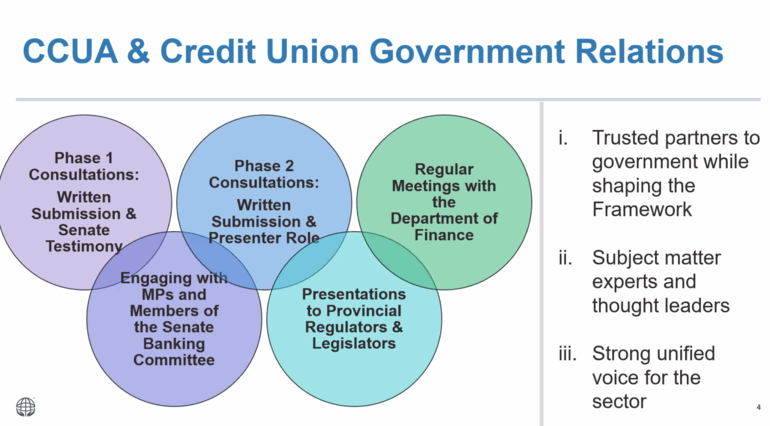
Barr said the country’s credit unions have become trusted partners to the government in creating the framework.
Barr stressed the number-one priority of Canada’s CUs is ensuring they have opportunity to participate.
“Some smaller credit unions have raised a concern that open banking will bring overwhelming regulatory and compliance costs, as well as overwhelming technology costs,” he said. “We have been advocating for an opt-in system giving CUs the option, but not the obligation, to participate in open banking. The overarching and most pressing issue that impacts all of our policy positions and every engagement we have with government on open banking concerns risks around misalignments between federal and provincial regulation.”
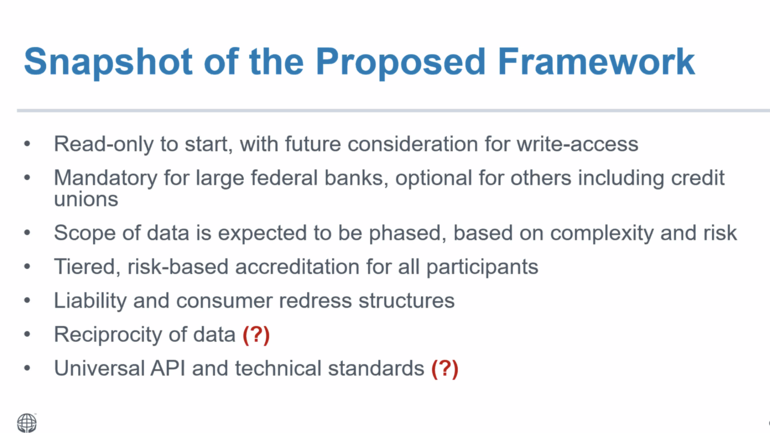
The question marks in the chart above represent government proposals that Barr said are “quite contentious,” with disagreement around support.
The next steps toward open banking in Canada include the finalization of recommendations to be presented to the finance minister, followed by a consultation on implementation, and then the establishment of open banking implementation deadlines.
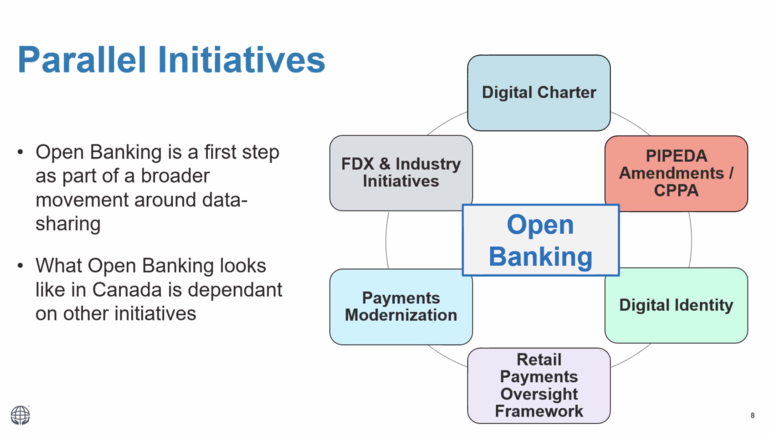
Parallel Initiatives
Barr said open banking cannot be viewed in a silo, as it is dependent on what is taking place across numerous other areas, as outlined below.
One other key issue, he stressed, is ensuring CUs are agile and prepared for whatever the future holds, including the hiring and development of staff for an open banking future.
“The truth is that most of the important roles in credit unions five years from now are not who credit unions are staffed with today. I’d be shocked if CUs had API architects on staff today,” he observed.
The United States: ‘So Far Behind’
And then there is the United States, which Lance Noggle, senior director of advocacy with CUNA, acknowledges, is “absolutely nowhere near Australia.” Or Canada.
“Even who would be in charge of sheparding open banking standards in the U.S. would be difficult to determine,” said Noggle, saying it would most likely require an act of Congress.
“We are really far behind. We don’t have any sort of defined open banking standards yet. That’s not to say we’re not looking at it or that private industry isn’t looking at doing something,” he said. “There are a lot of moving parts to be looked at before we can get anywhere near where they are in Australia or Europe.”

Lance Noggle
One concern, said Noggle, is the American consumers will not fully understand what it means when they provide their credentials to a third-party.
Complicating matters, he added, is that there is still no comprehensive national privacy law in the United States.
“We need to crack the privacy nut, if you will, before we move onto any sort of open banking,” he said.
What privacy legislation is in place has mostly occurred at the state level.
“We are so far behind it’s likely we will see private solutions first,” said Noggle. “It may mean financial institutions partnering with fintechs. As we move forward the United States will probably look to adopt some of these practices from other countries.”