

By Ray Birch
PLANO, Texas–Negative interest rates are certainly something credit unions should be thinking about, according to one expert, who said the U.S. was actually “living in that environment” for a short period earlier this year.
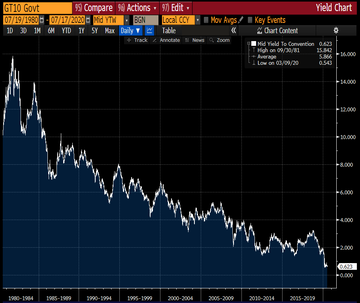
What’s more, said Mark Wert, a senior advisor at Catalyst Strategic Solutions, the overall trend for term rates since the mid-80s has been downward, an indicator rates someday could go negative.
“It was the third or fourth week of March and we were living in negative interest rates on the front end of the treasury curve and it just really didn't get publicized,” said Wert. “It was well known to the big, institutional players, but it really wasn't well known on the margins.”
Should the United States ever actually see negative interest rates again, it will be around rates the Federal Reserve does not control, similar to what occurred in March, said Wert.
“This would be rates the Fed does not plan to control outside of their target rate range of 0%-.25% for fed funds,” he said.
What Needs to Be Recognized
What credit unions leaders really need to recognize, said Wert, is the country has seen rates decline—outside of a couple of short “blips” when rates rose—for more than 30 years.
“Since the mid-80s rates have been steadily coming down,” said Wert. “Look to where the 10-year note is today, and you can say that for the 30-year note, as well. It's been a slow decline to close to zero now. If you think about that trend, what's going to stop that? Will rates go below zero?”
Numerous analysts, including Wert, have said the answer is no--the Federal Reserve won’t let the target rate slip below zero.
“But the Fed is not currently controlling term rates through yield curve control, and there is the chance term rates could slip below zero,” Wert said. “The Fed has said they are not going to go there, to negative rates. And at this point they have so many different reasons—and so many levers to pull—not to go to below zero with their monetary policy...However, stepping outside Fed policy, we’ve seen negative rates.”
The Driver
Wert said the likelihood for term rates to go negative will be driven by the demand for U.S. Treasuries.
“That’s what does it. And if there continues to be a strong demand for the safety and liquidity of Treasury assets…” noted Wert, who said he expects the strong demand for Treasuries outside the U.S. will continue. “We are seeing the classic flight to quality, where you have large investors coming into the Treasury market just to park cash there because of the safety. Not to mention U.S. rates still remain positive compared to the likes of Europe and Japan.”
But, he added, it would take a significant additional influx of investments in Treasuries, a real “flight to quality,” he said. “So (negative rates) would really occur more for a technical reason now instead of a fundamental reason.”
Do Not Ignore
What all this means to the managers of credit union balance sheets is they should be thinking about what might happen and how they would address a negative interest rate environment if it occurred, Wert told CUToday.info
“They should not be ignoring this,” said Wert. “Credit unions should be thinking about how they might address negative interest rates operationally—can their systems accommodate negative interest rates? I am not saying this will happen, but they should find out if there systems are ready for it. It's almost like the Y2K concerns from years ago. So it’s not so much that credit unions need to be concerned about how they will start making loans with negative interest rates; it’s more about are they ready to handle negative rates if they were to come to fruition and stay out there for an extended period.”
Wert said one concern is many credit union solutions and models were built without anyone ever envisioning rates could go negative.
“When you think about it, most systems were really not designed for negative rates,” he said. “When you are modeling your balance sheet, a lot of models out there do not incorporate negative rates. It's very important to have that capability, because a lot of the models historically, over the last 15 years, floor rates at zero. Now, do you do a bunch of work and it never comes to fruition? Maybe. But you still have to be prepared.
What the Future Holds
Wert does not think CU balance sheet experts, most of whom have never had to deal with a true, extended rising rate environment, will have to address rising rates in the foreseeable future.
“What is the chance we will see a true rising rate environment again? Honestly, I feel those chances are very small unless something completely unforeseen due to the pandemic occurs,” said Wert. “What that may be, I don’t know. Or another thing could be something like a war or trade war and foreign investors stop buying Treasuries. But from a fundamental standpoint, I think the probability is very low. Why? For non-fundamental reasons, the Fed can simply step in and buy every Treasury under the sun to cap rates if they wanted too. But why from a fundamental standpoint? Again, slim at best, because I don’t see this country growing GDP in the future at rate that would be necessary to push rates meaningful higher. In turn, lacking the ability to grow at 8% to 10% for several years will keep inflation in check, thereby keeping rates from moving higher in a meaningful way.”