

WASHINGTON–Why has Washington become such a nonproductive, gridlocked mess?
Two former congressman from opposite sides of the aisle are offering three reasons for the sad state of affairs–as well as some solutions for making things better–although neither expects anything to change anytime soon.
In joint remarks before NAFCU’s Congressional Caucus, Tom Davis, a Republican who formerly represented Virginia, and Martin Frost, a Democrat who formerly represented Texas, noted that historically Congress has never been known as a bastion of cooperation, yet “it’s gotten worse.” But why?
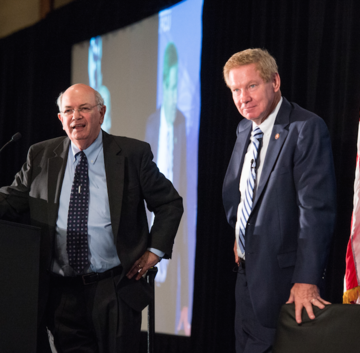
Martin Frost, left, with Tom Davis at NAFCU's Congressional Caucus.
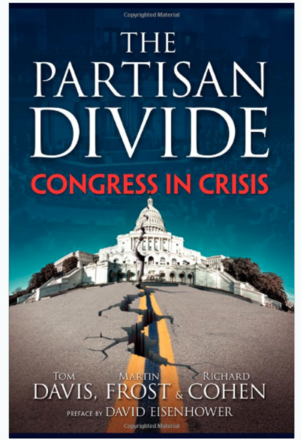
That’s the question tackled in a book co-authored by Davis and Frost, along with Richard Cohen, titled “The Partisan Divide: Congress in Crisis,” that offers some insights into what is has driven that political divide even wider. They also offered some thoughts on why many general elections are already done deals and what it is driving the emergence of presidential candidates such as Donald Trump.
Behind everything, said Davis, a seven-term congressman who opted not to run for election and who stepped down in 2008, is what the book refers to as an “ideological sorting of the parties.”
Davis and Frost pointed to three developments and decisions that have brought America to the point it has now reached: redistricting, new media business models, and, not surprisingly, money.
1. Redistricting & Gerrymandering
“Eighty percent of the House (races) are predetermined every election,” said Davis. “These elections are determined in the primaries.”
To illustrate his point he showed graphics of bizarrely shaped congressional districts that have been gerrymandered to ensure re-election. He pointed to what’s known as “residential sorting,” which is that people who tend to think alike also tend to live in clusters, as contributing to the gerrymandering. Similarly, he said the Voting Rights Act might have outlawed discriminating against minorities, but but doesn’t mean they can’t be “packed together” in districts.
“We’re getting these prepackaged districts where it is a race to the right in the Republican districts and a race to the left in the Democratic primaries,” he said. “The race is over with the primaries.”
2. Media Business Models.
Davis said the decision in 1987 by the FCC to eliminate the Fairness Doctrine, which required the holders of broadcat licenses present both sides of controversial issues in a manner that was “honest, equitable and balanced, has created a strongly partisan media landscape.
“The end result of that is a polarization of the media and the center is gone. These are successful business models; pure news it’s not,” said Davis. “On the Internet what we call the crap-to-content ratio is extremely high. People are tuning into this stuff and then forwarding it around. Cable news, talk radio, it’s all polarized.”
3. Money in Politics.
“The center is gone here, too,” continued Davis. “ When Congress passed McCain-Feingold (finance reform) all it did was say political parties can’t raise soft money. And those of us opposed to (McCain Feingold) asked, ‘Where do you think this is going to go?’ It’s gone to the wings. The media is out on the wings. And the districts are on the wings. The combination of these has created this mess.”
All of those factors have led to people who identify themselves as either Republican or Democrat having highly negative feelings toward the other party, something he said wasn’t true 30 years ago.
What has happened in the U.S., according to Davis, is something resembling the form of government in the U.K, for instance.
“Voters are voting in a Parliamentary manner for the party, not the person,” he said. “When members come to Washignton they act like it’s a Parliamentary system, but that’s not what we are. You’re not the minority party now, you’re the opposition party. You oppose everything.”
Davis cited analysis done by the respected National Journal which has ranked members of Congress on a scale of most liberal to most conservative. In 1982, National Journal ranked 244 members of the House as being in the “middle.” By 2002, that number had declined to 137. By 2014, the number was just three.
“Compromise is not rewarded, it’s punished,” said Davis, noting that Republican members of Congress even avoid being seen in the television picture when the President Obama enters the House for the State of the Union speech.
Looking forward, Davis said states have definitely moved in a clear red or blue direction, and that the next presidential race will come down to a nine state race.
Suggestions For Fixes
Frost, the Democrat from Texas who served from 1979-2005, said he and Davis have offered some specific suggestions for fixing some of the factors that have led to a Congress in crisis.
1. Congress must pass laws requiring states to draw congressional districts using bipartisan commissions.
“Voters in Washington, California, Arizona, Idaho, and New Jersey, have already done this,” said Davis. “Would Congress do this on their own? Probably not. They like the current system that got them there. But voters can do this on their own.”
2. Campaign finance reform and donor disclosure.
Over the years, said Davis, Congress and the Supreme Court have helped to create a system he called “the wild west.”
“There are no limits on spending, so now we have all these Super PACS and 501(c)4s, which are supposed to be charitable organizations that spend on politics, and there are no requirements in C4’s that the donors be disclosed,” he said. “We have suggested that Congress pass a law that anyone who gives any donation that supports a candidate be disclosed. We have a system of dark money, and the problem with that is when the playing field is tilted because of the way districts are drawn in Congress and in states, very wealthy donors can make a large donation in a primary. Since independents can’t or don’t vote in primaries, a very narrow slice of the electorate decides who the party is going to be. Lots of incumbents now live in mortal fear of losing a low turnout primary race. Another suggestion we have made is that we have a national primary day for Congress to increase media attention and hopefully get a larger turnout. We have incredibly low turnout in our primaries and even general elections, so we ought to be doing things to make it easier for people to vote. We would have to amend the Constitution to override (the) Citizens United (decision). But could require more disclosure.”