

PLANO, Texas–A well-regarded economist and his firm are predicting economic growth in 2021 and 2022 under a President Biden administration would actually be stronger than that under a second term for President Trump.
In remarks to Catalyst Corporate’s Economics & Payments Forum, Bernard Baumohl, chief global economist at the Economic Outlook Group, who was ranked by the Wall Street Journal as the most accurate economic forecaster for 2018, offered a forecast for what he sees ahead economically, saying in advance of his remarks he would not “pull any punches in (his) assessment.”
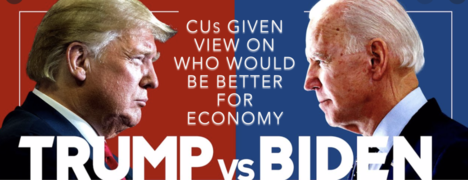
Baumohl covered a wide number of issues, but it may be his thoughts on an election now three weeks away that will be of greatest interest to credit unions. The election and what it might mean was one of four macro-issues addressed by Baumohl.
Stressing his firm is apolitical and that it bases its own forecast and baseline assumption on work done by RealClearPolitics.com, Fivethirtyeight.com and CookPolitical.com, Baumohl acknowledged the November presidential election involves “two adversaries with profoundly different personalities and policy agendas.”
Baumohl said his forecast has identified one commonality for both Biden and Trump: Whomever wins, he believes it will be part of a larger “trifecta,” involving not just winning the White House but the respective candidate’s party also winning both houses of Congress.
If Biden Wins
If Biden wins, Baumohl is forecasting:
- The economy will see 3.4% growth in 2021 and 4.3% growth in 2022.
- Biden may seek modified lockdown in 2021
- A more generous stimulus package will be passed in Q1 2021.
- Biden will reappoint Jerome Powell as Fed chairman to ensure consistency in monetary policy.
- There will be more spending on infrastructure, climate protection, education and expanded health care.
- There will be a partial rollback of 2018 Tax Act that would raise taxes on corporations to 28% vs. 21%, and on people earning more than $400,000
- The U.S. will rejoin multilateral organizations, including the CPTPP and Paris Climate Accord and there will be a reengagement with NATO.
- Biden will seeking to boost U.S. leverage against China by organizing a coalition of countries that trade with it. “I think Biden will continue to be tough on China,” he said.
- There will be less uncertainty over U.S. domestic, trade, and foreign policies and that will set the stage for more business investments.
“When you put this all together we see less disruption to trade and supply chains, less uncertainty over domestic and foreign policy and we believe that creates a backdrop more conducive to more hiring and business spending,” Baumohl said.
If Trump Wins
If Trump wins reelection (and Republicans win the House and Senate), Baumohl is forecasting:
- Growth of 2.2% in 2021 and 2.6% in 2022.
- Trump will feel he’s no longer constrained and his main focus will be on forging his legacy on the economy, trade and deregulation.
- There will be more tax cuts, including credits for companies that domicile plants in U.S.
- There will be more spending on infrastructure, border security and defense.
- The GOP will look to cut entitlements.
- Trump is unlikely to reappoint Jerome Powell as Fed chair, a decision Baumohl said will unnerve global financial markets.
- Geopolitical tensions will intensify against China, Europe, North Korea and Iran (China may retaliate by reducing or stopping investment in U.S. Treasury debt).
- Trump will pull the U.S. out of the WTO and NATO, which could “destabilize the international political system.”
- Business spending will turn cautious given the uncertainties over trade, supply chains and geopolitical conflicts.
Other Macro Issues
Other macro-issues affecting the forecast for the next several years, according to Baumohl, include:
The Path of COVID-19
“We cannot fix the economy without fixing the health crisis,” said Baumohl. “It’s not fiscal and monetary economic policies that will dictate the timeline for growth. The virus is calling the shots this time. An economic rebound is not the same thing as an economic recovery.”
Baumohl outlined three different scenarios depending on state of a vaccine, and he reminded that COVID-19 may never fully go away, with or without at a vaccine.
An Economic Stimulus Package
Baumohl said the lack of any stimulus package from Congress likely means a 90% chance of a recession.
“It’s crucial to pass it right now,” he said. “With President Trump in the hospital, there is even greater pressure for Congress to get this done. The real reason is we do need a financial lifeline for businesses to keep them financially afloat and that keeps households whole. We need to make sure there is a financial vaccine that outlives the coronavirus. That’s critical.”
Baumohl said there can be no financial vaccine, however, without a credible COVID-19 vaccine, and believes President Trump’s hospitalization makes legislation more likely, if not in the current Congress than before year-end.
According to Baumohl, the three most critical elements of any package would be:
- Critical funds for state and local governments. With 49 of 50 states having balanced budget amendments, Baumohl said no federal help will mean the slashing of teachers, nurses, public education, “so it’s really a high priority.”
- Pandemic unemployment assistance through January, 2021.
- New funding for the PPP. “We do want employers to remain solvent and keep employees on payrolls,” he said. “We are already seeing some companies that received PPP funds have had to let go employees.”
What’s Left for the Fed?
Baumohl said there is little more the Fed can do, having made ample liquidity available through multiple programs.
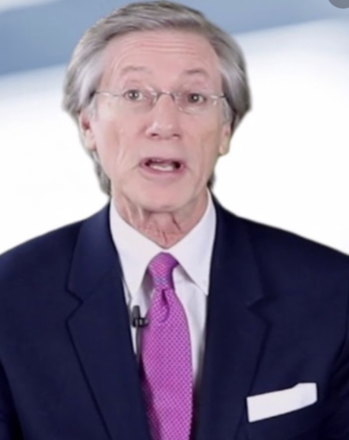
Bernard Baumohl
Baumohl said he believes the Fed Funds rate will remain close to zero for at least four to six years, and reminded that it took seven years after the financial crisis before the Fed Funds rate got a boost.
The other reason a stimulus package is critical, said Baumohl, is the necessity of ensuring consumers are in good shape.
“This is a consumer-driven economy; they are the bedrock, and yet people are quite fearful about the economy,” said Baumohl, pointing to basic concerns over whether to go out or send kids to school. “Anxiety is manifesting itself in consumer spending.”
Credit unions and banks have fears of their own, he added. “
“Financial institutions are not sure in this environment who is creditworthy,” observed Baumohl.
The uncertainty continues, Baumohl said. He told the Catalyst meeting there have been increases in factory input, yet with 700,000 fewer employees working. Airlines, which he said are part of the country’s infrastructure, are burning through $200 million in losses per day. Disney has announced it is furloughing 28,000 employees.
“The key things that stand out in my mind is if these companies are announcing these layoffs now it’s because they’ve come to the conclusion this situation isn’t going to change anytime soon,” said Baumohl.
Permanent Changes Coming
Baumohl urged credit unions to prepare for a number of permanent changes he said are coming to the economic and business landscape.
“Do not expect a flip to switch and everything will go back to normal,” he cautioned. “I think the pandemic has fundamentally changed the financial and economic landscape.”
Baumohl said he expects the economic divide, which he called a “tale of two economies,” to continue.
“Low-income households and minorities have suffered disproportionately,” he said.
Other points raised in Baumohl’s forecast:
- Deglobalization it staking place. China is no longer the world’s manufacturing hub, he said, but the big question is where to relocate that manufacturing?
- Shipping cargo trans-ocean has become more expensive due to industry consolidating.
- The economics may sufficiently change to bring production back to the U.S.
- There has been an energy paradigm shift. Baumohl said the coronavirus, wildfires, and extreme hurricanes have all heightened alarm over global warming. He said it appears demand for fossil fuels is peaking. “Some of you may not agree but I think this planet is facing its greatest threat in history from global warming,” said Baumohl. “2019 was the second warmest year for the planet on record. Another fact that may startle you: the Greenland ice sheet, which is three times the size of Texas, last year saw ice melting at one million tons per minute. It’s a critical change and it’s alarming.”
- Corporate travel “as we know it is history. More people and companies are comfortable with video conferencing, and people are more productive. A minimum of 10% of 15% of business travel is history.”
- The U.S. remains “woefully unprepared” for pandemics. “ICBMs, tanks and submarines cannot protect a country against biological terrorism. There are going to be a lot more dollars spent on protecting the nation from these pandemics. We will be dramatically reducing our reliance on China and India for critical medicines.”
Concerns to Watch
Finally, Baumohl said these are some of his concerns moving forward that deserve being watched:
- Delays in the availability of an effective vaccine against COVID-19.
- The U.S. sleepwalks into a national debt crisis, with $1.8 trillion in new debt be added in 2021 alone. “Who will continue to finance it and at what cost?” asked Baumohl.
- A financial asset bubble suddenly bursts and triggers a recession.
- A trade war escalates against China, Europe, Canada and others.
- The U.S. and the Chinese military have a military confrontation in South China Sea.
- Iran enriches uranium.
- A cyberwar is waged on the U.S.