

By Ray Birch
HELENA, Mont.—Tracie Kenyon is not certain what’s ahead for credit union leagues, but she knows there’s still room for state-level associations that want to remain independent and serving CUs in their current boundaries.
Kenyon, president and CEO of Montana’s Credit Unions (MCU), spoke with CUToday.info about her 22 years leading her league and the outlook for the league system as more mergers take place. Kenyon will retire in the spring of 2023.

“Just like more credit union mergers are coming, we will see more mergers of leagues,” said Kenyon. “But I don't have a crystal ball. So, I'm not really sure how all this will play out.”
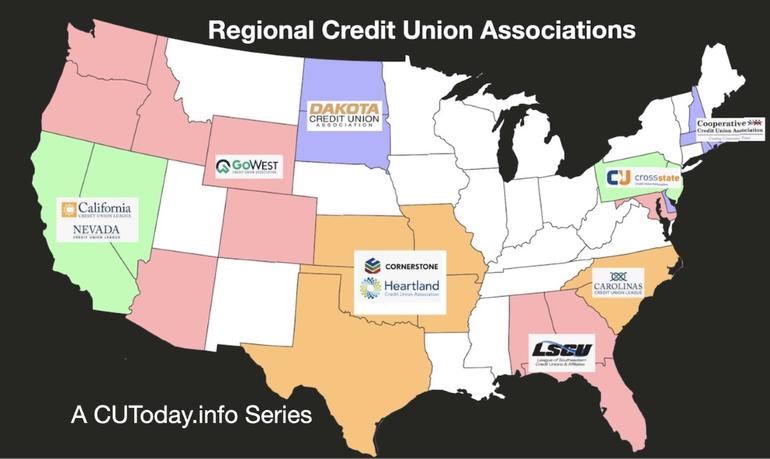
As CUToday.info noted, a question is being raised about where will all the league mergers take the credit union system. As credit unions themselves have shrunk in number due almost exclusively to mergers, their state-level associations have in many cases followed, as dues income has decreased at the same time demands for certain services has increased. Where there used to be a “league” for every state (in some cases, two), today there are regional associations that stretch across as many as six states.
Big Mergers Occur
Case in point: the newly formed Go West Credit Union Association, which was created by the merger of the Mountain West Credit Union Association and the Northwest Credit Union Association on June 30. But those two latter associations were also formed by mergers, with leagues that once served Washington, Oregon and Idaho, respectively, creating the NWCUA, and leagues serving Colorado, Wyoming and Arizona combining to form the MWCUA.
“These big mergers that are going on right now, maybe that will be the end of this for a while. But I really could not make a prediction,” Kenyon said.

Tracie Kenyon
The Cornerstone League, which represents credit unions in Texas, Oklahoma and Arkansas, and the Heartland Credit Union Association, which serves CUs in Kansas and Missouri, have also now voted to approve a merger that would create an organization serving 718 credit unions representing 14-million members across the five states.
Other multi-state associations/agreements include the California/Nevada leagues (the leagues are separate, with the California league managinig the Nevada league under a contract), the Dakotas Credit Union Association, the League of Southeastern Credit Unions (Alabama, Florida, Georgia), the Carolinas CU League, the CrossState CU Association (New Jersey and Pennsylvania), and the Cooperative Credit Union Association (Massachusetts, New Hampshire, Rhode Island and Delaware).
On the other side of the coin are leagues such as Montana’s Credit Unions.
“I have argued for years that it's never been the size of a credit union that's made them a credit union. It's their commitment to credit union ideals and principles,” she said. “It would be hypocritical for me to say anything different about a large league. My hope and wish are that every member of an affiliated league will feel special, and we'll always have that connection. That's the way we do business here. Maybe it isn't as important to everyone…I hope that as leagues continue to expand that their members, regardless of size, still feel important and engaged and getting the services they were getting when they had an independent, and smaller, league.”
Does a Direct Membership Model Lie Ahead?
But as individual state CU leagues continue to merge, and multi-state leagues also combine with other multi-state leagues, will there remain a need for a CU to belong to a league, or does a direct membership in CUNA model lie in the future?
“I hear what you are saying about the large mergers,” said Kenyon. “I actually still believe that there will always be a place for the three-tiered system—credit unions, the leagues and the CUNA. And we could build that system out even further with (the World Council) and the league chapters. I still believe that leagues are inherently built to be the boots on the ground. CUNA is built to be a national trade association. When we work together in concert, that's where we get our true power. I can't be in Washington every week. I trust our partners at CUNA to handle that. And, by the same token, CUNA can't come out and be in district and meet with our lawmakers as well as our league can. I believe there will always be a place for the three-tiered system.”
Powerful Sources
Kenyon emphasized leagues are powerful sources for credit union advocacy.
“We are the ones who often cultivate the grassroots relationships,” she said. “We are constituents. We’re voters. We live in districts, and so we're a powerful reason for the existence of leagues—it is for political, legislative and regulatory advocacy.”
In leading the MCU for 22 years, Kenyon said she is most proud of helping to form two league businesses that have “uplifted credit unions.” Those organizations include:
- Montana Credit Unions for Community Development, a charitable organization that creatively combines advocacy efforts with outreach and development
- Montana Credit Union League Group Benefits Trust, a self-funded benefits plan for employees of Montana’s credit unions that “incorporates wholistic approaches to wellness, including financial wellbeing.”
Another Point of Pride
Kenyon added she’s also proud of being able to bring credit union people together.
“I've been league president for 22 years and I have absolutely loved the role of convener,” she said. “I love working with people. I love bringing people together to find solutions for our credit unions. I am also fond of the fact we've had 100% affiliation in almost all of the years I have led the league.”
Kenyon said the league is doing well and that she expects that will continue as she exits.
“I made a commitment to myself years ago that I would go out while the league was doing very well, and we are killing it now,” she said. “I didn't want to be one of those people who sort of mailed it in at the end and just faded away into retirement. I still really love what I do. I'm still really passionate about credit unions—passionate about people, really.”
More in this series: