

ALEXANDRIA, Va.–At the time, the maturity dates felt so far off they only added to the feeling of loss. What were perceived to be penny-on-the-dollar future recoveries were written off by most. For America’s credit union community, it was more than a black eye that appeared would never heal—it was what one person now describes as an “extinction-level” event. And yet that eye would not just heal, it would see good news come early—and America’s credit unions would not become extinct.
2021 marks the final maturity dates for the so-called “legacy assets,” portfolios of mostly mortgage-backed securities that were assumed by NCUA and repackaged into a new abbreviation, NGNs, in the wake of the failure of five corporate credit unions and their conservatorship as the result of the collapse of the U.S. housing market. More than a decade ago few were concerned about 2021; the worries then had everything to do with surviving the here and now.
Now, 2021 is here, and CUToday.info is launching a week-long series examining the recovery from the crisis and the conservatorship of the five corporate credit unions; how NCUA responded, how many of the participants now look back upon the decisions made, including whether the agency really needed to act at all, and even whether NCUA should have instead have allowed the five corporates to continue operating.
Now, too, there are lessons to be learned from the crisis, according to one NCUA board member who only recently joined the agency.
Following a recent presentation to the board on the status of the last of the legacy assets held by the agency, Board Vice Chair Kyle Hauptman observed, “We have an opportunity to do something more important — learn from it. We owe it to the credit union movement to examine what was done well and what could have been done better. To those who say this could never happen again, I say, ‘History may not always repeat itself, but it often rhymes.’ We must be ready.”
Not Prepared
In 2009, NCUA was not ready. Not that anyone suggested it should have been—although there were warnings--given the unprecedented nature of the crisis. Housing—where the one, ironclad rule was that the market never depreciated—crashed, and the iron turned to rust.
As former chairman Michael Fryzel told CUToday.info in an earlier interview, “…I was told by an NCUA senior staff member that ‘we may have a problem.’”
That would obviously turn out to be among the great understatements in credit union history.
During a recent NCUA board meeting, agency CFO Eugene Shied said in response to a question that the “collapse of the corporates was the single greatest peril the system has ever faced. Losses were estimated at $30 billion, which was several times the share insurance fund.”

And there was another problem: Just as faith in the U.S. housing market proved unduly rosy, many credit union leaders were overly optimistic, as well. “I recall one credit union CEO saying the corporates could never fail,” Fryzel said in that same interview.
Fryzel wasn’t alone in discovering just how out of touch corporate leaders were with the situation. Debbie Matz, who succeeded Fryzel as chair after being appointed by President Obama, recalled in an earlier interview with CUToday.info, “There really was a disconnect, and that’s when I really started to get a sense of how bad things were. When the transition team met with the CEOs of the troubled corporates they made it seem like everything was just fine. So then we knew we had a huge problem. Either they were not willing to discuss the dire situation or they had their heads in the sand.”
No Day at the Beach
But many heads were about to be pulled out of the sand to find a new reality that was anything but a day at the beach.
In March of 2009, Fryzel and NCUA placed into conservatorship the then $27-billion U.S. Central Credit Union in Kansas and the then $34-billion Western Corporate (Wescorp) FCU in California. In September 2010, with Matz now chairing the board, the agency seized three more corporates: the $10-billion Members United in Naperville, Ill., $7.5-billion Southwest Corporate in Plano, Texas, and $1.3-billion Constitution Corporate in Wallingford, Conn. Eventually, all would be shuttered or merged following the formation of so-called “bridge corporates,” which were based on the good bank/bad bank model.
On top of broader economic worries, considerable criticism and debate over the corporate failures swirled in the credit union community and elsewhere. Many CEOs were angry over the losses and capital write-downs. CEOs who served on the boards of the corporates were blamed for allowing the collapses to happen. NCUA was blasted for having had examiners on-site at the largest corporates and yet no red flags were raised until it was too late.
Many in CUs, already upset over having to pay into a new Corporate Stabilization Fund, were furious when they learned one year before Wescorp was seized its CEO, Bob Siravo, received a $6-million payout. Siravo and four other members of Wescorp's senior management team eventually entered into litigation with NCUA when the agency filed suit. That litigation was eventually settled, with NCUA issuing a prohibition order against Siravo in 2009 that included a $600,000 fine and also prohibited him from working again in credit unions.
The Early Days
In 2009, when it was created and added a new abbreviation to the CU lexicon, there were projections the Temporary Corporate Credit Union Stabilization Fund (TCCUSF) into which all federally insured credit unions had to pay, could ultimately involve payments of as much as $9.2 billion. The Stabilization Fund was projected at the time to close in 2021. It would instead close four years early.
In those early days of the crisis NCUA staff prepared action plans for numerous scenarios for the NCUA board to consider, including conserving the entire corporate CU system.
On Sept 24, 2010, NCUA, which had retained the advisory firm Blackrock, unveiled the Corporate System Resolution Program, which included the NCUA Guaranteed Note (NGN) Program to provide long-term funding for distressed investment securities from the five failed corporate credit unions.

At the time, those legacy assets consisted of more than 2,000 investment securities secured by approximately 1.6 million residential mortgages, as well as commercial mortgages and other securitized assets. NCUA transferred the legacy assets to the NGN trusts, which in turn issued approximately $28.3 billion of NGNs, backed by the cash flows from the legacy assets.
NCUA guaranteed the timely repayment of principal and interest to the investors, backed by the full faith and credit of the United States. The agency had requested and Congress had approved the use of the full $41.5 billion Central Liquidity Facility borrowing authority, which had been capped at $1.5 billion. As a result, NCUA was able to infuse approximately $20 billion in liquidity assistance into the corporate system.”
‘Pins & Needles’
But at the time they were created no one at the agency was completely confident how the markets would respond to the NGNs.
“We were on pins and needles for months,” Matz told CUToday.info in that prior interview about executing the agency’s plan to securitize the cash flow from the legacy assets, the weakest of the mortgage-backed securities. “All this really came to a head when the first NGN security was offered and we just literally held our breath and huddled in my office. We had no idea if the offerings were going to be received well or rejected by the market.
“That first offering sold immediately as did the 10 others that followed,” said Matz. “And I believe all were oversubscribed. We literally broke out a bottle of champagne to celebrate .”
The plan to securitize the NGN cash flow was driven by then Director of Examination and Insurance Larry Fazio and his team, which closely worked with the Treasury and Barclays. Fazio’s insights will be featured as part of this series.
NCUA’s original borrowings from Treasury were $11.2 billion, and at the peak the outstandings were $5.1 billion, which NCUA would ultimately pay off early in 2016 as the result of improved performance of the underlying mortgage-backed securities in the NGNs and from legal settlements with the banks that had sold the securities to the corporates.
An Early Payout
When the NGNs were created, the long-end of the maturity cycle was 2021, more than a decade away. Few held out hope for much in the way of recoveries. Indeed, in 2016, during an NCUA board meeting offering an update on the resolution of the failed corporate credit unions, during which was discussed how and when any type of “rebate” might be paid to insured credit unions that earlier paid assessments to cover losses, CUToday.info reported, “One thing that remains clear: it’s highly unlikely any credit union will see any type of rebate prior to 2021.”
But the payouts began to come early, and in 2017, credit unions began to see some of the proceeds.
On Sept. 28, 2017, the NCUA board unanimously voted to close the TCCSF effective Oct. 1, 2017, ahead of its planned sunset date of June 30, 2021. All remaining funds, property, and other assets were transferred to the National Credit Union Share Insurance Fund.
The then two-person NCUA board consisting of Mark McWatters and Rick Metsger also announced some good news, saying in 2018 credit unions could see between $600-million and $800 million in payouts from the fund, due in large part to nearly $4 billion legal recoveries at that point. In March NCUA announced a payout of $736 million to credit unions that had been capital-holders in the failed corporates.
In the years that followed additional payouts in the hundreds of millions of dollars have been paid to certain credit unions, a windfall many had not expected.
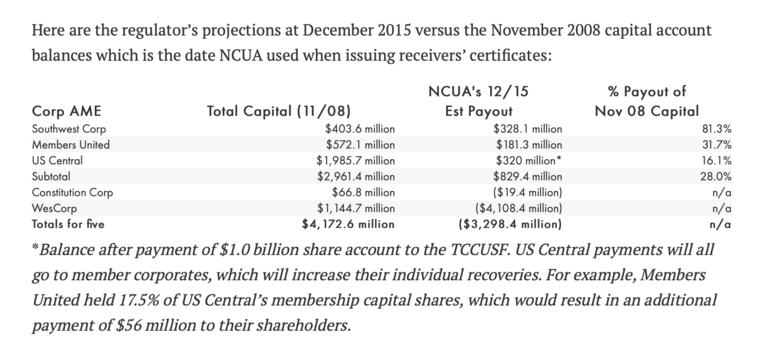
The chart below shows update provided by NCUA to credit unions in 2015.
Not Everyone Agrees
Despite the good news surrounding the payouts, not everyone has been supportive of the course of action the agency began pursuing more than a decade ago.
In early 2018, a group of 19 credit unions calling themselves the “Coalition to Appeal NCUA Board Action” sent a letter to the agency’s Inspector General’s Office requesting an independent review of NCUA’s actions. The group was led by Chip Filson, the co-founder and chairman of Callahan & Associates who served as NCUA’s director of the Office of Programs, as president of the Central Liquidity Facility, and as CEO of the NCUSIF during his career at NCUA from 1981-1985.
Filson, who had earlier stated he believed NCUA had moved too quickly to conserve the corporates, as their portfolios of mortgage-backed securities recovered more quickly than many had believed, said at the time the agency needed to return significantly more to credit unions.
“I think NCUA saying we will give you a little bit now feels more convenient than waiting another four years for a big amount,” said Filson. “Unfortunately, that let this whole precedent set in. The idea that NCUA can retain recoveries because they are administrator of the recovery, I think, is contrary not only to the entire history of the NCUA, but to common sense. The administrator does not get to claim that since they did a super job, the recoveries should then go to them rather than credit unions. Credit unions spent over $10 billion—that is documentable, that is not hypothetical. For NCUA to say it’s their recovery would set an unfortunate precedent, and I think a lot of credit unions are missing out on the significance that this event has for future activities by NCUA.”
The full story on Filson and the group of 19 CUs that argue credit unions are leaving money on the table can be found here.
NCUA’s Fazio has also responded to the suggestion the situation could have been handled differently, saying critics have overlooked numerous big issues. Those comments are included in a separate piece this week.
More to Come
In the coming week CUToday.info will also feature interviews with other significant players in the resolution of the corporate crisis. As always, CUToday.info welcomes reader input.