

LAS VEGAS–Does the war for talent really just come down to paying more, or can a credit union offer some other intangibles that help to compensate for offering lesser compensation?
Both sides of the debate around that question were voiced during a session at Mitchell Stankovic’s “Underground Collision: CUSO Mayhem” event here titled, “Pay to Play?”
In their respective corners on the issue were Phil Dupree, chief revenue officer with Origence; Lynn Dufrane, senior account executive with Visa; Amber Harsin, president/CEO of Prodigy; and Brandi Stankovic, the organizational change expert known to many in credit unions.
The meeting was held in conjunction with NACUSO’s Network conference.
Here's what each had to say on the issue of compensation for credit union and CUSO employees and prospects:
Dupree: I have a lot of passion around compensation and the right incentive programs. I understand both sides, but I took the position you’ve got to pay to play today. There is a war for talent and with the pandemic the environment really changed. I look at it a little like match.com; if you're trying to find a partner within your area, you're limited. All of a sudden now all these geographic lines have disappeared and that's good for both. That’s good for the employee, especially if you're willing to do hybrid or remote. But it's also really good for the employer, because now my pool has opened.

Phil Dupree
‘Show Me the Total Comp’
I would tell you that I do believe you have to be competitive. We say ‘Show me the total comp package.’ I need to look at that and understand what are those components. I know for us, on the development side we're paying 10% or 15% more in the Irvine (California) market where our corporate offices are, versus the Ontario (California) market where we started.
We have a great partnership with HR. I probably have a couple of hundred staff in my organization, so there's always opportunities to work with HR. I do believe that you've got to put a competitive package together. One of the things that that we happen to offer, and I couldn't believe it when I started six years ago, is we have an 8% 401(k) match. If you look at the benefits, that kind of cuts through some of that clutter out there.
Harsin: I don’t disagree, but pay doesn’t always have to be compensation. There is a cultural element. A lot of my employees are looking for a mission in addition to salary. We have had employees come in from Goldman Sachs and other large organizations who took less (money) because they like the mission of a credit union. We train on (the credit union mission) in week one. We have had great success in giving them something to believe in. Yes, giving them something cool to work on is also important.
Fair compensation is not negotiable, it’s not something you take off the table, But we do think compensation at the CUSO level can come with the credit union heart.
Dufrane: Our mission is to uplift everyone, everywhere, I’m not sure there is any better alignment than that with the credit union movement.
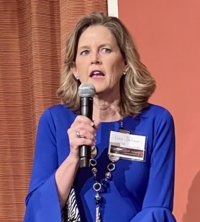
Lynn Dufrane
When people are talking about vendors versus partners, I would ask how many of you have a vendor management group? I'm assuming everyone's going to raise their hand. I’m going to challenge you to think differently and stop thinking about it as vendor management and start thinking about it as partner collaboration evaluation, because it matters.
‘Make a Difference’
We have to look at things that can basically help us make a difference. Those things don't always come on the balance sheet. One of the things that Visa does with our partners is we have something called a Community Investment Fund. We actually give dollars out to credit unions to invest in any way they want to make a difference in their communities. We have examples of many credit unions starting their own foundations using the funding from Visa.
I think that's where Visa tries to make a difference in being a true partner. It doesn't matter what size credit union you are.
Stankovic: I got my MBA back in 2003, and for those of you who have been industry for as long as long as I have, you know there were sexier industries to go to work for than credit unions, especially in the lead up to the (housing) crash.

Amber Harsin, left, with Brandi Stankovic.
Most of us in this room did not come to a credit union because you're going to make lots of money and most of you didn't stay because you're going to make lots of money. It really does come back to what we've all really been saying, and that is that benefits are beyond the dollars. It is about the people, it is about the service, it is about the mission.
Dr. (Brian) Branch didn’t fly to Ukraine because he’s been paid to do it. We're doing it because we believe in what we do. Now, mind you, I do take an entrepreneurial spirit that we can't let our employees live in poverty. If we make more money then we can pay more money, as well. But I don’t think credit unions and CUSOs have the luxury to have entitled employees for whom it’s just comp, comp, comp.
Harsin: At CUProdigy, we have a rule that I will never make more than four times our lowest-paid employee. In order for me to make more money, we need to motivate them to make more money.