

LAKE FOREST, Ill.—Will the Federal Reserve adjust rates during its two-day meeting that begins today? One person says the “Fed gap” offers a strong signal.
An increasing number of economists believe it’s possible. If it does move to cut rates, it will be the first time it has done so since Sept. 18, 2007.
While some analysts have referenced the latest jobs report and lagging consumer sales as indicators of a slowing economy that should prompt the Fed to move, Michael Moebs, economist and CEO of Moebs $ervices, believes there is another more compelling reason to reduce rates–the gap between what the Fed “thinks” the economy should have as its base rate, and what banks and credit unions “know” the interest rate needs to be to to motivate depositors to grow their funds in their financial institution.
“This gap should be plus or minus 10 basis points,” said Moebs. “But it’s not today.”
The Fed’s ‘Driver’
Moebs noted there is almost $11 trillion in insured domestic deposits. For the first quarter of 2019 the average interest paid on deposits at banks, thrifts and credit unions was 0.79%, which is up eight basis points since the fourth quarter of 2018.
Fed Funds are priced at 2.37%.
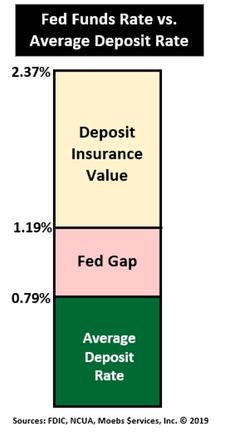
“Savers are willing to forgo 1.19% of interest for deposit insurance. So, 2.37% minus 1.19% minus 0.79% equals a .40% gap, or ‘Fed gap,’” said Moebs. “Deposits are the driver for the Fed to decide whether to cut the federal funds rate or hold off. Our Interest Rate Study shows a 40 BP gap. There was over a 50 BP gap when the Fed in September 2018 and December 2018 decided to increase the fed funds rate twice by 25 BPs. The deposit marketplace is telling the Fed they overpriced money.”
Willing to Give Up Half
Deposits include transaction accounts or checking, basic savings, money market deposit accounts, and term accounts or certificates of deposits, said Moebs, reminding all have a federal guarantee.
“The consumer and small businesses are willing to forgo half of what could be earned in interest for the protection of deposit insurance,” he said.
The average user who keeps deposits at banks, thrifts and credit unions is willing to give up 50% in interest paid for deposit insurance, said Moebs, referring to his company’s study.
“Deposit categories will vary in interest forgone. For checking, the consumer will forgo almost all interest, while CD consumers will forgo very little interest. All deposits collectively average almost exactly 50% in forgone interest to obtain deposit insurance,” continued Moebs. “These are not investors—savers are extremely risk adverse.”
Impact on Credit Unions
How might a rate adjustment impact CU product pricing? Moebs urges paying close attention to money market deposit accounts, and not so much to shares or CDs.
“MMDAs need to have a variable price conforming to most Fed changes,” said Moebs. “Half of the $11 trillion in deposit dollars are in MMDAs. The MMDA price, not shares, becomes the basic critical rate for credit unions.”

Michael Moebs
So, all that said, what will the Federal Reserve’s Open Market Committee do this week?
Moebs believes ultimately the committee will do nothing.
“I said in September 2018 the Fed was wrong in raising the rate, and again they were wrong in December to raise the rate. In January, I predicted the Fed would do nothing until 2020,” Moebs said
What Gap Means
Moebs noted that banks, thrifts and credit unions increased interest paid on deposits by just eight BPs in the first quarter.
“With a 40 BP gap, this means the Fed funds rate gap will be closed in five calendar quarters or by September 2020. Waiting 15 months to equalize rates creates an economic picture of uncertainty,” said Moebs, before adding his own recommendation. “Deposits are very stable funds and growing, so, reduce the interest rate now, Fed Chair Powell.”