

By Ray Birch
LAKE FOREST, Ill.—A new report reveals that since the Great Recession, it has been credit unions—not banks—that are generating more in fee income—and they are doing it by having lower charges.
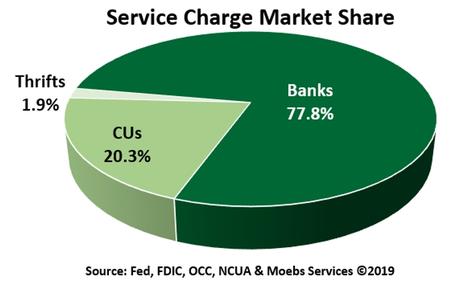
“Exactly 11 years ago, service charges for all depositories hit an all-time high of $49.5 billion,” explained Michael Moebs, economist and CEO at Moebs $ervices, citing the company’s latest Service Charge Study. “Since then, banks are at only 84% of their overall 2008 service charge totals, while credit union have soared to 132%.”
Moebs further pointed out that for the first time ever credit unions this year hit more than $9 billion in annual service charge revenue.
Since 2008, overall FI service charges have fallen and are now $44.7 billion. Service charges as a percent of assets were 32 basis points of total industry assets in 2008; today, service charges in 2019 are only 22 BPs, Moebs said.
“This is down 31% in 11 years, and during this time credit unions’ market share of fee revenue has increased to 20.3%, or a surge of 46%,” Moebs said. “Banks, including thrifts, have lost market share that CUs have gladly taken.”
What’s Included in Charges
Service charges include fees on deposits ranging from checking account minimum balance charges to penalties on certificates of deposits. Big the biggest share of service charges belongs to overdraft fees at 77.3%, noted Moebs.
“Banks have lost $7 billion in services charges since 2008,” explained Moebs. “The bank low point was in 2014 with only $31.2 billion. Slowly, banks have tried to rebuild service charges. The main cause for banks’ struggle to restore service charges is their high price for fees. The bank brand is high priced, while the credit union brand is low price.”
Moebs said his company’s Service Charge Study shows prices for all types of service charges for most depositories are too high.
“The primary service charge, overdrafts, proves the study’s conclusion,” said Moebs. “Currently, the median price for overdrafts is $30 per OD transaction. Banks charge $32, but thrifts and credit unions are at a median of $30.”
A Key Indicator

Michael Moebs
The key indicator that price is too high is the volume of transactions, stated Moebs.
“OD transactions peaked in 2007 at 1.4 billion per year and have subsequently fallen 21% in the past 12 years to 1.1 billion transactions today,” he said. “Yet overdraft prices grew 20% during the same time. This 40% swing in volume vs. price is best seen in the number of overdrafts per the 365 million consumer checking accounts, which has fallen from four overdrafts per checking account per year to 2.9.”
Moebs said that with the higher prices, consumers are learning to reduce volume—their usage of overdrafts—to save money on fees.
Some Final Advice
Moebs also offered some advice for financial institutions looking at their fee structure.
“Service charges are a vital part of net income at any bank, credit union or savings institution. Greater service charge revenue can be obtained by lowering prices of service charges and gaining volume,” said Moebs. “Service charges become less critical to the bottom line if a depository can cross sell three or more services per consumer household—volume is crucial.”