

ORLANDO, Fla.–One of the best color commentators in college basketball shared numerous insightful observations with credit union leaders here, beginning with why “everything you do is important”--most especially that which seems unimportant—and ending with a life lesson from ladders.
Drawing on his career in basketball and his time with one of the most influential leaders in the game, Jay Bilas shared with the Finance Council Conference here that he is not a motivational speaker, but instead looks to share stories and experiences from his life that have inspired him.
Not surprisingly, many of those lessons have come from his coach at Duke, Hall of Famer Mike Krzyzewski, who won five national titles while at the school and who was a six-time gold medal winning coach or assistant coach in the Olympics.
Bilas played under the man better known as Coach K for four years as a starter and won a national championship in 1986. He was drafted by the Dallas Mavericks and played professionally in Italy and Spain, before joining the Duke coaching staff for two years. He became a color commentator and studio analyst for ESPN in 1995. He also earned a law degree and continues to practice law.
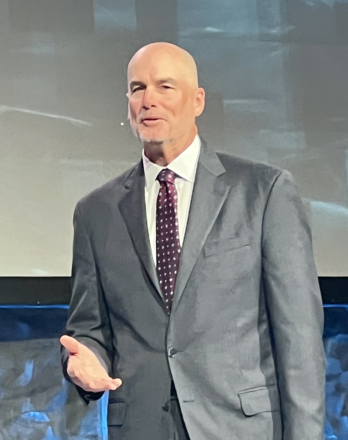
Jay Bilas speaking to Finance Council in Orlando.
‘The First Thing That Hit Me’
“The reason I brought up motivation versus inspiration is because that's the first thing that hit me about Coach K,” said Bilas, who was highly recruited coming out of high school. “I'd been getting phone calls from coaches from all over the country and I had never heard of Coach K. When I first met him in 1981, I was 17 years old and I didn't know who he was and when (Duke) had not had any success. I was considering bigger names and more successful coaches, but Coach K had a way of inspiring me as a high school kid.”
The Lessons
Bilas offered the following lessons about basketball and life from Coach K.
Number One: ‘Everything We Do Is Important’
Bilas said the first lesson he took away from Coach K was, “Everything we do is important.”
He recalled an early season game against a lesser opponent in which the Blue Devils were heavy favorites.
“Coach K came into the locker room for our scouting report and he said, ‘This is the most important game on our schedule,’ and as soon as he said that, hopefully, he couldn’t see the reaction in my face but I was like, ‘Important? What are you talking about? After this game we have North Carolina coming up and Maryland and all these quote-unquote big games. And he said, ‘The reason this is the most important game is because we’re playing and everything we do is important.’
‘Why We Prepare’
“He talked about winning a championship and said, ‘All of you have said you want to win a championship. If you want to win a championship you have to treat every game like a championship game. We prepare for it like a championship game, we practice and model championship habits and then when we do get to a championship game and we will know how to behave.’
“That made a really big impact on me and it’s one that carried forward into my broadcast career and into my career as a lawyer.”
Bilas recalled he started his ESPN career with a low-level game of Hampton vs. the Citadel, but he treated it like it was Duke-North Carolina for a reason.
“I know when I played my mom taped those on VHS. If the announcer made a mistake about me, my mom was incensed,” he shared. “I knew these players’ families were watching. This might be the only time their game is televised during their careers.”
Bilas also clearly prepared for his Finance Council audience, making several references to “hedges” and “derivatives” and always saying member, not customer.
Number Two: Preparation
Bilas called Coach K “incredibly well prepared.”
“Before we could win, we had to be worthy of winning. We could control the level of our preparation, we could control, our attitude, our effort and our enthusiasm,” he shared. “Now, they call it energy. We felt like we were the most prepared team when we stepped on the floor…Our preparation led to confidence and as a result we could react instead of think.”
Bilas said he has taken that approach as a broadcaster who does about 50 games per year, noting he does detailed scouting reports on each team that he writes out by hand.

Jay Bilas when playing for Duke.
Preparation and Grit
Bilas shared a story of how Coach K made players run the mile every year, a challenge he hated and which he called “hell.”
But one year he decided he was going to be totally prepared for the mile run and he spent the year training.
When the day arrived, among those also running the mile was teammate Mark Alarie, who had done no training.
“Mark kicked my ass,” said Bilas, slightly exaggerating by noting, “He was back in the dorm before I finished.”
Bilas said he was “pissed” at how Alarie’s time was better than his, and he asked him, “How did that happen? You didn't lift a finger to prepare for the mile and I did all this extra stuff.”
What It’s Really About
“He very matter of factly responded by saying, ‘You know it doesn't really matter how much you prepare. It’s really about how much pain you're willing to endure’,” Bilas shared. “That hit me like a ton of bricks. I was like man, he's right. I did all this work but I did it with the wrong mindset. I should have done it with the mindset that I want to be more productive, so I should be just as tired but I had the capacity to bust it more and endure more pain.”
Bilas shared a quote from Duke women’s basketball coach Kara Lawson in which she talked about those who believe the work being put in is about making things easier.
“She said, ‘It's not going to get easier. The work you put in is to prepare to handle hard better.’ It was a brilliant way to encapsulate the grit in your preparation.”
Number Three: Communication
Bilas said Coach K was very focused on communication, and that begins with looking people in the eye.
And communication wasn’t just verbal. How players react to a play or something that happens on the court needs to “project strength,” according to Bilas.
Taking Advantage of Stops in Action
Bilas said he was participating in a basketball clinic with Doc Rivers, now coach of the Milwaukee Bucks, who questioned why football teams seem to communicate better than basketball teams. He said after some study he concluded it all has to do with “stop actions” during games, those times when action isn’t taking place on the field or court, such as timeouts or dead plays.
“There are opportunities there to communicate, to talk, to get on the same page,” said Bilas. “Coach K called it ‘echoing commands’; that when he said something to the point guard, the point guard needed to echo it out to another member of the team or the whole team and everybody called it out. It gets everybody together.”
As another example of non-verbal communication, Bilas quoted former Wisconsin coach Bo Ryan who said, “It’s not what you say, it’s what you accept.” In the case of his teams, he didn’t accept turnovers.
“Do we model championship behavior in the way we communicate?” asked Bilas. “Praise the action you want repeated.”
Number Four: Empathy
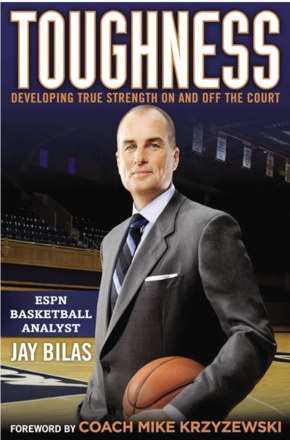
Jay Bilas' book.
Bilas shared a story from the classic 1992 match-up between Duke and Kentucky in the NCAA tournament that Duke won when Christian Laettner hit a shot at the last second in overtime. Immediately after the victory, Coach K went and sat down with famed, veteran UK radio broadcaster Cawood Ledford, for whom the UK loss marked his last game.
“That was euphoric for us and devastating for Kentucky. Coach K had the empathy to put himself in Kentucky’s shoes,” he said.
Bilas urged credit union leaders to understand that when it comes to empathy, “Just because you're on the same bus doesn't mean that everybody's taking the same trip.”
Bilas urged CU leaders to “think outside” themselves and to understand “everybody's going through something different.
A Story of Trust
Bilas shared the story of a life-long friend who has battled addiction, and during a conversation he said his friend said he understood he needed to regain everyone’s trust.
“I said, ‘Listen you can't worry about other people's trust. Giving trust is an individual decision. What you need to think about is being trustworthy. If you're trustworthy and someone decides not to give you their trust, that's their decision…If you have an organization where everyone works to be trustworthy and dependable, trust will follow. We have to build a culture of trust.”
Bilas relayed an observation that had been shared with him by an administrator at NASA who oversaw the Space Shuttle program who said the mantra is, “Be responsible to the element, accountable to the mission.”
Using a basketball analogy, he cited man-to-man defense, where thinking, “My man isn’t going to score” is the wrong approach.
“I’m responsible for my man, but I’m accountable for the other team not scoring. It’s a we-first attitude,” said Bilas. “That’s the thing about having empathy in basketball, it’s not about me, it’s about us. If we do well, each individual gets more.”
Number Five: Next Play
Bilas said a frequent observation made by Coach K is something he thinks about every day: “Next play.”
“The philosophy was that things happen so fast in a basketball game you don't have time to think about what just happened and dwell on it positive or negative,” Bilas said. “If you're thinking about the last play and dwelling on the last play you're taking yourself out of making the next play and really it's about being present and concentrating in the moment.”
The Difference a Step Makes
Bilas shared a story from his upbringing in which he was working construction on a property in Los Angeles owned by his father during a summer away from college.
“I had a pretty low-level job on the crew and part of my job was when I got there in the morning was to help get materials from the ground level up to of the roof,” Bilas said. “Being a dumb kid that thought he knew everything I didn't like that job. When I first started the first thing my dad said to me was, ‘Hey, before you start, just let me know what task is too small for you to do.’ When he asked me that I thought, ‘OK, well maybe I should list some things out that are too small.’ Then I realized he's telling me there's nothing too small for you to do. Realize who you are and what your role is.
Confessions of an Idiot
“My job is to get these materials up the ladder so the real big shots on the crew could get their work done,” Bilas continued. “Being an idiot I made the calculation if I carry twice as much stuff I can take half the amount of trips up the damn ladder. So, I overloaded myself and on one of those trips I missed a rung on the ladder. I fell dead on my back. I thought maybe I hurt myself but I didn't…I don’t I think he realized he was being profound at the time, but he was and he said this one phrase that has stuck with me every day since: ‘You can't get to the top of that ladder in one step, but you can get to the bottom in one.’
“It doesn't do you any good to think about the destination being the top and it doesn't do you any good to think about the rungs you've already come up. That’s over. You’ve got to think about the rung that you're on and be present and concentrating on what you're doing while you're doing it.”
Number Six: Hold Yourself to Standards
Bilas shared that Coach K had no rules, such as curfews, saying he instead had standards as a way to give everyone something to aspire to collectively and individually.