

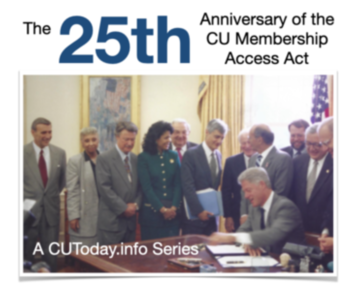
Editor’s Note: 2023 marks the 25-year anniversary of a two-year battle in Congress to get the Credit Union Membership Act not just introduced, but passed. It was a historic fight that led to an even more historic change for America’s credit unions, which were deeply threatened by banker lawsuits and court decisions that had gone against FCUs and how NCUA had interpreted field of membership rules.
To mark the event a quarter-century later, CUToday.info is featuring coverage originally published as part of the 20th anniversary with a series of stories in which those close to that fight shared their recollections of the time and their insights into how it changed credit unions.
The first three articles in this series can be found here, here and here.
WASHINGTON—For three credit union leaders involved in the fight to pass the Credit Union Membership Act a quarter-century ago, those were days of determination driven by being laughed at, frustrations over initially disjointed efforts, and results that left at least one person on a “PR high.”
John McKechnie still recalls when he was working on Capitol Hill in 1997 and 1998 and getting reports from congressional staffers that lobbyists for the banking industry thought of credit unions’ effort to get the Credit Union Membership Access Act passed were “ridiculous.”
When it came to credit unions on the Hill the bankers were “smug” and “dismissive,” he remembers.
But that banker perspective actually was a good thing for credit unions and their fight to have Congress pass what remains better known as HR 1151, according to McKechnie, who was VP of legislative affairs at CUNA two decades ago when credit unions were in the fight of their lives in both the court system and Congress. McKechnie today works in advocacy for CUs on Capitol Hill.
‘Tremendously Helpful’
Looking back on the years leading up to the two-year fight for HR 1151, McKechnie said credit unions laid the groundwork for the bill’s passage quietly, right under the feet of bankers.
“It was tremendously helpful to us to be underestimated by the banking industry,” said McKechnie.

John McKechnie
Credit unions would eventually amass more than 200 co-sponsors for HR 1151—including then Speaker of the House Newt Gingrich, even though Speakers typically don’t sign on to legislation–but when the number hit 100, McKechnie said CUNA held a press event on Capitol Hill.
‘Laughed at Us’
“I remember hearing that day from a friendly congressional staffer that an ABA lobbyist had stopped by and ridiculed us, laughed at us,” he said.
McKechnie said the news at first made him angry.
“But then I became very pleased that this was the bankers’ attitude. I wanted them to continue to underestimate us. That made me feel good,” said McKechnie. “I think the bank lobby ultimately was very slow to move against HR 1151 and very uninformed about what was really going on. That cost them.”
McKechnie said that the bankers did not pay attention to the relationships credit unions were working to build within Washington and the grassroots support they were mustering in districts across the country.
“We were always involved in grassroots efforts,” said McKechnie. “We worked very hard in the vineyard, so to speak, building a network, making sure that all of our political efforts fit hand and glove with legislative efforts.”
Early Investment Pays Off
McKechnie said those efforts had been under way well before HR 1151, before credit unions knew what the “battle was going to be.”
“I think we always knew that we needed to construct a political machine so that when the time came, it would be ready for the fight,” said McKechnie.
McKechnie pointed to an example of that thinking—maybe one of best political moves credit unions have made—when the Georgia CU League cultivated its relationship with Gingrich long before he ascended within Washington’s ranks to become speaker of the House, and a co-sponsor of HR 1151.
“The league got involved in Gingrich’s race for a seat in the House. Here was this guy who wasn’t established yet in Washington,” recalled McKechnie. “But the league got involved in the race—as Gingrich had just faced a couple tough primaries—and they built a relationship with him. They educated him about credit unions and showed him what kind of force we could be politically.”
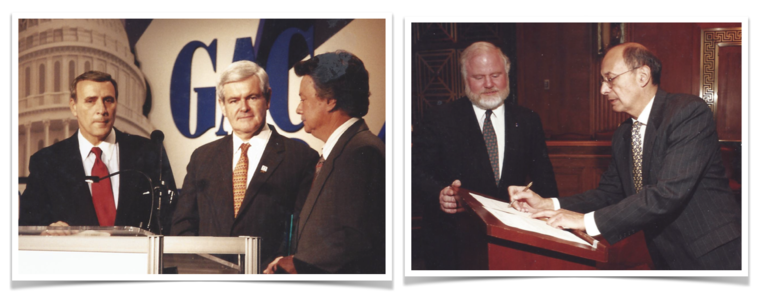
At left, Newt Gingrich at CUNA's GAC between Dan Mica and Buck Levins. At right, NAFCU's Bill Donovan, left, with Sen. Alphone D'Amato
‘Things Might Have Been Different’
McKechnie emphasized that credit unions had no inkling of what might transpire in Gingrich’s career when they began supporting him.
“I always said that if we did not cultivate Gingrich as a friend before we needed him, things might have been different in 1998,” said McKechnie. “If he had not laid hands on that bill and co-sponsored it … Speakers of the House rarely sponsor legislation.”
But Gingrich, in McKechnie’s opinion, led the charge for credit unions in gaining sponsors for the bill. McKechnie recalled the February 1998 CUNA Governmental Affairs Conference in Washington when Gingrich rallied support.
“I’ll never forget it, he took the microphone at the GAC and said he was going to co-sponsor the bill,” said McKechnie. “That was an extremely important signal to the Republican majority that it was OK to back this bill.”
The full story can be found here.
What CEO Will Never Forget
WINSTON-SALEM, N.C.—The CEO of the credit union at the heart of the battle for the Credit Union Membership Access Act says he won’t forget the character, fortitude and teamwork that led CUs to victory 26 years ago.
But he also questions whether the movement would show the same kind of strength and partnership today.
“It was a very empowering time and very fulfilling time in the sense that we literally saved the credit union system, and look where it is today,” said Marc Schaefer, who spoke with CUToday.info while he was CEO of Truliant FCU, which was formerly AT&T Family FCU, the credit union that was at the heart of the fight over field of membership and the Federal Credit union Act. .“It was heady stuff for everyone involved at the time. But you have to ask yourself: are we up for that same challenge today if a similar threat presented it itself.”

The former AT&T FCU, now Truliant.
Schaefer joined the credit union in 1995. Five years earlier, First National Bank & Trust in North Carolina had filed a lawsuit against AT&T Family, alleging it had violated the Federal Credit Union Act by expanding to serve non-AT&T-related businesses. Eventually, the state bankers association, several other banks and the American Bankers Association signed on as plaintiffs, and NCUA replaced the credit union as the defendant.
Winding Through Courts
The case worked its way through the courts for nearly a decade before the Supreme Court stunned credit unions by announcing on Feb. 25, 1998 that it had ruled 5-4 against NCUA–and credit unions–on the issue of field of membership.
What Schaefer says still stands out most among his memories of the fight for HR 1151 is how the movement—both big CUs and small, as well as competing trade associations—set aside differences and worked together toward a common goal. He acknowledged, however, that the fight against the bankers did not begin with a united front.
“When I arrived at AT&T Family in January of 1995, it seemed like this case was just bumping its way through the courts,” recalled Schaefer. “However, in July of 1996, the bankers got standing in the U.S. District Court of Appeals in D.C.”
Schaefer said that’s when the issue suddenly became more serious to credit unions.
“That is when I believe all of us within the movement said, ‘OK, this is going to be a problem.’ Shortly afterward, NCUA Chief Counsel Bob Fenner called me and said we can’t bring in any more employer groups. That is the point everyone manned their battle stations.”
Don't Go After Bankers 'Head On'
Schaefer said he soon flew to Washington, where he knew several banking lawyers and large PR firms. He said he spoke with legal counselors and public relations firm Hill & Knowlton, which would eventually be retained by credit unions’ in the fight.
“They all advised me that it would not be wise for credit unions to go after the bankers head on,” said Schaefer. “They have more money, more lawyers and more lobbyists, I was reminded.”
He was also advised not to make the fight an attack against the bankers, a misstep he said both NAFCU and CUNA made at the outset.
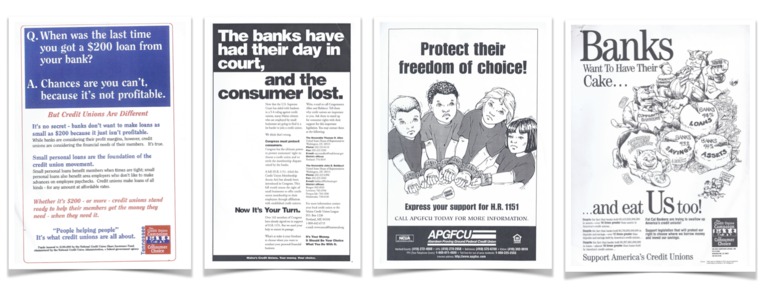
Credit unions ignore the advice and take-on banks in 1998.
‘Greater Sense of Urgency’
Schafer, then a member of the NAFCU board and executive committee, advised both trade associations that a central group needed to be formed to defend against the banker attack in the courts, legislatures and Congress. He said it was not difficult for all credit unions to see that if NCUA was prohibiting AT&T Family from adding any more SEGs, that same prohibition would soon extend to all credit unions, including state charters.
“We then started to get a greater sense of urgency from many other credit unions to rally around this issue,” he said.
It was “disappointing,” said Schaefer, to see both CUNA and NAFCU at the outset take approaches with their individual efforts to fight the bankers that ran counter to the advice he had been given.
“NAFCU, if I recall correctly, started a campaign called ‘Beat Back the Bankers.’ CUNA’s effort, I believe, was called ‘Operation Secure’,” said Schaefer. “Both of these campaigns were taking the bankers head on, as opposed to making the argument about consumer choice.”
Trades Needed Prodding
The differences between the two groups and the new strategy were finally settled when CUNA and NAFCU–with their backs to the wall–eventually combined their efforts under the umbrella of the Credit Union Campaign for Consumer Choice, Schaefer noted.
But it took some prodding to get them there, recalled the CEO.
“The National Credit Union Roundtable at the time was fairly independent of both trade associations and we met in Chicago at the Marriott hotel at the airport,” said Schaefer. “We asked the two trade association leaders to join us—Dan Mica, who had just started at CUNA, and Ken Robinson from NAFCU. We basically sat them down and said you guys need to stop fighting against each other and we need a common campaign.”
One Big Group
What Schaefer remembers most fondly about the effort to get HR 1151 passed–as have several others in CUToday.info’s series–is how the effort brought together the entire industry to work as one big group.
“It was a true coming together of the credit union movement, and the operation of the democratic system to ensure consumers had the choice to join a credit union,” he observed. “It was a seminal moment for credit unions—I am certain we would not have had the growth we have today had this legislation not been passed.
The Big Question
In reflecting on that success, and looking at the credit union community today, Schaefer said he has a big question regarding the movement’s future.
“Today I ask myself, if credit unions faced a similar challenge that threated the movement, would this same thing happen again? Would we all come together under one united front?” Schaefer asked. “I am not terribly happy with some of the things that have happened recently. And I am not bashing anyone. I have a huge amount of admiration for the leaders of both credit union trade associations. However, I do wonder that if the issues surrounding HR 1151 had happened today, would the large credit unions and the trade associations have the will and the fortitude to do the same thing?”
The full story appears here.
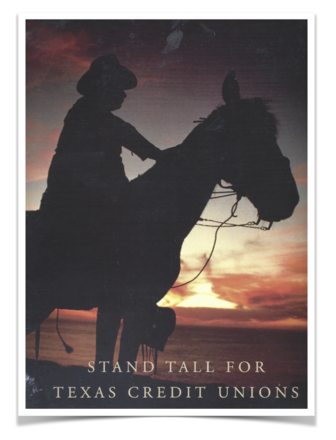
A Time to ‘Stand Tall’
PLANO, Texas–1997 and 1998 were a time of real grassroots lobbying for credit unions suddenly fearful over their futures. It was a time of long days. And it was a time to “Stand Tall.”
Those two years were a time that Terry Young, then VP of corporate communications at the Texas CU League, recalls as exhilarating for everyone involved.
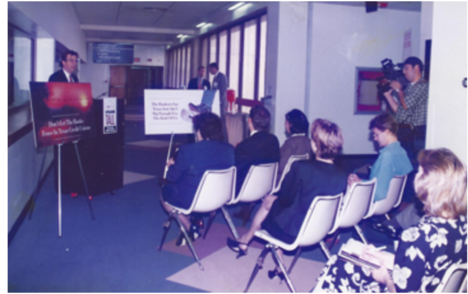
Terry Young speaks to a group in 1998.
“All across the country there was a moment of unity and clarity, and the movement was really moving,” said Young, who would eventually join Catalyst Corporate FCU before retiring.
Those days had Young on a “PR high.”
“We were rockin’ and rollin’ and hitting on all cylinders,” recalled Young about the effort to not only sway Congress via lobbying efforts but to generate support from CUs and members. “While it was always up to Congress to decide on this bill, I felt you could not do any more to excite and influence members of Congress than what we were doing.”
Across Texas
Across the breadth of Texas, Young pointed to the coordinated letter writing campaigns that “bombarded” Washington with well-timed messages.
“We had letter writing stations at credit unions across Texas,” said Young. “We had stamped envelopes ready to go. With those letters we’d attach newspaper editorials supporting the need for credit unions to extend their common bond.”
Those grassroots efforts, said Young looking back, gave the state’s lobbying team all the ammunition they needed.
“And we just kept it coming. I think Congress felt like they were getting doused by a firehose.”
Feeling the Passion
Just how much that grassroots effort led to the Senate finally passing HR 1151 can only be known by those within Congress at the time, emphasized Young.
“But I know they felt the voice of credit unions—they felt our passion. There was a lot of passion then around protecting the movement and helping it move forward through this common bond extension,” said Young. “We had the professional lobbying efforts and the grassroots campaign. We were punching with both arms, and Congress felt that.”
All that punching was no easy feat for the then Texas Credit Union League or its affiliated CUs spread across the 262,000 square miles of the Lone Star State. It made for many long days of seeking support for the Credit Union Membership Access Act.
“I remember we chartered a jet one February morning in 1997. We left Dallas at 6 a.m. and flew to Houston to pick up a bunch of credit union people,” said Young. “We had a plane full of Texans and we flew into D.C. for a quick rally and then flew back that night. But that’s what you did then.”
Shot In The Arm
When the Supreme Court issued a ruling in February 1998 that favored the banking industry’s interpretation of the Federal Credit Union Act–that FCUs may not consist of more than one occupational group having a single common bond–he said the league, while always hopeful, was prepared for the decision to go against credit unions.
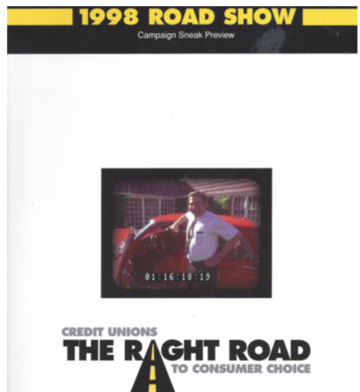
Not a Good Outcome, But…
“While that was not a good outcome for us, it did allow us to launch our ‘Stand Tall for Texas’ campaign,” said Young about the massive effort to drive support for HR 1151 using that theme. “We already had in place our plan of action in case the Supreme Court ruling did not go our way. In fact we had a press release ready to go the day of the decision.”
“I think Dick Ensweiler (then president of the Texas League, which is now the Cornerstone CU League) spoke at just about all of them,” recalled Young.
Young said that some of the important results of that tour was getting a lot of editorials supporting the CU position published in newspapers.
“I recall us getting 15 editorials placed within a four-week period,” said Young. “We took all those clips, put them together, and shipped them out to other newspapers. We took those successes, kept using them and building on them. We were a machine.”
The full story can be found here.