LVIV, Ukraine–A pair of ambulances funded by credit unions in the United States and Poland has been delivered to Ukraine, where they are now being driven further east toward greater danger in a country constantly under attack by Russia.
The ambulances, each of which was filled to the roof and from side to side with medical supplies, were paid for by the Via Stella Foundation, the joint effort by Polish and U.S. credit unions that has, among other things, now helped to underwrite the cost of seven such vehicles for the Ukrainians.
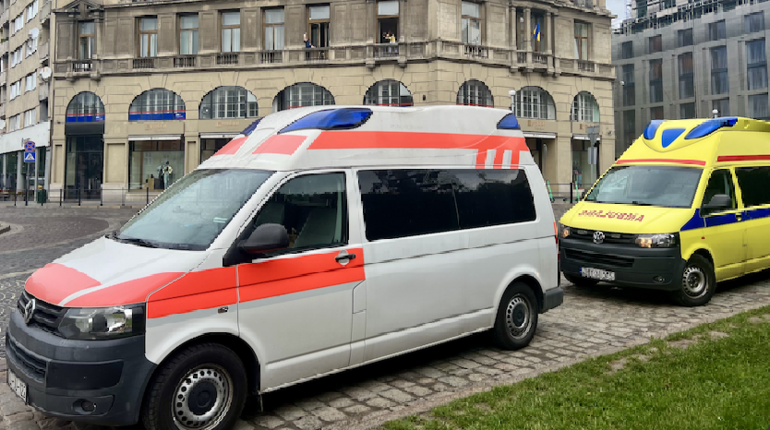
Two ambulances shown here after being delivered to Lviv, Ukraine, from Poland.
All of the ambulances but one remain operational, in large part because they are not used at the front, where the Russians deliberately target emergency vehicles. Instead, they are headed to two cities in Eastern Ukraine whose own ambulances have been taken and used in the war effort.
CUToday.info joined representatives of the Via Stella Foundation, the joint U.S./Polish foundation that was created shortly after the war began to help Ukrainians in their home country and Ukrainian refugees in Poland, for a week in the two countries to see where the funds are going and who is being helped.
Dangerous to Get Close
“It is very dangerous to drive an ambulance close to the front line,” said Rafal Matusiak, president & CEO of Poland’s trade association, the National Association of Credit and Savings Unions (NACSCU), who now chairs the Via Stella Foundation. “The Russian bandits try not only to destroy Ukraine, but medical equipment and ambulances. Ambulances are a primary target. It’s better to use a different type of car to transport people from the front line to the first safe place.”
As CUToday.info reported here, EMT Jakub Osipow plans to drive a camouflaged Toyota Land Cruiser that is actually a well-equipped ambulance all the way to the front lines.
The Day Begins
The day of delivery began at a hotel in Bytom, Poland at 4 a.m., where Matusiak, who drove one ambulance, and Robert Rusiecki, who drove the other and who also works for NACSCU, met with Brian Branch, the former president and CEO of the World Council of Credit Unions, before the group travelled to a parking lot where the two refurbished vehicles had been parked the night before.
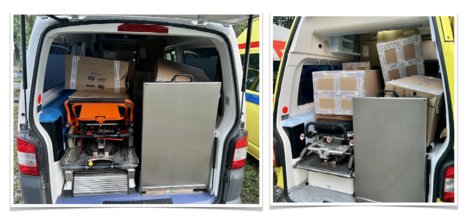
The two ambulances shown here full of medical equipment.
The ambulances are both diesel-powered Volkswagen T-5s; one had been bought in Poland, the other in Belgium by a company NACSCU works with to acquire the vehicles and ensure they are mechanically sound. The very first ambulance purchased required an engine replacement. The initial drivers of the ambulances taken into Ukraine were paramedics.
The medical equipment jammed inside the ambulances includes a wide range of supplies for an even wider range of needs.
Becoming Experts
Matusiak said one employee of NACSCU has become something of an expert on ambulances and medical equipment. The association, for instance, has learned all about what are called R-1 bags, which include a variety of medical supplies for treating everything from broken limbs to burns to stopping blood loss. He noted that when Via Stella first reached out to medical professionals in Ukraine for what they needed, the response was, “We need everything.” On occasion, the Ukrainians have asked the foundation to purchase something specific.
The “everything” is now being funded by the Via Stella Foundation, which was created in April 2022 shortly after Russia attacked Ukraine, by Branch and Sue Mitchell, CEO of Mitchell, Stankovic & Associates, along with Matusiak. From day one, Matusiak has emphasized NACSCU is covering all costs related to operating the foundation and 100% any money donated goes directly to those it seeks to help.
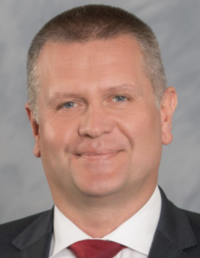
Rafal Matusiak
The day begins with optimism over the trip and the ability to make at least a small contribution to the war effort. But everyone knows anything can happen, from mechanical problems to issues at the border.
And it will prove to be a day of great contrasts, beginning with the first leg of the approximately 420 kilometer journey, when the ambulances drive pastbillboards for Nestea, a KFC, a Maserati dealership, another billboard for what appears to be a holiday trip, and a mall with a large H&M logo, all scenes tough to reconcile with the fact the country next door is under attack in a devastating war.
Getting Underway
By 5 a.m., what was expected to be a five- to six-hour drive—plus the time needed to clear customs –on what was a sometimes rainy day to Lviv was underway. The trip east across Poland was uneventful, the four-lane highway smooth and efficient, on par with any in the U.S., if not better.
During the drive Matusiak noted several times how strongly Poland feels in its heart about the Ukrainians and the need to provide help. He recalled that in the days after Russia attacked, people from across Poland drove their own cars to the border, waited in lines and drove refugees back to their own homes, where they then offered them places to stay until they could find places of their own. Others collected aid, and the country itself opened its schools and health system to Ukrainians. Poland is proud that no refugee camps were opened.
If there is one thing that worries Matusiak it is that after more than 500 days of fighting people have begun to feel differently than at the beginning, when there was shock and fear and outrage, especially that Poland could be next.
“When it becomes an everyday message it’s important to remember this is the same barbaric and dramatic war. Every day people are dying in Ukraine. I think that through our activities we can remind people of the war and the need to support it every day.”
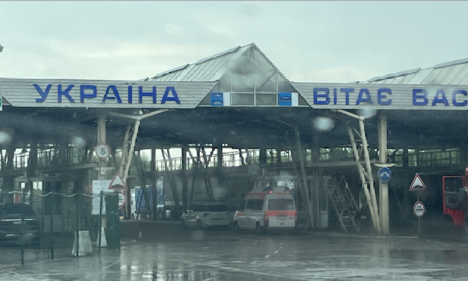
Sign at border station welcoming people to Ukraine.
Arriving at the Border
After driving past a miles-long queue of semi-trucks looking to cross the border—one person said truck drivers can wait for as long as 25 hours—the ambulances were directed to a line at customs reserved for “tax free” vehicles, meaning no personal cars or commercial trucks, with the team arriving at 8:40 a.m. under a sign in the Cyrillic script in the Ukrainian language reading, “Welcome to Ukraine.”
The customs buildings are a plain, aging and humorless set of dusty concrete buildings left over from the days when the Soviet Union controlled both Poland and Ukraine. Indeed, the catwalks that were formerly patrolled by machine gun-toting soldiers remain above the lines for vehicles.
The first step, passport control on the Polish side, went relatively smoothly for the group that included two Americans. The Via Stella Foundation uses a customs agency in Poland to handle many of the formalities, which speeds matters.
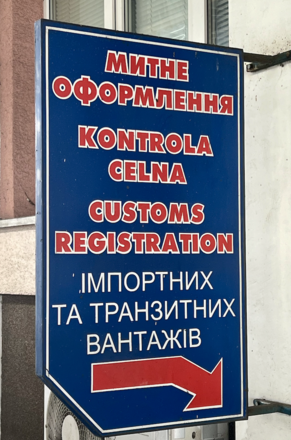
Passport control on the Ukrainian side also goes without a hitch. Passports stamped, the two ambulances were then moved forward to the second step, the paperwork phase for each vehicle,
Lots of Paperwork
The Via Stella Foundation has learned from previous border-crossings what paperwork it needs to bring, but there were still a few challenges in filling out forms, which are in English and Ukrainian. A different form had to be filled out for the ambulances and for the medical supplies inside. And for reasons no one was sure of, customs required paper copies be made of all the passports and paperwork.
As rain began to fall it hit the canopies covering the queued vehicles, including numerous buses headed in both directions that are filled almost solely by women and children. Men are required to serve in the military in Ukraine, and many women and children evacuated to Poland and now return for occasional visits. All are forced to exit the buses before the vehicles are checked and they are permitted to reboard.
In all, it required just a few minutes under two hours for the ambulances and their drivers and passengers to be given the OK to proceed to leave.
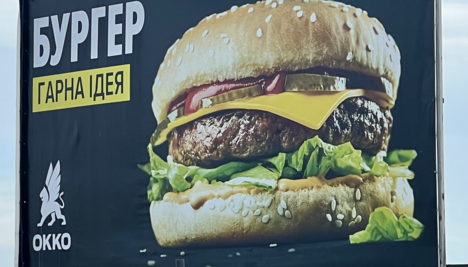
The first billboard spotted in Ukraine.
And what was the first piece of Ukrainian culture to be encountered? A billboard dominated by an oversized hamburger.
Moving into Eastern Europe
But with the burger in the rear view meal the eastern European flavor of the country soon became apparent along the two-lane highway in need of maintenance that would take the ambulances to Lviv. Matusiak said the surface of the road and the type of maintenance work that was being done reminded him of when he was younger in then communist Poland. In Ukraine, the funds budgeted for roads are going to the war effort.
In a devoutly religious country, especially in rural areas, regularly appearing along the route were the gold-domed churches of the Orthodox Church of Ukraine, Catholic churches, shrines to the Virgin Mary (at one of which a woman was seen rapidly making the sign of the cross), and billboards with religious imagery.
There were also occasional billboards honoring fallen soldiers, and the realities of the situation became more apparent as Lviv got closer. As the ambulances approached the city, concrete bunkers had been built that were covered in camouflage netting and which jutted into the road, making it difficult to pass by quickly. Soldiers in uniform were also seen more frequently, and there were in many places dozens of the tank barriers known as “dragon’s teeth” that could be moved into place at any time.
A Once-Popular Town

Lviv was once a popular tourist draw, especially its charming Old Town with its cobblestone streets and public squares. But first Covid and then the war have emptied it of tourists from outside the country; one person told CUToday.info those who visit today are from elsewhere in Ukraine as they seek to get as far west as they can for a respite from the war.
But the war has also visited Lviv. One week prior to the delivery of the ambulances, 10 people were killed and many more injured in a Russian missile attack that struck a residential building. And that made for a stark juxtaposition; despite the threat of a missile from the sky at any time, the streets of Lviv in the mid-afternoon were teeming with people and the sidewalk cafes were full.
After their long journey, and with a longer one to go, the ambulances were parked at Adam Mickiewicz Square, named for the famed Polish poet. Lviv was once part of Poland before World War II led to the shifting of national boundaries, which is one of the reasons so many Poles feel an affinity for their neighbor to the east.
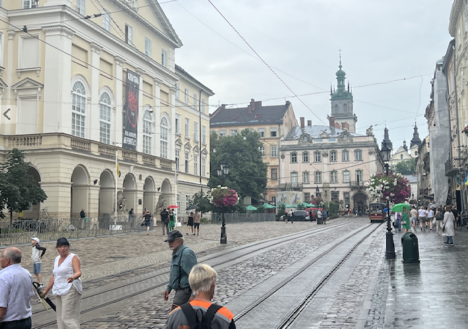
One week after a missile strike, and the streets of downtown Lviv were active.
Meeting the New Drivers
At the Square, the Via Stella team met the Ukrainian drivers who have volunteered to risk their own lives and drive the ambulances 1,300 kilometers to the southeast of Ukraine to the cities of Marganets and Pokrov, respectively, on the Dnipro River in the region of Nikopol. The plan is to take two days to complete the journey.
The drivers, named Andrew and Andrii, told CUToday.info through an interpreter that they were not afraid for the journey, even though they would be getting closer and closer to the fighting. “All Ukrainian people are afraid,” Andrew said. “But I’m not worried about driving.”
On several occasions both men referred to one devastating recent attack, the blowing up of the Kakhovka Dam on the Dnipro River, which flooded a wide swath of the land in which they live and left many without clean drinking water. Thousands of people have fled the region, but tens of thousands remain, they said, and are dependent upon clean water being trucked in and then carried in jugs to homes.
Water service is not expected to return until the end of the year, if then, they said, adding that drilling for water is an option, but many people can’t afford it.
Can’t Return Fire
Were that not challenging enough, the region is also home to the South Ukraine nuclear power station, which the Russians have occupied and used as a launching spot for howitzer attacks and more, knowing the Ukrainians will not return fire and risk damaging the plant and creating devastating consequences.
Andrew had worked for a large commercial bakery before it was hit by Russian attacks and destroyed, a video of which he shared with everyone. Andrii works in the government. Both men have kids; Andrew has two adult children, Andrii has a seven-year-old daughter named Monika.
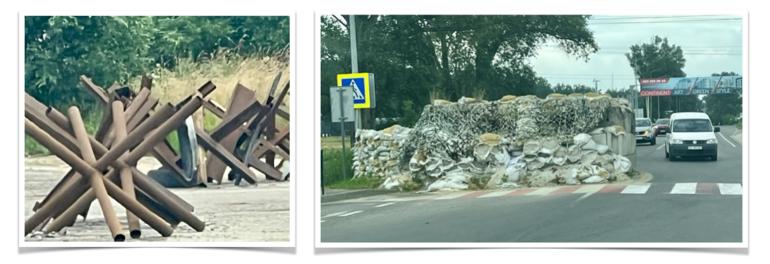
'Dragon's teeth' along roadway, left; A military bunker built on road near Lviv.
A ’Grande’ Thank You
Both Andrew and Andrii shared something else in common with many of the Poles and Ukrainians with whom CUToday.info has met this week—they profusely thanked the Americans and the volunteers and donors for their support.
“We thank you for all the help for the Nikopol District, for the people, and for all of Ukraine,” said Andrew. “We thank you very much.”
In English, he added, “A big grande thank you.”
When asked how long they would continue to volunteer, Andrew and Andrii were in agreement: “Until the end of the war and victory,” they said.
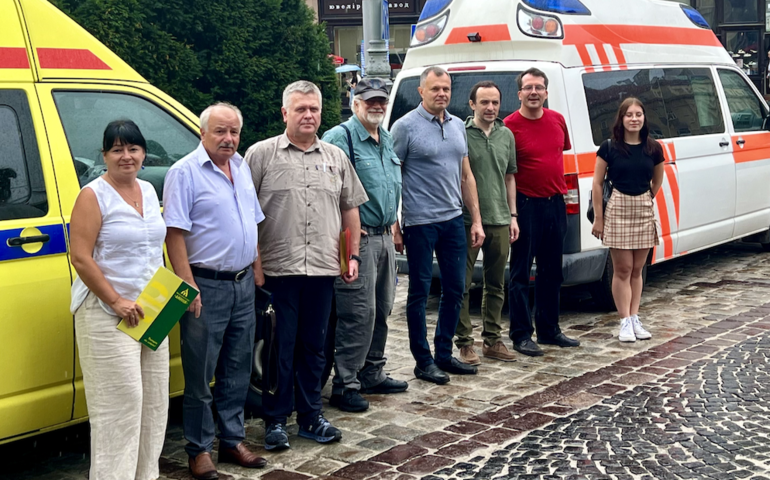
Members of Via Stella Foundation meet with Ukrainian CUs, Ukrainian ambulance drivers.
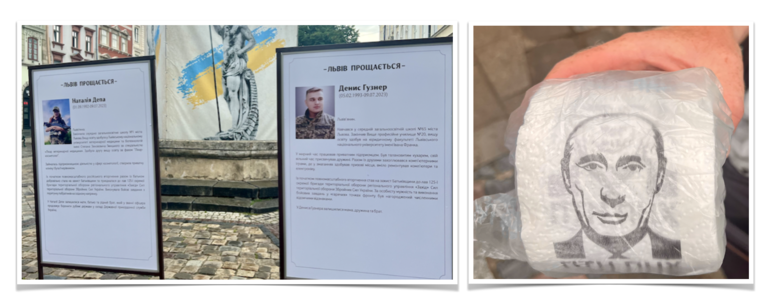
In downtown Lviv, a tribute to fallen soldiers who lived in the town; Vladimir Putin toilet paper for sale.
Appropriate Meeting Place
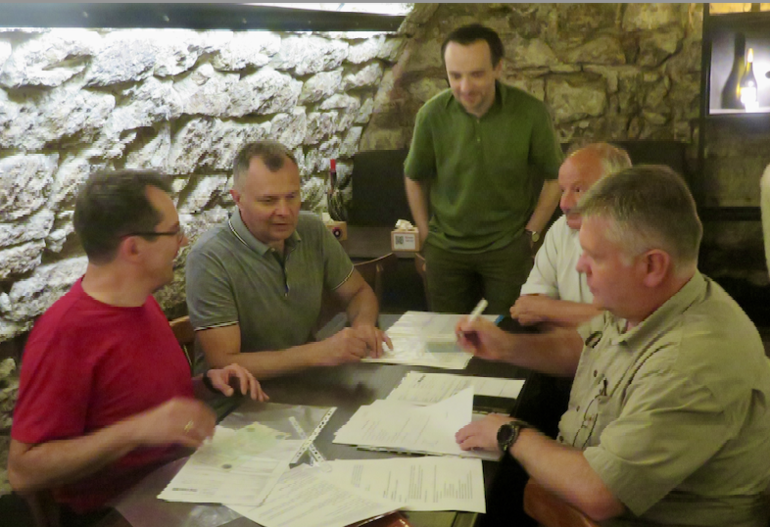
Inside a Lviv restaurant, in a basement room with an arched vaulted ceiling made of stone and appropriately titled “The Bunker,” the Poles and the Ukrainians signed off on all the paperwork needed to transfer ownership of the two ambulances.

After a brief lunch, everyone returned to the Square where the keys were exchanged and there were handshakes and hugs, along with much more sincere expressions of concern for the Ukrainians than the typical “take care.” Everyone knew what is at risk.
As the ambulances headed east from Lviv, a driver piloted the visitors from the Via Stella foundation west, back to the border, where they much more easily passed back through customs into Poland and where once more there were buses full of women and children returning to their adopted homes.
Trip to be Repeated
An employee of NACSCU picked up the Via Stella group in her car and drove everyone 100 kilometers to Lublin, Poland, where they spent the night.
According to Matusiak, there remain funds for at least two more ambulances plus medical supplies. So, it appears the journey of July 13 will repeat itself again, and somewhere in Ukraine a city will find itself with a new ambulance thanks to credit unions in Poland and the U.S.
Below, documents are signed transferring the amblances from the Via Stella Foundation to the Ukrainians.