

ALEXANDRIA, Va.–More than a decade after the failure of five corporate credit unions, when any potential recoveries and distributions seemed so far away that many in credit unions wrote off their capital investments as a complete loss, more than $368-million is about to be distributed to more than 2,000 credit unions.
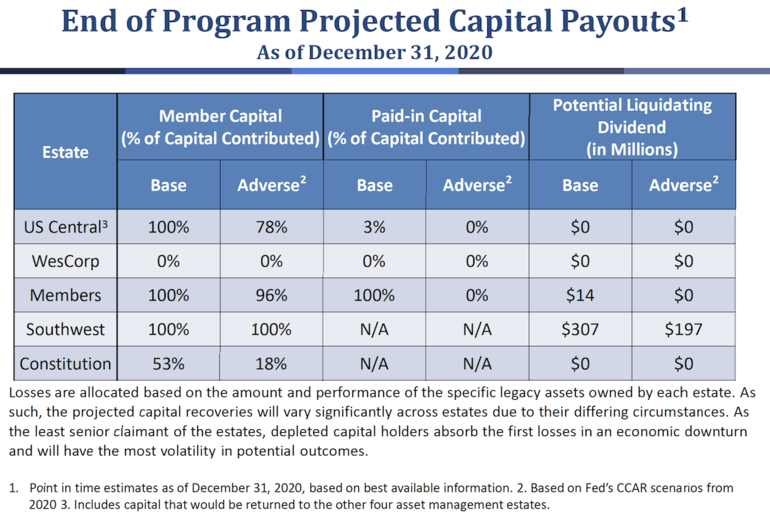
The funds will be paid out in April as NCUA winds down its Corporate System Resolution program and its NCUA Guaranteed Notes (NGN) program, and will go to credit unions that held capital in the former U.S. Central Credit Union, Members United Corporate FCU, and Southwest Corporate FCU.

The funds—as well as those paid out earlier as the Temporary Corporate Credit Union Stabilization Fund was wound down and merged into the National Credit Union Share Insurance Fund—have come with a tab of more than $1 billion paid out to the law firms the agency retained.
Capital-holders in the defunct Constitution State FCU and Western Corporate FCU (Wescorp) will not being seeing any payouts, according to NCUA staff who addressed the board meeting, including Keith Morton, Southern Regional director; Eugene Schied, chief financial officer, and Anthony Cappetta, supervisory financial analysist in NCUA’s Office of Examination and Insurance.
In mid-2020, nearly 900 credit unions that had membership capital shares in the failed Southwest Corporate Federal Credit Union shared in a $171-million asset management estate payout. Southwest Corporate eventually merged with Georgia Corporate to create Catalyst Corporate FCU (which eventually absorbed much of the former Wescorp).
Concerns CUs are Unaware
With one NCUA board member expressing concerns that many among the 2,000 CUs that are to see the funds are unaware the money is coming and haven’t planned for it, NCUA said it plans to send letters to distribution recipients notifying them of their amount and other payment details. The distribution will be made to credit unions generally through an electronic funds transferand additional information will be available here.
News of the announcement came during an update on the NGN program during the agency’s March board meeting.
Looking at the life of the Corporate System Resolution Program, NCUA staff said its creation saved credit unions $40 billion in losses as the result of sales of assets—nearly all mortgage-backed securities—and the legal recoveries from firms that sold the corporates investments that tanked as a result of the housing crisis and massive depreciation in the underlying assets.
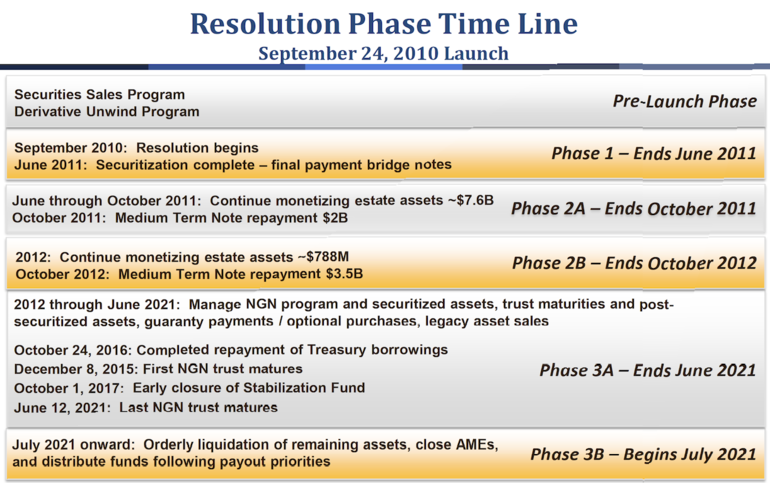
On June 12, 2021, the last of the NCUA Guaranteed Notes is set to expire—the outstanding note is for $78 million--although agency staff said there remain a “significant amount” of post-securitized legacy assets to be monetized. The goal is to be done with those assets by year-end, but market conditions may affect the time schedule.
In all, 13 NGS were issued, several with multiple tranches, with total proceeds raised in the series of 18 notes amounting to $20.3 billion as Wall Street and other investors picked over the remains of the assets held by the one-time corporate CUs.
The NGNS issued can be seen in the graphic below.
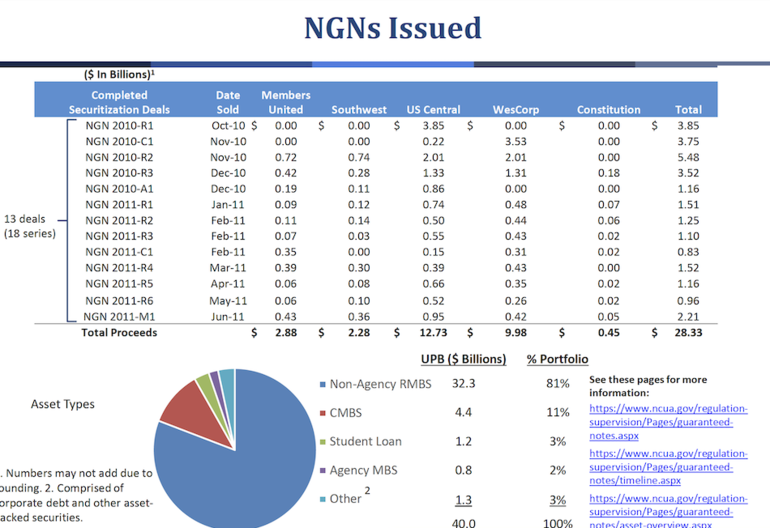
At the time the NGNs were issued all had maturities of 10 years or less, but in 2009-10 many in credit unions held little hope of see much return on the dollar.
A timeline of the program appears below.
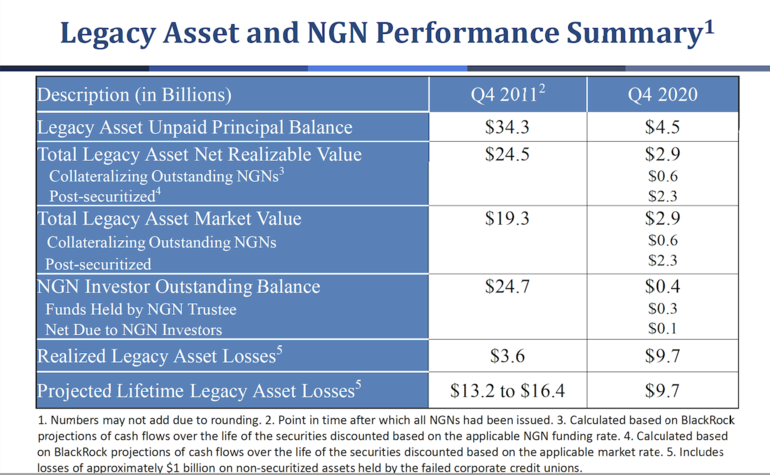
The graphic below summarizes the sale of legacy assets.
A ‘Critical Milestone’
NCUA Chairman Todd Harper noted the March 2021 NCUA board meeting marks a “critical milestone” in the Corporate System Resolution Program.

NCUA Chairman Todd Harper
“With the last NCUA Guaranteed Note scheduled to mature in June, we are nearing the end of this landmark initiative that allowed the credit union system to absorb over time the failures of U.S. Central, Wescorp, Southwest, Members United, and Constitution corporate credit unions,” said Harper, who earlier in his career served on the NCUA staff in the years after the collapse of some of the corporates. “A decade ago, very few of us could have imagined the NCUA would return any funds — let alone two rounds of distributions — to the former capital holders at these five failed corporates. And, we still have the potential for other distributions in the future.”
Harper said “exceptional efforts” by the agency contributed to the “least-cost resolution” of the corporate crisis that has led to the return of nearly $540 million in depleted capital to credit unions, with additional distributions to come.
“To be sure, other factors have contributed to the success of the Corporate System Resolution Program, including a persistent low-rate interest environment and rising housing prices over much of the last decade,” said Harper. “The shrewd decision to pursue litigation against the Wall Street firms that sold faulty mortgage-backed securities is also a key reason why we are now making distributions.
Indeed, without those legal recoveries, there would be no checks sent to capital holders.”
An ‘Opportunity to Learn’
For his part, Hauptman, who is relatively new to the NCUA board, noted that when the “Corporate System Resolution Program was developed, many did not believe a distribution would materialize. At the time, credit unions had written off their investments and initial projections predicted no recoveries for holders of depleted member capital at the affected corporates.”

NCUA Vice Chairman Kyle Hauptman
Hauptman praised the “Herculean efforts and difficult decisions” made by the agency to resolve the corporate failures and recover funds.
In response to prompting from Hauptman,
NCUA staff said the agency will work to better communicate with the credit unions that will be receiving payouts. While NCUA staff said the information is being published on www.ncua.gov, Hauptman said the agency has a responsibility to push that information to the affected credit unions.
“I’d like to add one more comment. While today’s presentation is indeed good news, we have an opportunity to do something more important — learn from it,” said Hauptman. “We owe it to the credit union movement to examine what was done well and what could have been done better. To those who say this could never happen again, I say, ‘History may not always repeat itself, but it often rhymes.’ We must be ready.”
Hood: ‘Time to Examine What Went Right & What Went Wrong’
NCUA Board Member Rodney Hood, who first served on the NCUA board from 2005-09 in the lead-up to the housing crisis and the failure of the five corporates, said of that experience, “We didn’t know what to expect. And while the Corporate Resolution Program was put in place after I left the agency, we are still dealing with this issue and the fallout from it--although it is winding down.”

NCUA Board Member Rodney Hood
Hood added, “The faster this can be resolved and the more transparent we can be the better it is for the credit union system…”
Hood, who said he believes a decade later it is an “appropriate time to examine what went right and what went wrong with the NGN and AMEs winding down with the corporate crisis,” asked NCUA General Counsel Frank Kressman for additional information on the legal expenses the agency has incurred in suing the banks and firms that sold the failed investments to the corporates. Kressman said the costs to date have been $1.2-billion, or approximately 23.5% of the monetary recoveries to date.
“Are there any plans to go after the ratings agencies?” asked Hood, referring to the safe ratings given the investment firms by those agencies. “I was really concerned that Fitch and S&P got off relatively scot-free. Have we done any litigation against the rating agencies?”
Kressman said NCUA has not sued the ratings agencies, nor have any of the other federal regulators.