

WASHINGTON–Jokes about Wells Fargo. Serious observations about the bank. Criticisms of the CFPB, including that it’s an insult to the Founding Fathers. Discussion of the NCUSIF. Threats to the tax exemption.
Credit unions heard all that and more from a steady stream of members of Congress, administration officials and regulators during day two of NAFCU’s Congressional Caucus here.
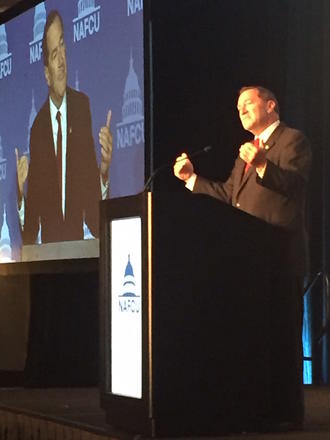
Sen Joe Donnelly speaking to Caucus.
Below is an overview of much of what was discussed, debated, laughed at and applauded.
The ‘Unbreakable Trust’ Compared To You Know Who
WASHINGTON–A senator who was about to head off to a hearing with Wells Fargo’s CEO told credit unions there is “deep respect” for the role they play in communities.
Speaking of the Senate hearing, Sen. Joe Donnelly (D-IN) told NAFCU’s Congressional Caucus, “What we’re going to be talking about is, hopefully, things you never do in your organizations,” he said to laughter and applause.
Donnelly, who said he has belonged to Notre Dame FCU for 43 years, helped organize with Sen. Ben Sasse (R-NE) a letter to the CFPB calling for exempting CUs from many of its rules that attracted the signatures of 70 senators.
“When you have 70 senators you have most everybody,” said Donnelly. “Most everyone knows how hard you work to do the right thing. We have a hearing for Wells Fargo. There sales culture apparently required regular people working in their branches to meet such unrealistic sales targets that they were unattainable without opening fake accounts. We have thousands opened in Indiana with overdraft charges and damage to credit ratings, but no one seemed to know anything about it. The person in charge of that department is leaving with a $125 million separation package for hitting sales goals for hitting sales marks they never hit.”
Donnelly told credit unions they have an “unbreakable trust” with members who recognize that “everyone is in this together. That when I put money in my savings account it’s going to be used to help someone else by a house or a car or a bicycle. And at the end of the day everyone is accountable. You enable all of us to reach the American dream.”
Economist Sees Fed Moving On Rates In December; Plus Insights Into NCUSIF
WASHINGTON–NAFCU’s Congressional Caucus is being held at the same time the Fed’s Open Market Committee is meeting and the group’s chief economist is forecasting there will be no increase in rates—until December.
NAFCU’s Curt Long, who told the group’s Congressional Caucus here that economists have a very poor record of rate forecasting, nonetheless said he believes the Fed will not make a move but is more likely to do so when the FOMC next meets in December.
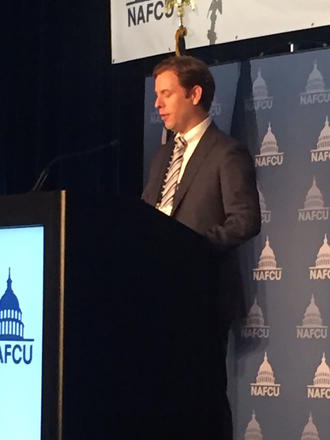
NAFCU's Chief Economist, Curt Long.
One change he said the Fed has made is that it is projecting rate increases will be a flatter model than had previously been thought.
Meanwhile, in response to questions posed by NAFCU EVP and General Counsel Carrie Hunt, Long offered these thoughts:
Hunt: NAFCU has a Share Insurance Fund Committee that tracks the health of the fund. During NCUA’s last discussion of the NCUSIF they give a forecast of where the equity ratio is going to be. How do they predict that?
Long: There are a number of different factors, but the two most prominent are their forecast for share growth and for investment yield. In addition, operating expenses are a factor. Of late, both of (the former) have been drags on the equity ratio as share growth has strengthened, and investment yield, obviously, has remained low. They have actually extended the duration of their portfolio since the crisis, but it hasn’t been enough to stanch the decline in investment yield.
Hunt: NCUA keeps the ratio right around 1.3% (of insured deposits). Why do they like it there, because under the statute it can be kept 1.2 and 1.5?
Long: There’s nothing magical about the number 1.3. Anything under 1.2 means credit unions get hit with assessments, so they want to keep a little bit of a buffer. If they were to shoot for a target above 1.3 that would mean raising those funds from somewhere, and that would be (credit unions).
Hunt: This year NCUA estimates credit unions could see an insurance premium of zero to six BPs. What do you think?
Long: I think a premium is unlikely for 2016 and 2017. Assuming we don’t run into severe economic distress, I think the odds of running below 1.2 are very low for next few years. But the equity ratio has been trending down due to a number of headwinds, and down the road it does look like that 1.2 number could be an issue.
Hunt: How does NCUA determine whether it’s reserving appropriately? NAFCU and many of our members, whose money it is really, believe it could be lower.
Long: During the financial crisis reserves built up to a really high level and as it turned out failures were not the issue that had been forecast at the time. If you look at a lot of the metrics on an aggregated level, capital ratios are doing well.
Hunt: What about potential losses, such as from taxi medallion credit unions? Is that a factor?
Long: Taxi medallion lending is a market that has fallen to pieces. Fortunately, there aren’t a whole lot of credit unions with huge concentrations of taxi medallion loans. In terms of the overall fund it’s not a huge threat, but it’s something we and NCUA are keeping tabs on.
1,800 Pages Later, What’s Being Said Here?
WASHINGTON–As if the compliance burden needed to be any worse, it’s also becoming more difficult to figure out exactly what the burden is, according to one person.
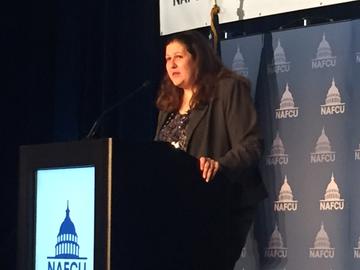
Brandy Bruyere addresses Caucus.
Brandy Bruyere, director of regulatory compliance with NAFCU, told the Congressional Caucus here that one trend she and NAFCU’s compliance team are seeing is that “increasingly, you need to dig deeper and deeper to see what the regulators are expecting from you. We see this with the CFPB all the time. It’s not enough to read the rule; you’ve got to read an 1,800-page preamble. It seems ironic to me that the whole point of the rule is to make it easier on the consumer, but you can’t understand how to fill out the compliance.
“Increasingly ambiguous rules are becoming more and more difficult to apply, and with it comes increased litigation risk,” Bruyere continued. “Rules that used to apply to particularly predatory practices are now being extended to pretty much all consumer credit. We talk to credit unions every day trying to figure out, ‘Can we still have our statutory lien?’ for instance. A phrase such as ‘credit-related ancillary product’ is a pretty vague phrase, and there’s no definition.”
Bruyere said NAFCU has been fielding numerous calls from credit unions about complying with rules for loans to members of the military, which are coming with unintended consequences.
“The result from speaking to credit unions is that we are not going to be protecting service members as much as cutting off some products and services to this community,” shared Bruyere. “One credit union said, “It’s the last thing we want to do, but can we cut off service to this market?’”
Bruyere said another credit union has opted to simply apply the Military Lending Act Rules to all borrowers.
“Anytime you have to go that deep into a preamble I would argue the regulators have done something wrong,” said Bruyere. “It would be nice if Congress would require a little more accountability from these regulators. People should be able to go to the rule and be able to figure out what the expectation is.”
A ‘Dangerous’ Time In Washington, Says Cruz
WASHINGTON–Sen. Ted Cruz gave an impassioned speech here during NAFCU’s Congressional Caucus that sounded right out of his recent presidential campaign and which was largely welcomed by credit unions.
Cruz, a Texas Republican who lost in the primaries to Donald Trump, told Caucus “This is a dangerous people who believe in free markets. I will tell you the country is hurting because of it.”
Cruz said his number-one priority in the Senate is economic growth, which he called the foundation for solving just about every challenge facing the government, including knocking down the federal deficit, rebuilding the military and lifting people out of poverty.
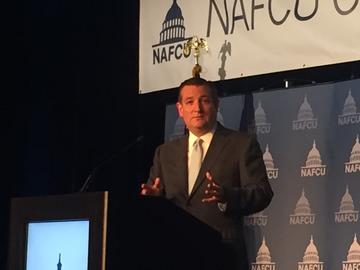
Sen. Ted Cruz addresses credit unions.
“With growth we can do all that,” Cruz said. “What you understand because you deal with it everyday is that growth does not come from Washington, D.C., it comes from the private sector and from putting capital to work.”
Cruz said the current state of the economy is one of “stagnation, misery and malaise” due to too much government and a punishing tax code. Tax and regulatory reform, he said, will result in “booming economic growth.”
Cruz found a particularly warm reception when he hit on one specific example of his position.
“In the financial services industry, and as credit unions, you all have been particularly hammered by Dodd-Frank. Talk about a bill you don’t need too read further than the title to know nothing good can come from it,” Cruz said to laughter and applause. “From my first days in Congress I have been leading the fight to repeal Dodd-Frank. Dodd-Frank is a great example of how Washington works. It was sold to the people as stopping Too Big To Fail. How has that worked out? The big five banks have increased (assets) 43% in five years. On the other hand, small financial institutions have decreased 14%. That’s not an accident. That was not an unintended consequence. When Dodd-Frank was written, the lobbyists for the giant financial institutions were sitting right there writing it with them. It’s a simple premise: it you put burdensome regulations on an industry the big guys can handle it. They have armies of lawyers and accountants, and they have to do something with them. The people who are hurt are the little guys like credit unions that don’t happen to have an army of compliance officers sitting around. When you hammer the financial sector it doesn’t just affect you; the dollars you provide are the oxygen for economic growth.”
Returning to the broader issue of economic growth Cruz said he’s a “numbers guy,” and that in the federal budget there is only one “first-order variable and that is economic growth…If we stay in the 1% -2% growth rates that we’ve seen in the entire Obama administration, our federal fiscal picture looks uglier and uglier each year going forward. But if we get back to robust economic growth suddenly the entire picture looks better.
“One of the most fun things to do is take old JFK speeches on cutting taxes and read them to Democrats,” said Cruz. “He campaigned on 5% GDP growth and he achieved 5% GDP growth. We know how to do this. What’s missing is the political will and the leadership to get it done.”
Metsger Updates NCUA Changes; Says More On The Way
WASHINGTON–NCUA Chairman Rick Metsger offered credit unions here an update on changes he said he has overseen that are designed to reduce the regulatory burden and help credit unions to live the mission for which they were created.
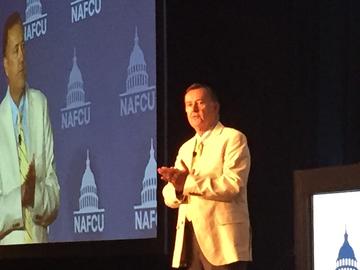
NCUA Chair Rick Metsger at Caucus.
He said that under his watch the agency has worked to create a “corral of regulations that allow you to maneuver and help you to serve your members. It’s about making sure the American consumer has the option of a not-for-profit cooperative.”
Metsger touched on three primary areas of focus, including ongoing efforts to streamline rules around field of membership.
“Who would have ever thought of how things have changed?” he asked. “The reality is people interact differently now than they did 20 years ago or even 10 years ago. It’s incumbent upon us as a regulator to look at the opportunities we can provide. The fact is Congress gave us the power to interpret local communities and who is eligible to join. I’m hopeful by this Fall we will have substantial changes in field of membership definitions and more opportunities to provide more services to more members of the American public.”
The NCUA chairman also addressed a word frequently used at credit union meetings, “transparency,” which he said means being open to how one does business as well as to dialogues about the manner in which it takes place. To that end, he reminded Congressional Caucus that the agency will host a budget hearing in October at its headquarters in Alexandria, Va. He said announcements related to other changes will be forthcoming, as well.
“Your mission and our mission is the same,” said Metsger. “Your responsibility is to promote thrift and to provide capital for provident purposes. And our job is to ensure you can do that.”
Support For CFPB, But Not For Overseeing Credit Unions
WASHINGTON–While the very existence of the CFPB and the Dodd-Frank Act that created it were blasted by several members of Congress during NAFCU’s Congressional Caucus here, Sen. Gary Peters (D-MI) walked a more nuanced line.
Peters, who noted he is a long-time CU member and who thanked credit unions for programs to make auto loans during the recession, said credit unions should not be treated like the very large, systemic risky institutions in the market.
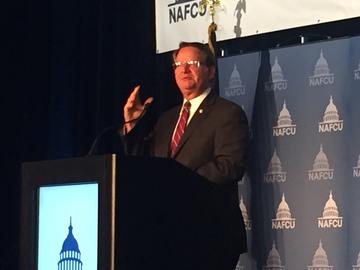
Sen. Gary Peters speaks to Caucus.
“I believe Dodd Frank was important to rein in a lot of that greed, but credit unions had nothing, absolutely nothing to do with that, and you should not be pulled into that kind of regularly framework,” Peters said. “So regulatory relief is certainly something I am focused on. We don’t need multiple government agencies focused on the same issue.”
Moving on to other issues, Peters, a member of the Homeland Security Committee in the Senate, called cybersecurity the “most significant threat we face as a country with highly sophisticated state actors in collusion with criminal organizations. We need to tighten that up.”
On an issue closer to home with CUs, he added, “We need to tell retailers they have a responsibility to strengthen their security, as well. It’s often left to you to pay for it. My view is wherever the breach occurs, they should pay for it.”
Peters said he would like to see the Small Business Administration more actively engaged with small businesses on vulnerabilities in cybersecurity. “They can often be the weakest link in the system,” he said.
Meanwhile, Peters said he is hopeful Congress will address tax reform in its next session, “but one thing I can tell you for sure is that I will always stand for credit unions continue to have their tax exemption. For me it’s very simple; you represent everyday people.”
A Power Transition Has Taken Place
WASHINGTON–It’s a frequent complaint of credit unions: millions of dollars are being poured into lobbying, bills are introduced in Congress, the bills go nowhere, and nothing ever happens. Not so fast, says one member of the House.
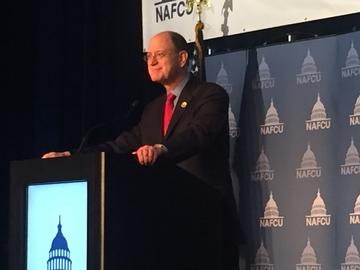
Rep. Brad Sherman speaks to CUs.
Rep. Brad Sherman (D-CA), a long-time credit union friend in Congress, said that while the perception may be that because bills don’t end up going through both sides of Congress and get signed into law that nothing is being done, that it not the case.
Instead, Sherman told NAFCU’s Congressional Caucus that Congress has “transferred a tremendous amount of power” to the regulatory agencies and it now works to influence the rules those agencies are creating.
Meanwhile, one rule Sherman said he remains opposed to is the Durbin Amendment.
“(Retailers) promised us lower prices at the stores and I haven’t seen them. It’s time to repeal the Durbin Amendment.”
From a larger perspective, Sherman said the recession of 2008-09 meant the social compact has been “shredded. “One group of financial institutions wanted government to give them capital. What you want is for government to get out of the way so you can go get capital. I would think government should not be a barrier to capital.”
For that reason, said Sherman, he co-sponsored with Rep. Peter King legislation giving credit unions access to supplemental capital.
Other issues touched on by Sherman:
- Data security. “Those who lose the data should pay for the problem of fixing it. You get money spent on safety when those in a position to provide for safety are not the ones who will bear the costs if safety isn’t achieved. It’s not just getting retailers to pay on the back end, it’s giving retailers the right incentive to pay on the front end.
- The CU tax exemption. “There is no way they could get a majority to say we want to tax credit unions because it’s such a great idea to tax credit unions. The big risk is in tax reform they are just a few billion dollars away from the targets of each party, and at that moment the banking industry will come forward and say, ‘We know where you can get the money,’ and their first step is to wildly exaggerate the amount of money involved. The banks have put forward a $2-billion revenue estimate, and you can believe it because it’s been certified by the Wells Fargo audit department.”
About The Credit Union Tax Exemption
WASHINGTON–It’s all about the numbers for Rep. Sandy Levin (D-MI). And in this case, the numbers are about credit union membership in his home state.
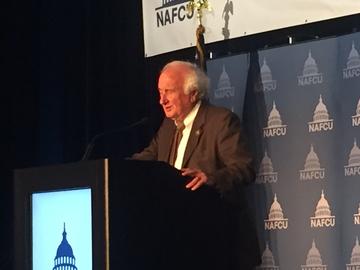
Rep. Sandy Levin at NAFCU's Caucus.
“In Michigan, credit union membership has gone from 4.5 million in 2014, to 4.9 million today,” he told NAFCU’s Congressional Caucus. “I think that indicates the depth of membership in Michigan and why it’s very clear that those who try to tamper with the tax status of credit unions that they will not succeed. It’s discussed that sometimes the tax exemption is ‘threatened’ in quotes, but I think that’s idle chatter.”
On the broader issue of tax reform, Levin, a member of the House Ways & Means Committee, said there is plenty of work left to be done and no guarantee any such reform will actually take place in Congress.
“Embedded in (reform) are some very difficult issues, such as international taxation. Apple paying one-tenth of 1% of income taxes in Ireland. That has amplified how we’re going to have fair taxation in this country,” said Levin. “But much of that remains at this point speculative. As always, you need to be on your toes.”
Before closing, Levin touched on another another misconception among credit unions.
“This is not a paid advertisement; the money you contribute to make sure you are represented here in Washington is money well spent,” he said. “Your representatives come to our offices to talk substance. When you talk substance, credit unions win.”
A Whole New ‘Underwater’ Issue For CU Mortgage Lenders
WASHINGTON–Is the day coming when a credit union turns down a mortgage applicant because 30 years from now the home might be underwater—literally.
That could be the case, cautioned Harriett Tregoning of the Department of Housing and Urban Development’s Office of Community Planning and Development. Tregoning has been leading HUD's Office of Economic Resilience, which includes dealing with and responding to disasters.
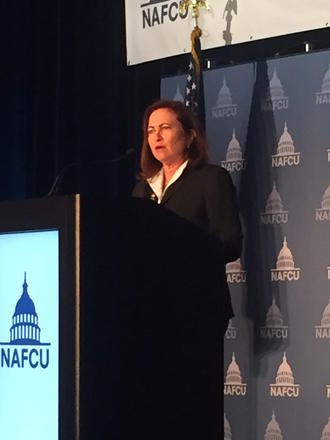
Harriett Tregoning at Caucus.
Tregoning noted that HUD has spent $50 billion since 2000 on long-term disaster recovery, much of it dealing with the results of a changing climate. One mistake many areas make after disasters is to try to get back to normal as quickly as possible by rebuilding things as they were, which often only leads to new disasters, she told NAFCU’s Congressional Caucus.
“Since March of 2015 we have 15 500-1,000-year weather events in this country, such as the flooding in Louisiana, their second 1,000-year-event this year,” said Tregoning. “It wasn’t coastal hurricanes or storm surge, just heavy rain. The damage in Louisiana is equivalent to damage in New Jersey after Hurricane Sandy.”
Credit unions need to be prepared for the role they can play in their communities to help build what Tregoning called a more “resilient future.”
“We might have to start looking at places whether we issue a 30-year mortgage, and say we can’t do that now because this property might be under water 30 years from now,” she said.
Forecasts indicate that as many as 60,000 homes in Florida will be affected by coastal flooding by 2060, according to Tregoning, who said Nome, Alaska, is already being impacted.
“We need to be as smart as we can in planning for these future disasters,” said Tregoning. Examples, she said, include using parks to manage extra storm water rather than building expensive new facilities; upgrading building codes and recognizing that a warming planet means a lot more energy is needed to cool homes and buildings.
What’s Interchange? A CU Rep Explains It To Congressman
WASHINGTON–Rep. Rick Mulvaney (R-SC) has started four different businesses during his career prior to joining Congress, but at no point, he said, did he ever know what an interchange fee was.
“I was a retailer, I paid Visa and MasterCard, but I never questioned it,” said Mulvaney in remarks to NAFCU’s Congressional Caucus.
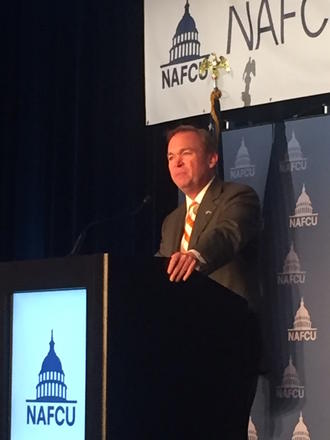
Rep. Mick Mulvaney speaks to CUs.
That changed when he met David Casey, Manager of Business Development and Government Relations at Family Trust FCU, in his home state. Casey was recognized during NAFCU’s Caucus with the group’s Paul Revere award for his advocacy efforts.
“David taught me about that issue. The same is true about fraud and the difference between when someone steals a card or hacks into a system,” said Mulvaney, who spoke to Caucus on the issue of advocacy and educating Congress.
He noted that in one of his first meetings as a Congress the talk was about overhauling the tax code and was centered on corporate taxes.
“I asked about the individual tax code, and I was told the discussion is about corporate tax code,” he recalled. “I asked if everyone there knew that 80% of corporations in the country don’t pay the corporate tax, they are S corporations and pay at the individual rate. I asked how many have ever seen a K-1; it was three people out of 40. That doesn’t mean people in the room were stupid, but if your life experiences haven’t exposed you to a small business you don’t know what a K-1 is. How can you sit down and try to fix a tax system if you don’t understand what’s wrong with it in the first place? How does that get resolved? It gets resolved by you doing what you do and coming and talking to us about it. If you want to speak to both parties, and you should, figure out a way how to show how your issue affects people and the opportunities that are lost in your community in the ways credit unions are managed or mismanaged by the government.”
Mulvaney said visits to D.C. by constituents are important, and that of the nine meetings he had scheduled for the day the meeting with Family Trust FCU was first, “because they are from my district. And then I will meet the people from my state. If you are from Missouri and you want to meet with me, the chances are probably zero.”
“I used to belong to bar associations and then the National Retail Federation and National Association of Realtors and I used to write those checks every month and I used to think it was the biggest waste of money,” Mulvaney continued. “I was wrong. the biggest mistake I made was not getting involved.”
The ‘Deeper Questions’ About Regulation
WASHINGTON–That credit unions have found themselves lumped in with global banks when it comes to regulation is only another example of why they must be involved in advocacy, according to Rep. Patrick McHenry (R-NC).
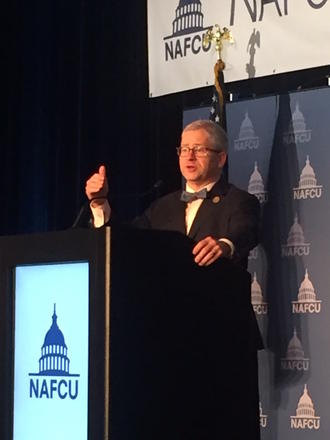
Rep. Patrick McHenry at Caucus.
In remarks to NAFCU’s Congressional Caucus, he used as his example the Consumer Financial Protection Bureau and its “one-size-fits-all” regulation. More than 300 members of the House signed onto a letter calling the CFPB’s approach a wrong one, noted McHenry, as did members of the House in a letter to NCUA on risk-based capital.
“The deeper question we have to contemplate right now for your members is how do we ensure we have the best regulation, the best law, so you can provide the best results for your members?” McHenry said. “This little-bit-of-risk lending that is so needed in communities? How do we make sure that happens? What is the next generation of regs and how should they be shaped? How do we change the law so it reflects the world as it is now, not 80 years ago? That’s the deeper contemplation we need to have.”
McHenry, who said the trajectory of his own family was changed by a credit union loan to his father, told Caucus, “There is a moral case for what you do in communities every day.”
Who Would Object To CFPB? The Founding Fathers
WASHINGTON–Most criticism of the CFPB centers on its voluminous rules and the burden it puts on credit unions. But one senator is suggesting what’s wrong with the CFPB should be seen in a far, far larger light: the founding fathers of the country would object to it.
Sen. Ben Sasse (R-NE) told NAFCU’s Congressional Caucus that he supports CUs in their narrow band of lobbying against its rules. But that is not enough, he said. What’s more important, according to Sasse, is a lesson in U.S. civics.
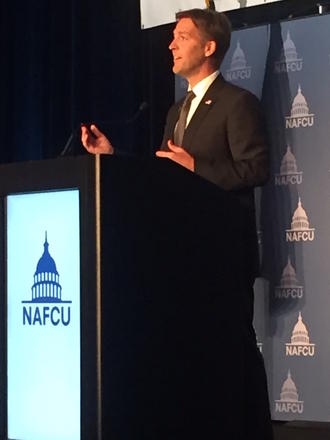
Sen Ben Sasse speaking to CUs.
“The CFPB will not be reined in regardless of how much issue specific lobbying you do,” he told NAFCU’s Congressional Caucus.
“We have a lot of people disinterested or who don’t understand the bigger issue,” said Sasse. “The CFPB is a writ small example of a lot that is wrong. The much bigger problem with the CFPB is it’s an example of an attack on what America really means and why we believe in limited government. I believe in small government. But that debate is within the domain of what America means. Limited government is part and parcel of what America means.”
The Nebraska Republican offered that civics lesson to credit unions, saying that America’s founders were “making a big, bold, anthropological claim about American dignity. Our founding was exceptional, because they were saying something that was really arrogant: most everyone in the world has been wrong about governance. They were saying government doesn’t come first, rights come first. In the history of the world people used to say we need to secure ourselves against the state of anarchy in a fallen world. People used to be subjects, another way of saying they were passive and they had to wait until the king told them what rights they would have and not have.
“Our founders said that’s exactly backwards. The people tell the government what rights it has,” continued Sasse. “So it’s really essential that our kids understand that the government doesn’t give us rights. The Constitution doesn’t tell us what rights we have. The Bill of Rights is not in the Constitution and is outside the document on purpose.”
Sasse went on to call the CFPB “the best illustration that we haven’t taught any of this to our kids.”
He said the Constitutional framers outlined a limited government with distinct responsibilities for the three branches: legislative, executive and judiciary.
“So how does CFPB work? Their budget isn’t part of the appropriations process. They make up their own rules. They can fine you in secret. They are government on autopilot that just makes it up as they go along and they are a fourth branch of government that in no way our founders could make sense of.”
Sasse, who received a standing ovation at the conclusion of his comments, expressed concerns that 41% of Americans under age 35 tell polls they think the First Amendment is dangerous, because someone might use their freedom of speech to hurt someone else’s feelings.”
Speaking again to limited government, Sasse said, “The whole point of America is that Washington is supposed to be a servant community for the communities we come from.” And yet, he observed, five of the seven richest counties in the country surround Washington, D.C., and are where “the lobbyists live.”
$650 Million A Year And No Oversight?
WASHINGTON–Add Rep. Frank Guinta (R-NH) to those who see no need for heavy regulation or agencies such as the CFPB.
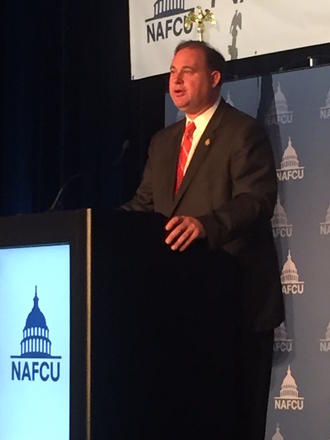
Rep. Frank Guinta at Caucus.
Guinta, whose district is home to the first credit union in the country, St. Mary’s Bank (to which he belongs), told NAFCU’s Congressional Caucus that when he meets with regulators he asks “why they believe they know better than our small community bankers and credit unions from back home. How does a regulator know me, the consumer, better than the loan officer back home?”
He said the regulators never have an answer to those questions.
In today’s Washington, freedom is under attack. And not just in financial services community, it’s in all aspects of government,” he said.
Guinta, the former mayor of Manchester, N.H., said he feels a bond with credit unions.
“I feel we have the same responsibilities,” he said. “I have constituents, you have members. My constituents are everything to me, just as your members are everything to you. I appreciate the relationship I have not just with the president of my credit union, but with every person at the branch.”
Guinta urged credit unions to invite their members of Congress into their offices to not only hear about the difficulties they are having, but to also see how they interact with members.
Meanwhile, he said, he’ll be keeping the heat on the regulators.
“I heard from (former NCUA Chairman) Debbie Matz at a hearing that she had no intention of changing the exam schedule to an 18-month schedule,” he said. “It frustrated me, because I understand the regulatory compliance issues you have to deal with can take up to 10% to 25% of your time. When she announced her retirement we saw it as an opportunity to meet with Mr. (Rick) Metsger and see if he would take a different approach. I wasn’t quite getting the answer I was looking for, a definitive change from 12 to 18 months, so we filed legislation. We have passed that legislation in the CHOICE Act in Committee. We have now what I believe is a firm commitment (from NCUA) this will be done in November once and for all.”
Guinta also earned some applause by saying he’s not a fan of the CFPB or of Sen. Elizabeth Warren of Massachusetts, a staunch supporter of the agency.
“While I respect anyone who wants to serve their communities, she and I have some very different ideas about the role regulators should play. More importantly, I believe in you. Some believe Washington taking a top-down approach is the answer. If it were up to me I would do away with the CFPB once and for all. We are on track with House legislation to make a fundamental change. Imagine an agency that gets $650 million and reports to nobody. When I tell people that they are shocked.”