

TUCSON, Ariz.–It’s time credit unions rethink everything when it comes to financial health and wellness, time to recognize the “financial” piece doesn’t stand alone, and time to realize well-intentioned financial literacy efforts just aren’t cutting it, according to one person who “implored” credit unions to make financial health a core strategy and who offered reasons why.

Ron Shevlin at THINK 23 meeting.
Speaking to Co-op Solutions’ THINK 23 event, Ron Shevlin, chief research officer with Cornerstone Advisors, said credit unions must “change your approach to financial health and wellness, because I think there is a huge opportunity for credit unions.”
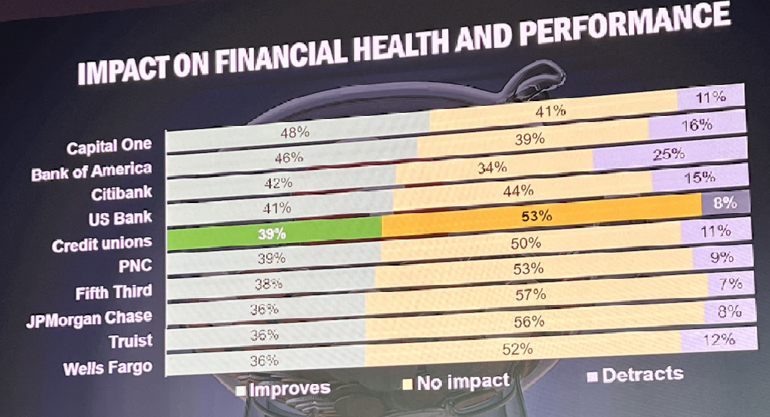
Shevlin, who conducts extensive consumer surveys, said he recently surveyed Americans on who is their primary checking account provider, and then asked those same consumers what impact those institutions have on their financial health and performance.
The results can be seen below, with credit unions finishing in the middle of the pack.
“Why is this the case?” asked Shevlin. “I’d like to put out the idea the reason so many consumers are saying their PFI is not having an impact on their financial life and performance is because the focus has been on financial education and financial literacy, and I don’t think it’s working. I am not the only one.”
It's important to understand what financial literacy is not, according to Shevlin.
- It’s Not Contextual. “It’s not being provided at the point of decision.”
- It’s Not Behavioral. “It’s trying to educate.”
- It’s Not Holistic. “It ignores other aspects of lives.”
- It’s Not Measurable. “There is no consistency to the measurements that are out there. And it’s not just measuring financial literacy that’s an issue, it’s measuring financial health overall.
Measuring Financial Health
Shevlin said the Financial Literacy Network has identified three categories of financial health: vulnerable, coping and healthy.
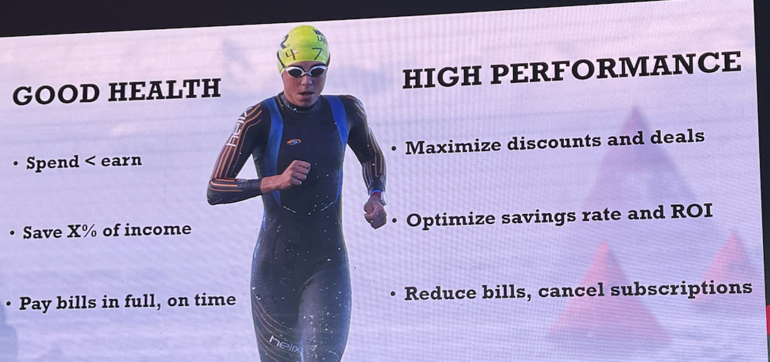
“But here’s the question I put to you. Is healthy really the top of the scale? I think performance, not just good health, is the goal. There is a difference between good financial health and high performance.”
Shevlin outlined those differences, below:
Three Steps to Take
There are three steps a credit union can take towards capitalizing on the financial health and performance opportunity, according to Shevlin.
Step One: Recognize Financial Health is a Service, Not a Resource.
“I bet that if I go to most of your institutions’ websites I will find a host of financial education literature,” Shevlin said. “It's great that you do that, but I'm also willing to bet that resources section is one of the least visited parts of your website. The goal here is not to make it a resource, the goal is to bake it into your products and services.”
Shevlin said he has recently seen some research that indicated the typical consumer has five or six financial relationships. But he argued the number is many times that, including stored-value cards, mobile apps, Apple Pay, Venmo, Zelle and more.
“Do not tell me consumers have five or six financial relationships. They have 30 or 40. Consumers have on average $10 billion sitting in financial apps. That’s $10 billion that used to be sitting in your accounts. They are spending $127 billion in buy now, pay later each year,” said Shevlin. “When you add up all these behaviors and relationships, it means consumers are switching their allegiances and alliances.”
Prior to 2020, Shevlin said he conducted research that asked consumers about their primary financial institution (PFI) relationship. He no longer asks the question.
“It’s meaningless concept. They have a primary checking account, primary apps. They don’t have a primary FI anymore,” said Shevlin.
He further noted that prior to the pandemic, 12% of Gen Z and Millennials said a fintech or a digital bank was their primary relationship. By January 2022 that percentage had gone up to 30%.
Begging the Question
“That begs the question ‘why?’ I will tell you what the answer isn’t. It’s not because of the mobile banking experience. It’s not that Chime or PayPal is providing a better experience. What’s making a difference is the product,” Shevlin said.
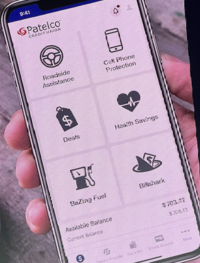
As an example of embedded fintech, which is about integrating fintech products into financial institutions’ websites, apps, and processes, Shevlin cited Patelco Credit Union’s member app and a core checking account that offers a number of other features.
“Why? They are doing it because their members and consumers in general want it. They want ID theft, subscription management and other services bundled with their checking accounts, and they are willing to pay for it,” Shevlin said.
Step Two: Measure Members’ Financial Performance
Shevlin noted there is no shortage of companies that can help credit unions create a financial health score for members, and not just a single score, but scores that look at their lending, their borrowing, their outcomes.
“With all the emerging technologies around AI, it’s becoming easier to ingest all of this data and come back with some scores and data that look at your members’ financial performance,” he added.
Step Three: The Holistic Approach to Financial Health
Shevlin said he defines “holistic” in this case as meaning the integration of a member’s financial health and mental health.
“The number-one social issue consumers are dealing with today is mental health,” he said. “Seventy-four percent of young consumers say they are stressed out about managing their financial lives. It’s a complex relationship between financial health and mental health. When people can’t pay their bills or loans as quickly as they should, they often feel shame and guilt.”
One result of that, he observed, is that “financial therapists” have now begun to emerge.
And beyond mental health, there is also the issue of physical health, as low incomes and rising food prices have left many people hungry, Shevlin added.
“Folks, this is not charity, this is strategy,” Shevlin said. “It’s about transforming your business and your credit union to deal with the physical, mental and financial health issues members have. What I am advocating for, what I am imploring you to do, is to make financial health and performance the core strategy of your credit union.”
There is ROI to be had from doing so, according to Shevlin, who cited Amazon co-founder Jeff Bezos’ oft-cited concept of a “flywheel” of success. In its case, as Amazon grew and became more efficient, it lowered its cost structure, which allowed it to lower prices, which improved the customer experience, and around it went.
There is a similar financial health and performance flywheel for credit unions and it starts with financial health and performance products and services, said Shevlin, who shared this illustration, below.
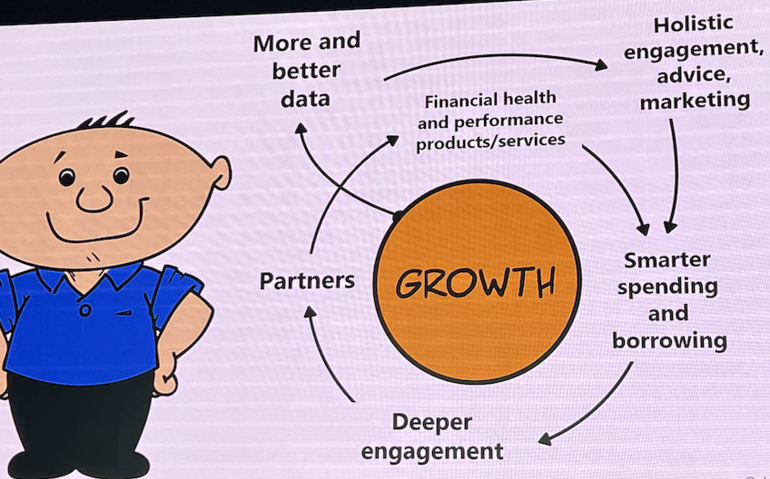
“Just like Amazon’s flywheel, there is a second order impact. As you improve you start to get more and better data about members, and that helps you to provide more holistic marketing to members and that drives even more success,” he said. “This is a million dollars’ worth of consulting on a single slide. It will change your organizations. The smarter spending and borrowing is the outcome, and it’s this focus on outcome that’s important, not the income or the output. It’s about results.”
The New Job Title: CFHO
Shevlin urged credit unions to add a new title to their C-suites: chief financial health officer.
“This is someone who can help to make sense of all the data; somebody has to take charge,” Shevlin said. “There is nobody in this country better suited to deal with the physical, mental and financial health of consumers than credit unions. There is nobody that can envision the business model changes required for this model better than credit unions.”