

MADISON, Wis.–Seeking to innovate inside your credit union? Consider the “fourth option,” and then prepare to be laughed at and for your kids to hide their heads in shame—but never stop being persistent.
That was the advice to CU leaders from a highly regarded expert on growth strategies.
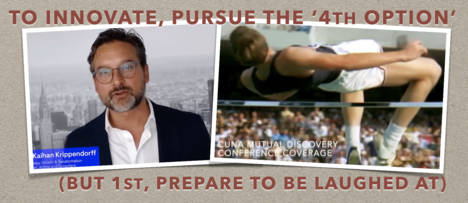
Speaking to CUNA Mutual’s Group’s Discovery Conference on the subject of “Winning the Future of Finance,” Dr. Kaihan Krippendorff offered insights gleaned from hundreds of interviews, from examples set by companies that have successfully innovated, and from observations on how the business model is evolving to one of “coordination, not control.”
At the core of all of it, he said, is that “fourth option.”
The High Jump Lesson
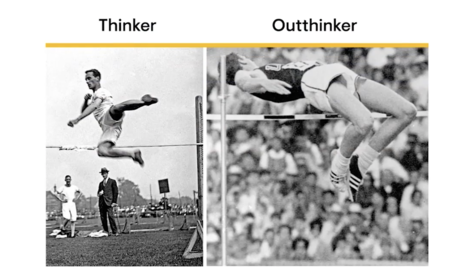
Krippendorff draws his “fourth option” metaphor from the long history of high jumping in track and field, where, up until 1968, there were only three methods used to attempt the high jump, and all of those were forward techniques. But that all changed at the Mexico City Olympics when Dick Fosbury introduced a fourth option by clearing the bar backward.
“The metaphor of three simply represents the point at which others stop thinking, when you hear them repeat themselves and say, ‘I've been in this industry for 20 years what you need to do is 123,’ or, ‘I've solved this problem before what you need to do is A, B and C,” said Krippendorff. “Now, they may be right but it also means they've stopped thinking and this creates an opportunity for us to look beyond the obvious to find the fourth option if we want to share the future of finance.”
Krippendorff said financial services providers do not lack for reasons to consider fourth options, given the constantly changing pressure from new and established competitors and technologies, such as blockchain and digital transformation, fintechs and open banking.
“There is also distrust, particularly large traditional brands, which does create an opportunity for us,” he told the event. “The question is how are we going to play the game? Will we continue playing the way we've been playing or are we going to see the opportunities that change represents for us and start playing the game? Are we going to keep going over the high bar forward or are we going to learn to go over backwards?”

Dr. Kaihan Krippendorff speaking to Discovery Conference.
A Common Belief Dispelled
Krippendorff reassured credit unions that change can indeed come from inside established organizations. In fact, he said, that’s where most change occurs.
Sharing a slide that included innovators such as Steve Jobs, Elon Musk and Bill Gates, Krippendorff observed, “There is a common belief that the people who know how to innovate look like this. If we look at lists of most innovative people in business, what we see are the same names that appear over and over again. What do you notice about their stories? First of all, if you look at their photos, they're all white men, so the narrative around who's going to shape the future is that you've got to be a white man. Now obviously, that can't be true.
The Hipster, The Hacker, The Hustler
“Second, it’s that they all get their ideas when they're young, usually in college, and then they take that idea and travel across the West Coast to the Mecca of innovation, Silicon Valley, where they then put together a small team. They’ve got the hipster, the hacker, the hustler and then…they bring it out on the world and they disrupt the incumbents,” said Krippendorff. “This story has been proven false, but it is so consistent that we have to wonder is it really the truth or is it just a kind of a hero journey story that we like to tell.”
Krippendorff said his own analysis of the 30 greatest innovations of the last 30 years as determined by
a panel of professors from Wharton Business School found that contrary to the myth, entrepreneurs are only behind 30% of the top innovations, while 70% of the innovations that really have affected society have come from employees working in established companies.
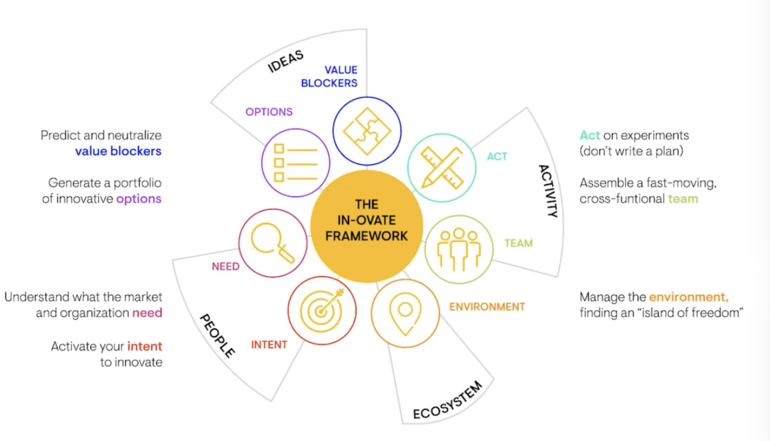
A credit union seeking to drive innovation within its organization, said Krippendorff, should follow a seven-part process that he calls “IN-OVATE.” That stands for Intent, Need, Options, Value Blockers, Act, Team, and Environment.
Three Things
To make it “easy,” Krippendorff focused on three things he said “you can do right now to start shaping the future of the industry.”
In his research, Krippner’s said he interviewed 150 internal innovators about the challenges they faced in trying to innovate from within and how they overcame those.
“Many of our would-be innovators or employees or ourselves have lost the intent to innovate or we stop trying because we are told ‘no’ too many times,” said Krippendorff. “How do we overcome that? We need to remove what blocks that intent. Next is the need to understand what the industry needs, what our members need, what the company needs and aligning that.”
Krippendorff said that means generating lots of options, not just a few, and then looking at where the value blockers lie.
“Your idea has a natural business model around it and it may be inconsistent with the credit union that you work with,” he explained. “How can we re-engineer that business model to start to remove the risk of it being rejected?
“Then we're going to talk about act,” he continued. “The ideas that come out usually require taking action on the idea before we can prove it. So, how do we run an experiment to generate the data to prove the idea? How do we organize a team around the idea across functions that can act with agility? Then, finally, how do we shape an environment that creates these islands of freedom that allow people to innovate?”
Wrong, But Useful
Krippendorff said he believes “all models are wrong but some are useful,” a motto he suggested is a “helpful way to remember where you are on the journey of driving innovation.” That journey, he added, always includes a “personal passion.”
In assessing where an idea/innovation stands, Krippendorff recommended looking at it across eight different dimensions: positioning, product, pricing, placement, promotion, processes and physical experience.
Problems to Solve
Using that framework, he said, allows a credit union to apply it to the industry to see where there are problems the CU could solve. Trust in financial transactions, he said, is one such problem that could be addressed by blockchain and smart contracts.
“We need to rethink processes and promotion as our members move more into digital. We need to start looking at innovating in digital marketing using big data to target…and distribute our products and services,” Krippendorff said. “We've all experienced virtual work; that's going to continue to some extent. Millennials demand different value propositions. People want purpose. We have an opportunity to change the physical experience of interacting with our members and our members interacting with our brands and our services. People are demanding hyper-customization and personalization of products and services.
“There is a shift from physical value towards digital value. With pricing, there's a consensus among consumers and members that the fees that financial services…just lack transparency and they seem unfair,” he continued. “There are all of these problems within the industry that are going to be solved. They could be solved by you.”
The Options Phase
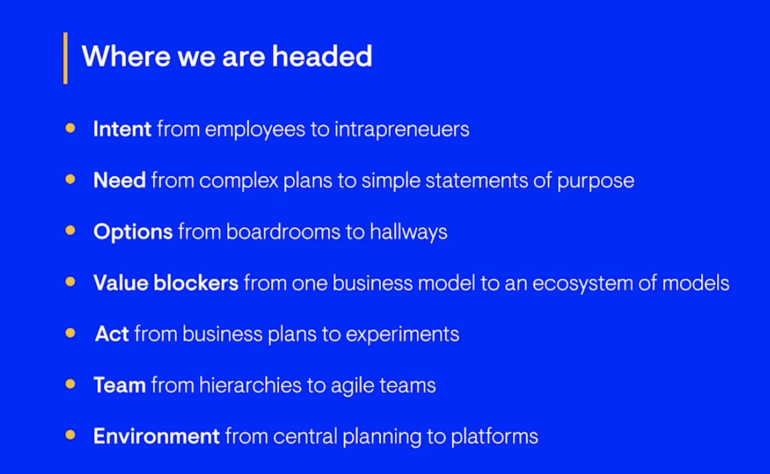
To really generate options it very much helps to be able to pay attention to patterns, said Krippendorff. “A really powerful thing to do with your team is to stop and ask where is the new battleground? what are new client and member needs? What are the new technologies? What are the new regulatory changes and economic shifts and what could we do to move there early now?”
The Evolving Paradigm
As an example of new thinking, Krippendorff urged CU leaders to recognize the “evolving paradigm” around where power now comes from: from coordination, not control. It’s all about coordinating the uncoordinated, he said.
New “business models don't control, they coordinate,” he explained. “Airbnb doesn't own the rooms. Uber doesn't own the cars. They create the platform to coordinate . The blockchain, I believe, is just the next iteration of this. In the blockchain we have the ledgers being coordinated by nodes, but now the nodes are coordinating themselves so it's kind of coordinating the coordinators and we see applications of this across financial services.”
He cited as an example a company called, fittingly, Common bond, that allows graduates of a university to fund loans for students at their alma maters.
“The main idea here is you want to ask who or what would we like to coordinate. If we could coordinate anything around us in the system in which we are operating, ask who would we like to coordinate so hopefully you're starting to experience thinking differently about your credit union,” he said. “We're playing for tomorrow rather than today.”
The Two-Front Battle
Krippendorff urged CU leaders not to define themselves by the industry—financial services—but instead by the experience or goal they are seeking to deliver. For example, he said Starbucks’ CEO said the company isn’t in the coffee business serving people, but instead in the people business serving coffee. Zappos views itself not as a shoe company, but as a customer service company that happens to sell shoes.
“It's really powerful to step back and ask what is your unique advantage or capability as not defined by your industry and ask how does that kind of credit union behave differently,” he suggested. “Peter Drucker, arguably the most influential management thinker of modern times, said strategy is simply the answer to the question of what business are we in. It's never easy to answer that question. That's why you should ask it and start managing what business you and your employees feel you are in so hopefully you're seeing by playing for tomorrow rather than today by coordinating rather than controlling.
“You’re going to naturally start seeing options that your traditional competitors, say banks, don't see,” he added.
Creating Good
Krippendorff said the ownership structure of credit unions already aligns with doing good, but it still needs to be taken to the “next level.”
“I think there are lots of opportunities for us here to better, more authentically, more powerfully communicate the good that we do for our members and for our community,” he said.
Don’t Be Discouraged
Those within credit unions should not be discouraged, even though organizations will push back on innovations, according to Krippendorff, “as most great ideas are discounted at first.”
For inspiration, he said CU leaders should remember Walt Disney was fired from a newspaper for lacking creativity, the creator of the radio was told “wireless music box has no imaginable commercial value,” and that while with HP Apple co-founder Steve Wozniak proposal for the design that became the Apple computer was rejected five times before he left.
The Best Place to Fail
“Most established organizations have adopted a prove, plan, execute model. Prove to me that this will work. Give me a business plan. I'll give you the money to execute it,” Krippendorff said. “But innovations usually require kind of the opposite approach of learn, build. In other words, we need to shift from ‘prove it’ to ‘do it to prove it.’ This is what really innovative companies do. (Amazon’s) Jeff Bezos said, ‘I believe we are the best place in the world to fail. We have had plenty of practice and failure and invention are inseparable twins.
“Weird things are going OK. I believe that most of our organizations are still designed as centrally planned economies and we know that central planning does not work, especially in times of rapid change. As (former GE CEO) Jack Welch said, ‘If the rate of change on the outside exceeds the rate of change of the inside, the end is near.’”
‘Everyone Will Laugh’
CU leaders who embrace brining forward the “fourth option” should prepare for a lack of applause, said Krippendorff.
“When you introduce the fourth option what's going to happen is they will laugh at you. Everyone will laugh. Your kids will hide their heads in shame,” he said.
Living through the laughter, he suggested, is also what allows an organization to laugh last.