

LOS GATOS, Calif.–The tech giants of the early 21st century are commonly referred to as FAANG: Facebook, Amazon, Apple, Netflix and Google, even if one of them, at least from a revenue perspective, doesn’t really fit. And yet the “N” company, Netflix, is always included, and that’s because of culture, according to one person.
In an interview with the New York Times, Jonathan A. Knee, professor of professional practice at Columbia Business School and a senior adviser at Evercore, as well as author of the new book “Class Clowns: How the Smartest Investors Lost Billions in Education,” said Netflix CEO Reed Hastings has always been the adult in the room when it comes to the so-called pillars of “Big Tech.”
Netflix is a fraction of the size of the others and it has eschewed acquisitions that might attract regulatory attention, noted Knee, but what makes it a peer leader are traits less coldly . financial and more softly subjective.
Hastings, Knee pointed out in his Times review, was in his 40s when Netflix went public in 2002 and had previously served as a public company chief executive. All of his counterpart FAANG founders were in their 20s or early 30s when they took their companies public.
The CEO’s ‘Preoccupation’
“Although trained in computer science, Mr. Hastings’s preoccupation at Netflix has been organizational design as much as product and technology. His PowerPoint presentation from 2009 on Netflix’s corporate culture had been viewed by well over 15 million people by the time it was updated and condensed in 2017,” reported the Times. “Sheryl Sandberg, the adult supervision at Facebook for its founder Mark Zuckerberg, said the initial presentation ‘may well be the most important document ever to come out of the Valley’.”
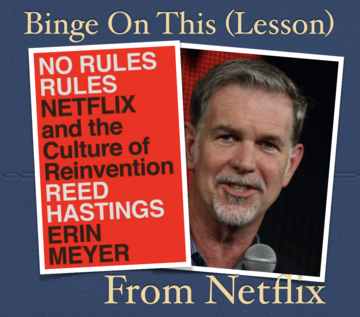
Hastings has recently published a new book “No Rules Rules: Netflix and the Culture of Reinvention,” that is narrowly focused on how to most effectively manage creative enterprises, Knee told the Times. The book is coauthored with Erin Meyer, a respected professor at Insead business school in France.
“The management approach advanced in ‘No Rules Rules’ is striking in its simplicity: Get the best people, give them honest feedback and empower their decision-making,” Knee told the Times. “Although Hastings has been talking about these three key elements for years, it is still jarring to see them synthesized and applied in context.”
Striking Simplicity
The management approach advanced in “No Rules Rules” is striking in its simplicity: Get the best people, give them honest feedback and empower their decision-making. Although Hastings has been talking about these three key elements for years, it is still jarring to see them synthesized and applied in context.”
Strikingly, having the best people involves a regular “keeper test,” observed Knee.
“If a manager won’t fight to keep an employee as an indispensable star, the solution is a generous severance package. In place of annual reviews — salaries are adjusted based on the market, not individual performance — a system of continuous written and live, 360-degree feedback serves a remarkable degree of organizational transparency,” Knee said of the lessons shared in the book. “The result is a work force with high ‘talent density’ who can be trusted to use their own judgment.”
Knee noted the confidence in unsupervised employee decision-making — managing by “context, not control” — allows Netflix to get rid of annoyances like expense processes and vacation policies.
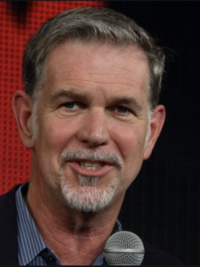
Reed Hastings
“Managers also have unlimited authority to make financial commitments within their domain without approvals,” stated Knee. “At least as many people would find the lack of approvals, rules and metrics terrifying as would find the level of autonomy liberating. That divide is presumably a major determinant of who applies to work at Netflix in the first place.”
An Overarching Issue
Knee said what struck him most in the book was that the overarching approach to culture endorsed by Netflix “speaks directly to the fundamental failure in technology industry leadership. Both the book and the first page of Netflix’s famous presentation are organized under the same banner: Freedom and Responsibility.”
According to Knee’s review in the New York Times, where Netflix’s tech peers have fallen down is by “emphasizing empowerment — their own corporate prerogatives as well as that of their high-performing employees — without establishing a clear context for understanding the corresponding responsibilities, both internally and externally. ‘No Rules Rules’ demonstrates how hard, but essential, it is to take the responsibility side of the equation seriously. Many may find the ‘keeper rule’ inexcusably brutal, but it is hard to argue with the seriousness with which the company takes its responsibility to develop its people.”