

CHICAGO–Consumers who are new to credit or early in their credit journeys generally perform as well or better than borrowers with established credit and similar risk scores, according to a TransUnion study.
The global study, “Empowering Credit Inclusion: A Deeper Perspective on New-to-Credit Consumers,” may give some “assurance to lenders in both developed and developing credit markets that they can extend additional credit products to such consumers without incurring materially higher delinquencies,” according to TransUnion.
According to TransUnion, the study included data and insights about millions of consumers in varied global markets, including the United States, Brazil, Canada, Colombia, Dominican Republic, Hong Kong, India, Philippines and South Africa.
TransUnion said it defined a new-to-credit consumer as one with no prior credit history on their credit bureau file who opened their first-ever, traditional credit product such as an auto loan, credit card or another loan unique to individual regions. The study then examined the behaviors and performance of those new-to-credit consumers over the subsequent two years after opening their first credit product, TransUnion added.
Focus on Credit Inclusion
“A particular focus around the topic of financial inclusion is credit inclusion — the ability of consumers to access traditional lending products, such as credit cards, mortgages and personal loans. These products serve as a means to financial mobility for consumers and can be a gateway to a better quality of life, enabling homeownership, business formation and wealth creation,” said Charlie Wise, co-author of the study and head of global research at TransUnion. “The more consumers who can participate in credit markets in a region, the greater the opportunities for broad economic inclusion.
“The data from our study demonstrate that new-to-credit consumers are often good risks who are hungry for credit and will show loyalty to those financial institutions that offer them their first credit accounts,” Wise added.
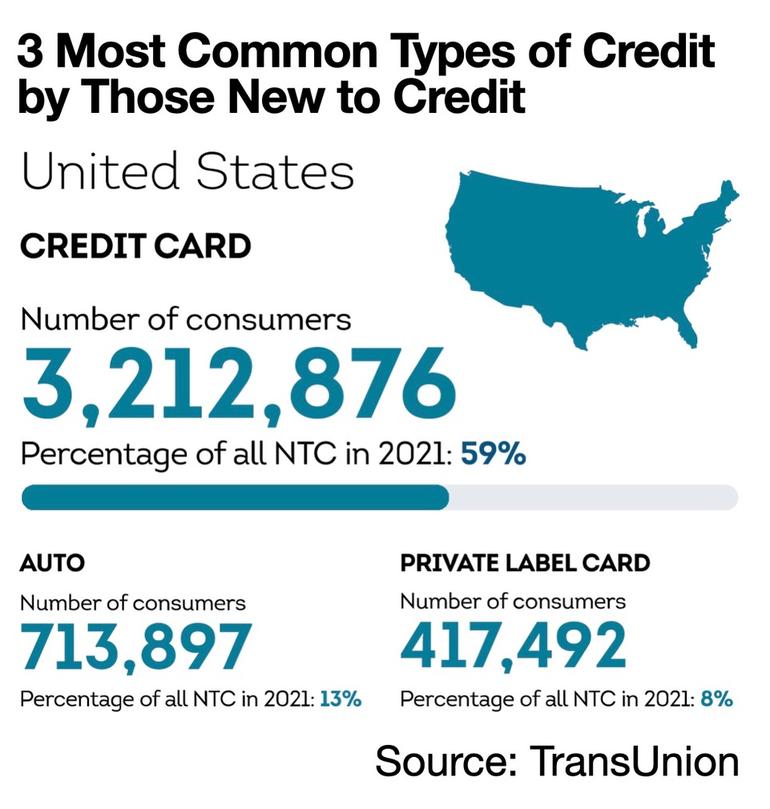
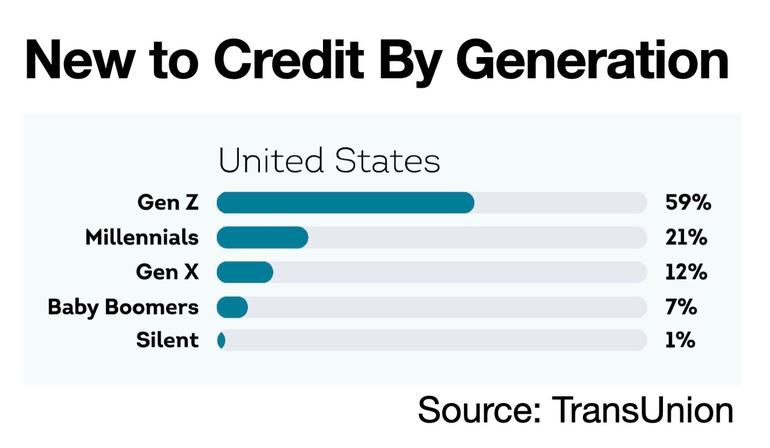
TransUnion reported that in the United States, 5.8 million consumers opened their first credit product and became new-to-credit (NTC) during 2021. Another three-million became NTC through the first half of 2022. In 2021, Gen Z made up the largest part of this group with 59%, followed by Millennials (21%), Gen X (12%) and Baby Boomers (7%), TransUnion said.
A Main Takeaway
“One of the main takeaways from the study: NTC consumers around the globe are generally good risks when compared to other established borrowers with similar credit risk profiles,” according to the company. “Credit cards are generally the first credit product opened by most NTC borrowers in the U.S. as well as many of the other regions studied.”
To better understand credit performance, TransUnion said the study looked at NTC consumers who opened credit cards as a subsequent product over their initial two year journey and the delinquency performance after six months on those cards. It then compared them to the delinquency rate of credit-served consumers who also opened cards in the same time period.
Additional Findings
The study found in the near prime and prime score bands — the score ranges where many NTC consumers fall early in their credit journeys — the delinquency rate for NTC consumers was comparable to, or even better than, more established credit-served consumers, TransUnion explained.
The trend was seen in both pre-pandemic and pandemic periods.
“In nearly every region, depending on risk tier or time period of origination, instances occurred in which NTC borrowers had lower delinquency rates on newly-opened credit cards than established borrowers,” TransUnion said. “In the U.S., on subsequent credit card originations after opening their first account, NTC consumers had slightly higher delinquency rates than credit-served consumers in the same near prime and prime score ranges, though the differences are small enough to make the NTC segment a potentially attractive segment for lenders looking for profitable growth.”
Lower Delinquencies
TransUnion added that in the U.S., when observing performance on the initial credit cards that consumers opened as their first product, NTC consumers with credit scores in the near prime tier had lower delinquency rates than credit-served consumers with the same age and risk profiles.
“This finding was observed in many of the other regions as well,” the company reported. “This is an indication that many NTC consumers are careful to make timely payments on their first-ever credit cards in order to preserve ongoing access to this new source of credit.”
Better Understanding Tendencies
TransUnion said it undertook a survey-based market research study to understand the voice of NTC consumers, which included responses from 8,465 NTC consumers from a range of markets, including Brazil, Canada, Colombia, Dominican Republic, India, Philippines, South Africa and the U.S.
According to TransUnion, the study found that new expenses were the primary driver for opening a first lending product in nearly all markets, excluding the U.S. and Canada, where having access to a convenient means of spending was the top motivator.
This is supported by the choice of first product types, where in the U.S. and Canada the most common first product opened is a credit card, TransUnion stated.
“A majority of NTC consumers across all regions, with the exception of India, reported receiving a credit product at the first institution where they applied — without needing to go to multiple lenders,” TransUnion said. “In the U.S., 54% of NTC borrowers reported receiving a credit product from the first institution where they applied.”
Other Keys
In addition, the study also found:
- The study also found that convenience is key for NTC borrowers and may portend more opportunities for lenders in the future, TransUnion said. In selecting which institution to open their first product with, convenience was cited as the top criterion in all regions except for Brazil. In the U.S., 33% of Americans cited convenience as their top factor.
- Lenders providing an NTC borrower with their first account also may benefit by building loyal customers. In the U.S., 57% of all NTC consumers who opened a personal loan as a subsequent origination within two years after opening their first trade, did so with the lender of their first account, TransUnion reported.
- The study found that on average, about six in 10 NTC consumers said their need for credit will increase in the next three to five years, with the highest levels in developing markets (led by India at 79%). Approximately 52% of American NTC consumers stated their need for credit will rise in this same timeframe.
A Large Role
“It’s clear that new-to-credit borrowers around the globe and in the United States will play a large role in the growth of many lenders’ books of business,” said Michele Raneri, co-author of the study and head of U.S. research at TransUnion. “Banks, credit unions and other financial institutions who use alternative data while providing products, channels and a positive onboarding process, will likely be the ones who succeed in building loyalty with this segment of the population.”
Still Free in ’23! The Freshest CU Headlines. Right to Your Inbox.
The biggest, best and freshest news reporting in credit unions remains free in ’23! Each morning CUToday.info delivers its daily update offering the latest headlines and breaking news right to your email, with the easy-to-read headlines format allowing you to click on the stories that interest you most in order to learn more.
If you haven’t yet signed up for the new email solution on which CUToday.info has partnered with ResponseGenius, you can do so here. Signing up requires less than one minute of your time—and it’s free!
Please note that after signing up you may need to go to your Spam/Junk folder and mark the morning headlines email as safe. CUToday.info does not provide its list of readers and emails to outside parties, and we will not be contacting you to sell you an extended warranty or sending you any links so you may cash in on an inheritance you didn’t know was coming.
And did we mention it’s free?