

TULLAHOMA, Tenn.—Caren Gabriel, president and CEO of Ascend Federal Credit Union, has announced plans to retire on April 7, and she is sharing some advice and lessons learned from her career as part of this CUToday Q&A Exit Interview.
Gabriel joined Ascend as staff attorney in 1985 and later was named general counsel and executive vice president. She became president and CEO of Ascend in January 2004 and during her tenure helped oversee growth to $3.8-billion in assets, 27 branches and more than 255,000 members, up from $960.3 million in assets, 12 branches and 117,000 members nearly 20 years ago.
According to Ascend FCU, Gabriel has also been instrumental in driving Ascend’s member return program, which includes bonus dividend payments, loan interest refunds and reward payments for loyal debit card use. Members have received a total of more than $104 million since Gabriel began the program 17 years ago.
Ascend FCU has named Executive Vice President Matt Jernigan as her successor.
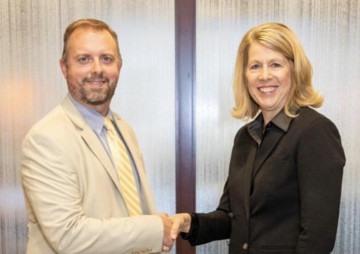
Matt Jernigan with Caren Gabriel.
Below, Gabriel shares her thoughts and insights:
CUToday.info: How did you come to be involved in credit unions?
Gabriel: My first job out of law school was working in labor relations for a support contractor at Arnold Air Force Base in Tullahoma, home to the AEDC Federal Credit Union, predecessor to Ascend Federal Credit Union. My job led me to work with the credit union’s board members, who also worked at the air base. When the board decided to add an attorney to the credit union’s staff, I was offered the position and accepted. I found the work interesting and fulfilling, and as time went on other opportunities opened to me to be of service to the organization, including serving as CEO for the past 18 years. It has been a wonderful career.
CUToday.info: What lessons have you learned during your career about driving and managing growth, and has that evolved?
Gabriel: One of the most important lessons learned about driving and managing growth is that you need to surround yourself with smart people who believe in the mission of the credit union as much as you do. It cannot be just a job for them — it is almost a calling. Once you believe in the mission and hire smart hard-working people to advance that mission, you naturally want to do all you can to improve the financial lives of the members and communities we serve – and that leads to growth.
I can say that almost every lesson I have learned over my 18-year tenure as CEO has evolved and changed during that time. If you are not learning and growing as a CEO, that is a problem.
CUToday.info: What lessons have you learned during your career about managing and leading people, and did that evolve or change?
Gabriel: It is a bit of a cliché, but as I said above, you must surround yourself with smart people who fill gaps in your skill set. You must get the right people on your bus. Managing and leading people has probably evolved the most, as the expectations of our members and our employees has changed rapidly.
CUToday.info: What advice would you share with a new leader in credit unions?
Gabriel: My advice to a new leader in credit unions is to make sure you understand and believe in the mission of credit unions. Take the proper amount of time to do that, especially if you are new to the industry. Be a continuous learner, as well as a continuous advocate for your employees, and never stop trying to improve the financial lives of your members. If you are a new CEO, spend the proper amount of time getting to know your board of directors and spend as much time as you can in one-on-one “check-ins” with them.
CUToday.info: What is your view on the future of credit unions, if there is to be one?
Gabriel: My view on credit unions is bright. But realization of this vision depends on a lot of hard work and innovation, as well as the willingness of boards and management teams to continuously improve and change.