

MADISON, Wis.–If things are going really well for your credit union, you may be in trouble, according to two experts, who suggested the risk lies in falling into the comfortable trap of planning vs. the discomfort that can come in setting strategy.
With 2018's Planning Season here for many credit unions, CUToday.info is featuring the opening keynote to CUNA Mutual’s recent Discovery Conference, in which Peter Sheahan, group CEO, and Dr. Julie Williamson, chief growth enabler, with Denver-based Karrikins Group, said knowing the real differences between planning and strategy is critical.

Peter Sheahan, left, and Julie Williamson during Discovery Conference.
“What is strategy?” asked Williamson. “It’s the promise of value. It’s the promise to create better lives for members. The difference between a well-formed strategy and a well-executed one is can you get humans to act on it.”
Sheahan kicked off the presentation by using Adobe as a case study. The company over the last five years has led the shift from static to smart imagery, and from software-in-a-box to cloud services.
“Adobe asked themselves the strategic questions, not just the planning questions. They asked, who can we be to our customers? What would set us up for the next 20 or 30 years?” said Sheahan.
Sheahan explained the company sought to address the biggest challenge to every marketer, which is trying to figure out which half of the marketing works. Adobe sought to do so by using data to better allocate scarce resources and to better identify a more relevant role for the future.
What Adobe and other successful companies have done, said Sheahan, is four things really well:
- They understood the difference between strategy vs. planning.
- They were willing to invest in the future (and bought capability where they needed to).
- They questioned assumptions, one of which was that marketing could be a science, not an art.
- They created a sound process, and engaged customers and investors and their own team in that process.
Sheahan and Williamson then addressed all four of those points:
Understanding the Difference Between Planning and Strategy
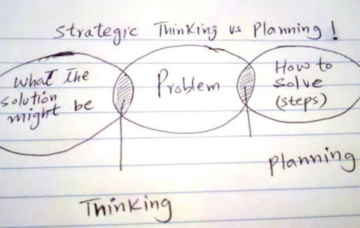
“I think it’s an important distinction to make between strategy and planning,” said Williamson. “Strategy is a fairly new business phenomena, but it’s very important today. You can’t afford to plan for success today by doing more of what you do better. Strategy is about how to we win in the future and succeed in a different world than we are in today.”
In setting strategy, the kinds of questions that need to be asked, said Williamson, include What if? What else is going on out there? What could we do in the future?
“It’s not what do we do now and how do we do it better,” Williamson clarified.
Making the setting of strategy more difficult, she continued, is that it’s about the less tangible, the less visible. “It’s also what might not be, and we have to navigate that uncertainly,” Williamson told her Discovery audience. “And uncertainty is not something people in financial services are comfortable with. To be great at strategy, you have to get comfortable in that space. You have to get comfortable with strategy as perspective, not as a plan.”
As an example, Sheahan and Williamson cited Canada’s Blue Shore Credit Union, which experienced big changes in its member and prospective member demographics as who it was founded to serve and who it would need to serve in the future evolved.
“Blue Shore really looked at changing demographics and where their market was going. And that can be difficult for a credit union, because you’re wrapped around who you serve today,” said Williamson.
She said the credit union further looked at assumptions about what it means to be in a banking environment and then did some fundamental changes. Took some creative thinking. It rebranded and repositioned itself, while working to ensure it did not lose its history. It asked itself, “How do we lean into the future?” Williamson said.
The Question for CU Executives
Sheahan said his question for credit union executives is this: “How much of your energy is going into building a plan vs. really asking the big questions? You can do a lot of planning when the market and members are predictable. But as that all evolves it becomes less about planning and more about strategy.”
Williamson cautioned that one common mistake is thinking of an “amazing operational plan” as a strategy.
Added Sheahan, “A credit union executive could be forgiven for saying ‘We’re in a strong place and I don’t think we’re being disrupted.’ Change can be slow until it’s not.”
The great risk, said Williamson, is that when “you wait for someone else to disrupt you, then you operate within the parameters they set. That’s why you want to self-disrupt when you are in a place of strength. Don’t wait for disruption to come to you.”
Everything ‘Fine’ At Your Credit Union?
If someone asks a credit union executive how things are going and they respond “Fine,” that’s a warning sign, according to Williamson.
“Fine is the death of great. It’s a great expression. Things were ‘fine’ at Adobe. Why go through this massive disruption? Because they wanted to embrace the future. If you’re fine right now, it’s a good time to set an ambitious strategy.”
Sheahan also touched on what he called a “little bit of truth right now” in credit unions. That “truth,” he said, is that the “credit union system is a story of two systems. We have the big getting bigger, and the smaller CUs really struggling. For some of you, truth be told, you are ono a burning platform.”
Citing Blue Shore Credit Union as an example again, it found itself facing a new demographic of high net worth people looking for banking services in their environment. “They had to take a step back and ask who are we, how do we serve them,” said Sheahan. “By rethinking those assumptions, they were able to completely redesign their whole experience and to rebrand. It’s a courageous thing to do for any organization, but especially an organization with a deep identity tied to a membership base. They were able to do something nobody else was able to do.”
Invest in the Future
Sheahan said he believes every credit union needs to “reinvest and rebalance,” and that includes moving away from investing in optimizing the core and instead investing in optimizing for the future. Credit unions, he said, need to better allocate the resources needed to win in the future.
“We have a generation of leaders who have come up and who are good at optimizing resources,” said Williamson. “But we’ve lost some of that muscle around optimizing for the future. It might be a moment right now to really ask the question of how are we putting time and effort to thinking about strategy as winning for the future, versus optimizing operations to win today.”
As another case study, the two presenters pointed to Nike+, the initiative launched by Nike to better engage consumers and which now has more than 28-million members. Williamson said the giant company could have tried to “incrementalize its way to the future,” but instead it took the longer view.
Credit unions have the opportunity to do the same thing, said Sheahan.
Sitting on Your Assets
"You are sitting on assets that underpin your relevance into the future,” he said. “But are you allocating resources to take advantage of that? Are you putting money into it?”
For those uncomfortable that they are simply unsure what the future holds, Williamson clarified, “Note we didn’t say how you might KNOW if you can compete in the future. The great strategic myth is that we think we can predict the future. It’s not assuming that you know, but assuming that you must learn.
“There is this concept of stepping up to the edge of disruption,” Williamson continued. “What does the future hold and how can you leverage the strengths to lean into the disruptions happening around you. On that edge, you find some of the greatest opportunities. Nike took sneakers and pushed them into the future.”
Sheahan added that it’s also critical to remember “You have to have the discipline to stop doing some things. Steve Jobs was more famous inside Apple for what he said no to, not what he said yes to. He felt you had to put your time and money and resources in a very aligned way.”
And saying no can be especially difficult inside credit unions, suggested Williamson. “One of the hardest things with that comes with identity, and we see that with credit unions. What are the precious things you are holding onto as a credit union where you need to say, ‘We need to imagine a world where we no longer do that’?”
Sheahan said that in his career he has never met a more passionate or more committed group of professional in his life than credit union executives. “But this is about more than working hard; this is about doing the hard work. It’s about stepping away from an identity.”
Question Assumptions
Questioning assumptions is about asking the right questions. Sheahan noted that the percent of shareholder value lost due to strategic risk is estimated to be between 80% and 90%, according to separate studies by PwC and Harvard Business Review.
The quality of the thinking that goes into the strategy is critical, said Sheahan. “It doesn’t matter how well you execute the wrong strategy.”
Process.
Williamson said one assumption that is often gotten wrong is that participating in the setting of strategy is a privilege for the select few, most especially senior management and the board.
“ I have worked with organizations where we get 60% to 80% of the staff of a whole involved,” she said. “When you involve more people in strategy and get more perspectives, the more people will understand it and act on it. The more engagement with strategy and planning, the more likely the team will align and bring the strategy to life. Diversity will help the quality of questions and answers.”
Sheahan said another assumption to challenge is that the future of the credit union’s relevance in the future for members will be determined by current relevance of products and services offered. “I’m constantly shocked by the lack of financial planning services available in credit unions,” he said, saying the service will be even more critical in the future.
Williamson said it’s important to be selling—and she stressed she intentionally said “selling”– to members the products and services to members that will help them to have a robust financial life, and not shy away from selling instead of just serving.
The Right Questions
Overall, when it comes to setting strategy overall, Sheahan said it must be understood that “If someone says they know the answer, then you haven’t asked the right questions. The right questions should force you to explore, to think more deeply. That’s a good cue if you’re trying to challenge yourself to think strategically.”
Sheahan said the best strategic sessions have an element of paranoia, but also a very deep sense of optimism.
“Optimism is not delusion,” added Williamson. “It’s about knowing you have the capabilities, the strengths and the people to help you move into the future. Delusion is thinking what you have always done is sufficient for the future.”
All that said, according to Sheahan and Williamson, the seven takeaways for creating a strategy are:
- Build a strategy, not just a plan
- Allocate resources to the future
- Define your Edge of Disruption
- Commit to doing the hard work
- Have the courage to question assumptions
- Be willing to deselect
- Pay attention to the process