

NEW YORK–“Teams” are often referenced within the credit union community, but what makes a team optimal? There are five key dynamics that drive optimal teams, according to research by Google.
The issue of what makes for a good team is explored by Christine Comaford, who writes about how leveraging neuroscience to create remarkable leadership, in a new posting on Forbes.com.
Many business leaders, including within credit unions, when pressed for what makes for great teamwork, will respond alignment, communication, collaboration, energy management, leverage, and trust, notes Comaford. But what else?
According to Comaford, Google did comprehensive research on the issue and found three common denominators.
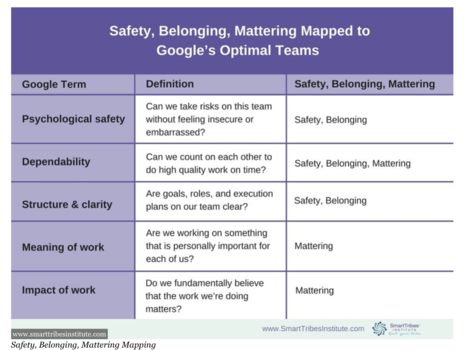
Google did some comprehensive multi-year research on this topic. I’ll refer to it below and map it to my work during the past 30 years in the areas of safety, belonging and mattering.
“I’ve found it all comes back to safety, belonging and mattering, no matter what structure you want to wrap around the idea of optimal teaming,” wrote Comaford on Forbes.com. “Let’s look at what Google learned in its extensive research on the topic.”
Comaford said that over the course of two years (ending in November 2015), Google conducted more than 200 interviews where it assessed more than 250 attributes of what makes an optimal team.
“The findings from the 180 teams studied were surprising,” she said. “While they had hoped to find a recipe for an optimal team (for instance, take one Ivy League MBA, one extrovert, one expert engineer), Google actually found that who was on the team mattered far less than how team members interacted, structured their work, experienced their contributions. The answer was in behavior and emotional resilience.”
What Google found, said Comaford, were five key dynamics that result in the optimal teams:
1. Psychological safety: Can we take risks on this team without feeling insecure or embarrassed?
2. Dependability: Can we count on each other to do high-quality work on time?
3. Structure & clarity: Are goals, roles, and execution plans on our team clear?
4. Meaning of work: Are we working on something that is personally important for each of us?
5. Impact of work: Do we fundamentally believe that the work we’re doing matters?
“Google found that psychological safety was by far the most important dynamic,” said Comaford, who is the author of SmartTribes: How Teams Become Brilliant Together.
“Without this people don’t feel comfortable speaking up, asking questions, checking in. There’s too much risk of being labeled as ‘out of it’ or ‘clueless.’ All humans want to belong to a group, and we’ll take tremendous risks (such as not speaking out even if we feel it’s very important) if we feel we may become an outcast, lose status in our tribe or be ostracized somehow.”
Google uses a tool called “gTeams,” said Comaford, which is a 10-minute check-in on the five dynamics. Meetings often will kick off with each team member sharing a risk they took in the past week. “The net is that they’ve seen psychological safety ratings increase by 6% and structure/clarity increase by 10%,” said Comaford. “But the best part is the increased connection in the team due to increased communication.”
Christine Comaford is a leadership and culture coach and the author of SmartTribes: How Teams Become Brilliant Together.