

WASHINGTON–Is the branch dead, as many believe? Quite the opposite, according to one expert—but the branch will need to be different as might the people who work there.
During a recent meeting, Bill Handel, general manager and chief economist with Raddon, told a breakout session during CUNA’s GAC it’s critical to get into the “how’s and why’s” of branching as the branch transformation process is well under way.
“The long tail of COVID will be significantly more impactful than COVID itself,” said Handel, noting the longer-term trends include retirements by Baby Boomers, digital adoption, how people want to do their banking, and the branch.
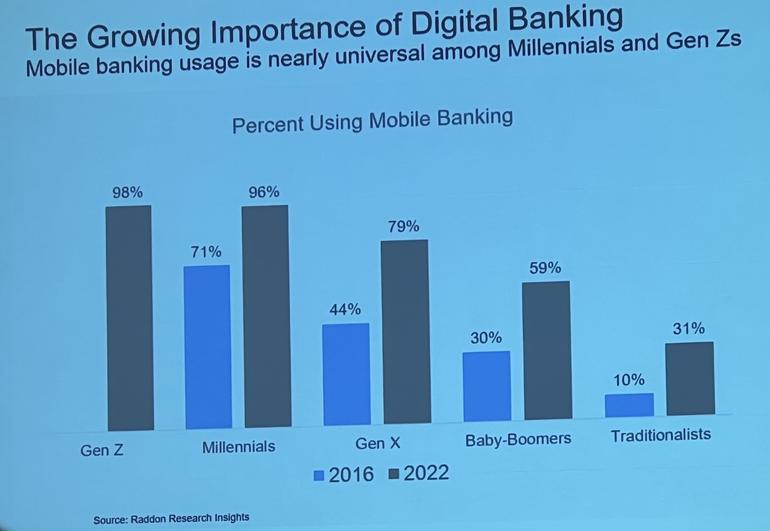
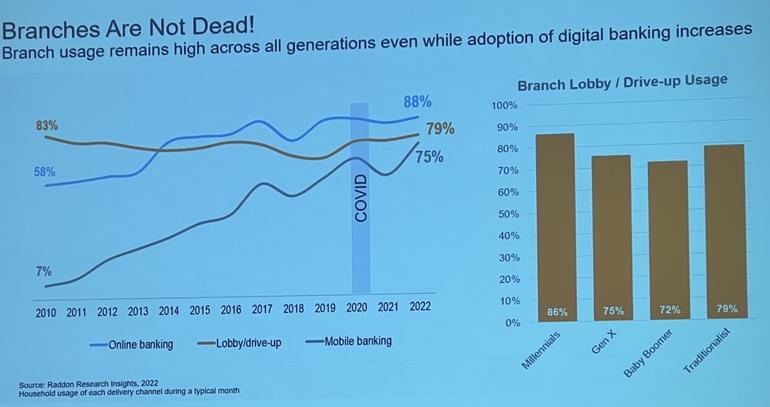
“Is the branch dead? That’s something that a lot of people are saying. People say the branch has short legs, it isn’t viable for the future,” said Handel. “That’s something our research indicates is just the opposite. The branch will play a very pivotal role in your future. But it will be different. It’s pretty startling to see what has happened in a pretty short amount of time with digital banking. COVID forced the adoption of digital banking by generations that previously really weren’t interested.”
Opposite Strategies
Handel explained that the bank and credit union strategies when it comes to branching have been opposite.
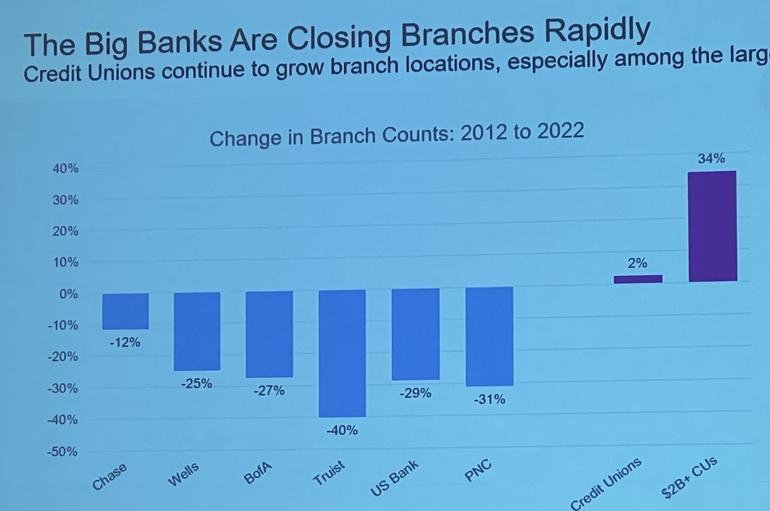
“Large banks are closing branches rapidly to enhance their financial results. Banks are abandoning marketplaces, they are rightsizing,” he said. “They overbuilt for so long because they knew branches drew checking accounts and checking accounts drive overdraft income. Now they are closing branches where overbuilt.”
Net Growth in CUs
Credit unions on the other hand, he said, have seen a net growth in branches between 2012 and 2022, even as number of CUs declined 30%. More striking, he said, is that CUs grew branch counts by 34% during this period.
“I really think the branch becomes important in a high-tech/high touch environment,” Handel said. “The problem is the banks get a big benefit from this in cost reductions that allow them to do different things. We don’t have that same advantage.”
In response to a question, just a few hands in the room were raised to indicate they have net fewer branches now than 10 years ago.
The 6% Effect
Handel urged CUs to pay attention to what is known as the 6% Effect. The 6% Effect shows that when an institution gets to 6% of the locations in a marketplace, the likelihood it will have greater than 6% marketshare greatly accelerates.
A Surprise
The Raddon research around branch usage by consumers discovered one “fascinating” finding, Handel said.
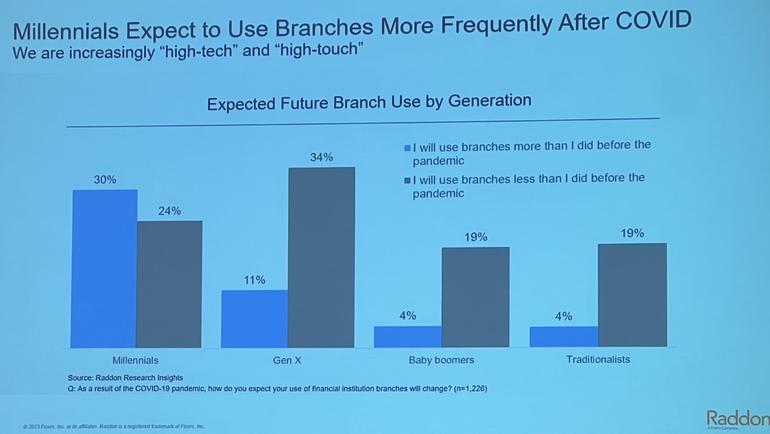
“Millennials are most likely to have walked into a branch. Why? The role of the branch is different from the past. Millennials are between 25-45 and they are moving into what we call the age of significance. What they are looking for from their financial services provider is different from what they needed in college. They are buying houses in droves. What this is really showing is there is a significant demand for branches.”
Questions to Ask
On several occasions Handel stressed that credit unions must move away from the notion of the branch as a transaction hub (which will continue), but the primary focus will continue to shift more and more toward advisory.
He said the implications of that lead to questions:
· Do we have the right technology in place?
· Do we have the right layout?
· Do we have the right people in place? “That’s the thing nobody talks about. What we have hired for in the past and traditionally in branches are people who can process transactions and solve problems. Unfortunately, we haven’t hired people who can probe and answer questions. So, I think we need to think differently about the people we are hiring.”
The Five Steps
“We have found many organizations are struggling with this process of branch transformation. We pull people together and everyone has an opinion. “The first thing to do is to get the facts.”
Handel said there are five steps credit unions should take as part of its Playbook for Success. Those include:
Market & Performance Analysis
This is about gathering the facts, said Handel, urging CUs to:
· Understand goals and objectives
· Analyze market growth potential. This typically involves drawing rings three-miles around the branch to understand the opportunity, he said. “Everyone of your board members will have their opinion on where you should go next. What you really want to do is bring that data to bear to get everyone on the same page. It’s not just where the marketplace is today, but what are the growth factors? That data is out there”
· Share market insights
· Report and benchmark current branch performance relative to the market
· Capture, categorize and size opportunities and challenges
“This is not just about the markets you are considering going into, but the markets you are into today. There are locations you have today that you say either A), we are going to close the branch, or B) we need to reallocate resources.”
Network Strategy & Roadmap
We have found most effective to be the hub-and-spoke concept, which allows you to optimize your spending.
In this step, Handel recommended:
· Present gap analyses for current state against objectives
· Consider redesign opportunities to enhance digital maturity and self service
· Select pilot branches and/or clusters
· Create 3-5 year investment roadmap to achieve growth objectives
Format Design & Technology
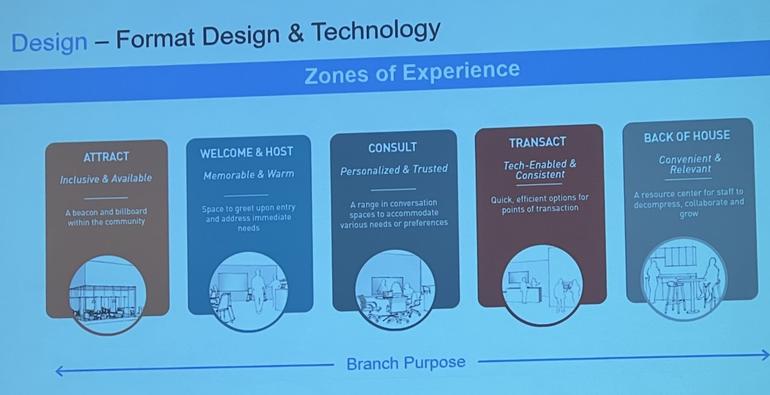
“This is about thinking about what we want to do in a branch,” said Handel. “We have to attract. The biggest issue for many credit unions is that many people don’t understand they can walk in and join a credit union.”
He outlined the “zones of experience” below.
Research that probed consumers regarding what they want in a branch layout. Not surprisingly, older individuals prefer a branch design that is more traditional, while younger individuals are much more likely to prefer tech-friendly designs.
“As you think about locations, demographics matter,” said Handel.
He said what Raddon is range of strategies, including:
· 1,500-square-foot branches with at least four associates, a greeter/concierge, open floor pans, advisory services, self-service ITMs and kiosks
· Mini-branches as small as 500 square-feet still focused on consultation
· “Branch in a Box,: a 100square foot footprint with 0-1 associates and extended hours of operation via a video-enabled ITM
Pilot & Rollout, Measurement & Optimization
“This piece is really, really critical and not done often enough. It’s about looking at the results you’re getting, not the results you’re planning, and then tweaking,” he said. “Get away from the idea of having someone responsible for branches, someone for mobile banking, someone for online banking and start thinking about a holistic relationship with your members. It’s critically important.”
The Evolution
Handel urged CUs to understand the evolution of the delivery ecosystem and especially an integrated delivery system.
“The experience you get in mobile should be consistent with what you get in the branch,” he said. “The vast majority of consumers are right there in the middle between high-touch and high-tech, and it’s across all generations. Our research has found that typically it’s the people who are a balance between the high-tech and high-touch are really the most valuable types of members.
“The other piece is how are we measuring success?” he continued. “The metrics for a branch often focus on teller transactions. Those are something that aren’t necessary. You need new metrics around growth and development.”
It’s Called Fresh for a Reason. And We Offer Home Delivery. For Free!
The biggest, best and freshest news reporting in credit unions remains free in ’23! Each morning CUToday.info delivers its daily Fresh Today news update offering the latest headlines and breaking news right to your email, with the easy-to-read headlines format allowing you to click on the stories that interest you most in order to learn more.
If you haven’t yet signed up for the new email solution on which CUToday.info has partnered with ResponseGenius, you can do so here. Signing up requires less than one minute of your time—and it’s free!
Please note that after signing up you may need to go to your Spam/Junk folder and mark the morning headlines email as safe. CUToday.info does not provide its list of readers and emails to outside parties, and we will not be contacting you to sell you an extended warranty or sending you any links so you may cash in on an inheritance you didn’t know was coming.
And did we mention it’s free?
Please note and/or make your IT department or email administrator aware the emails will be coming from the domains CUTodayinfo.com and CUTodayinfoReply.com