

SAVANNAH, Ga.–Everyone has one of eight “stress personalities,” according to one expert, who explained that while it’s important for leaders to know their own, it’s not necessary to know the stress personality of others—what matters instead is understanding everyone reacts differently to stress.

Dr. Lauren Hodges
Speaking to the CUES TalentNEXT event here, Dr. Lauren Hodges, founder of Performance on Purpose, LLC, and who has worked with numerous large organizations and universities on projects related to understanding and managing stress, told attendees, “Stress is fixed; it’s here to say. It’s not necessarily the problem. It’s the fixed variable. The malleable variable is growing our resilience to meet it.”
As part of her introduction to managing stress, Hodges outlined how the neuroplasticity of the brain works: neurons fire along neural pathways that are familiar to it. Managing stress is about rewiring the brain to create new knowledge, skills and habits, she said.
“When we are in a stressful situation, our thoughts, emotions and behaviors are automatic,” Hodges shared.
Critical thinking, reason and self-reflection are impaired, in what is often better known as the “fight or flight” response, she explained.
Stress Personality
Hodges said research has found because humans have default patterns of thought, emotion and behavior under stress, there are resulting “stress personalities” that are uniquely defined to every individual.
“How we support others when they are under stress is going to be different,” according to Hodges. “When we don’t show up for stress the same, it means we don’t recover from stress the same, either.”
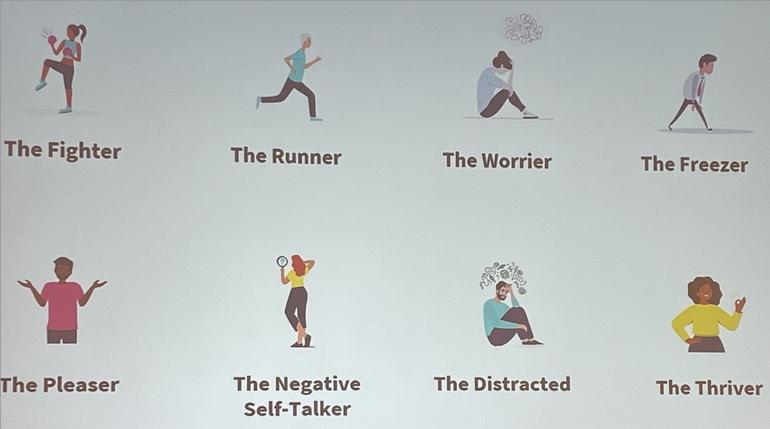
Eight Stress Personalities
Hodges shared eight “stress personalities” she said she and her team have identified, emphasizing that those personalities are affected by the context in which they are occurring. The eight stress personalities include (and people can fall under more than one of the categories due to that context), according to Hodges:
The Fighter: This stress personality in a fight or flight situation is to lean toward the threat and fight, with high, negative energy. Fighters look to squash the threat at the expense of others. They are very values-driven.
The Runner: The person is the “flight” in fight or flight.
The Worrier: This is the person who gets “stuck on the hamster wheel of uncertainty.”
The Freezer: According to Hodges, there are two types of Freezers. The first is the highly productive freezer who can very well compartmentalize things and negative emotions. “The problem is when you suppress a negative emotion too often you also suppress a positive emotion, and you can become numb and shut down,” Hodges said. “They tend to have health issues and issues with relationships. The other freezer is unproductive; when things get hard they just shut off. They emotionally and physically disconnect.”
The Pleaser: “They appease. They don’t like threats or confrontation. In the face of stress, they do anything they can to get rid of that stress by taking on other people’s stress. They try to make everything OK at the expense of their own well-being. They tend to be correlated with Imposter Syndrome.”
Negative Self-Talker: These individuals self-attack, said Hodges. “The key marker here is they start to attack their core values and identity. They can be difficult to manage as they have a lot of trouble with receiving feedback, positive or negative.”
The Distracted: This person has more of a cerebral relationship to stress, they feel it cognitively, according to Hodges. “They have trouble thinking straight, prioritizing their thoughts. They have headaches; it’s mental spaghetti.”
The Thriver: This is the person who has it together, Hodges said. “This person is self-aware, reflective. They are not devoid of stress. They can catch their stress personality almost in the movement and intervene.”
The Worrier & The Runner
Hodges spent most of her remarks focused on two of those stress personality types, the Runner and the Worrier
According to Hodges, the Runner struggles with
- Being overwhelmed, panic, anxiousness
- Second-guessing and questioning/procrastination/avoidance
- Withdrawal/wants to be alone
But the Runner does have a superpower: they are thoughtful, careful and considerate, she said.
The Worrier is the opposite of the Runner.
The Worrier struggles with:
- Incessant ruination/thought loops
- Trouble staying present: stuck in the past/future
- Trouble with decisions
- Catastrophizes/jumps to worst-case scenario.
The superpower of the Worrier is ability to weigh things carefully, along with being cautious, considerate, a good communicator and risk-averse.
“The Runner and the Worrier are huge assets to your team, just in different ways,” said Hodges.
How to Respond
In responding, Hodges urged CU leaders to undergo a “stress reset,” which she defined as any action, thought, saying, ritual or other strategy to “create space between your reaction to stress and response. And the best part is you probably already have a list in your brain of what works best for you.”
That list can include activities, people, pets, music, breathing and more, Hodges said.
According to Hodges, Runners like and respond best to:
- Alone time/processing time
- Making lists/triaging
- Mid wandering time
- Walk-in nature/movement
- Reframing
The Worrier
The Worrier best responds to:
- Talking it out/connection
- Journaling
- Focused meditation
- Mindfulness
- Reframing
“This is super important to you as a leader to know that what works for one person will not work for the other,” said Hodges.
Baking Them In
Instead of using the stress resets only at moments of stress, Hodges instead recommended baking them into one’s day and putting them on the calendar.
“There is a big difference in how you perceive something that comes up at the end of the day when you have had a good night’s sleep, you have moved around, done some deep breathing and shown gratitude,” said Hodges.
Two Most Important Questions
It is not the job of leaders to diagnose the stress personality of other people, Hodges said.
“It is simply to create the space for people to figure that out themselves,” said Hodges. “The two most important questions you can ask your team are: How are you feeling? And what can I do? It sounds simple, but it truly is about relationships when it comes to managing your team.”
Are You Being Gouged for Bank-Like Subscription Fees for Old News? Here’s a CU-Like Way to Fix That
The biggest, best and freshest news reporting in credit unions remains free! Each morning CUToday.info delivers its daily Fresh Today news update offering the latest headlines and breaking news right to your email, with the easy-to-read headlines format allowing you to click on the stories that interest you most in order to learn more. So stop paying those bank-fee-like subscription prices from other so-called “news”” publications!
If you haven’t yet signed up for the new email solution on which CUToday.info has partnered with ResponseGenius, you can do so here. Signing up requires less than one minute of your time—and it’s free!
Please note that after signing up you may need to go to your Spam/Junk folder and mark the morning headlines email as safe. CUToday.info does not provide its list of readers and emails to outside parties, and we will not be contacting you to sell you an extended warranty or sending you any links so you may cash in on an inheritance you didn’t know was coming.
And did we mention it’s free?