

MENLO PARK, Calif.–When historians of the early 21st century look back on the pre-COVID era, one of the absurdities they might highlight is the vogue for gigantic, open-plan offices, according to one new report, which predicts a new concept in office layout is taking hold—but for many it could include the same mistakes made in the past.
In its report, Inc.com noted that when Facebook opened its 433,555-square-foot Frank Gehry-designed open-plan office at its headquarters in Menlo Park, Calif., it was the apotheosis of the trend of breaking down barriers between co-workers. Opened in 2015, today it’s a ghost town, a “monument to offices vacated by the pandemic,” observed Inc.
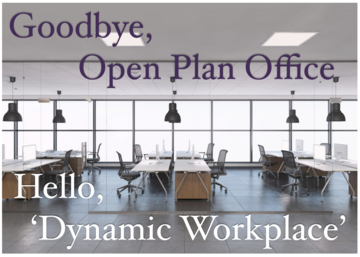
The questions now go beyond making workers feel safer with updated ventilation and enforced social distancing, it’s now more about how teams will use the spaces when some remain home, others split their time and others can’t wait to resume their daily commute and up-close collaboration, reported Inc.
“Cue the ‘dynamic workplace,’ a pivot away from the open plan, built on the idea that with fewer employees coming to work on any given day, offices can offer them more flexibility of layout and management,” Inc stated. “While open offices and dynamic workplaces share similar components—privacy booths and huddle rooms to escape the hubbub, cafe-like networking spaces, etc.—they’re philosophically distinct. One is intended to be a place where people come (at least) five days a week, and get most of their work done on site. The other is planned for people rotating in and out of the office, on flexible schedules they have more control over than ever.”
Inc. noted the open office tried to improve the office-work status quo; the dynamic workplace has to convince people to even bother showing up. Its biggest lures: more varied workspaces for collaboration, and a chance to be away from a distraction-filled home.
‘We’re Going to Move to This Model’
“For me it’s fairly clear we’re going to move to this model across every industry, even the more traditional ones,” Armen Vartanian, senior vice president of global workplace services at Okta Inc., which builds tools that allow secure access to business applications, told Inc.
Matt Harris, head of workplace and technology at Envoy, Inc., pointed out to Inc. that people naturally like to work in different environments throughout the day, depending on what they’re doing.
In its own office, Envoy has for the past year and a half offered employees a variety of spaces in which to work: desks for focus, couches and clustered seating arrangements for collaboration and socialization. Following the pandemic, the company is working on an office layout with more space devoted to collaboration and socialization.
When workers want to be left alone, they’re apt to stay home, or visit a cafe or co-working space closer to where they live, according to the Inc. report.
Repeating Mistakes
But Libby Sander, an assistant professor of organizational behavior at Bond University in Gold Coast, Australia, offers some caution.
“But by spending to remodel or even rebuild their offices with these new ideas in mind, companies are in danger of repeating the mistake they made when they all rushed to the open plan: ignoring the research that says these layouts may have just as many problems as the older ways,” Libby told Inc.
Libby noted research on hot-desking in office spaces, for example—where employees give up a dedicated space in favor of first-come-first-serve seating—finds that it decreases socialization and trust. This happens because employees figure they might never again see the person they sit next to on a given day, Sand said.
In other studies, employees complain they can’t find their colleagues, that it’s a hassle to find a new spot to work every day, and that such arrangements ignore humans’ innate territoriality and desire to make a space their own.
“If we think about it, bedrooms are the worst waste of space ever, but no one’s suggesting we should get rid of them, because we know the benefits of having a designated sleeping space,” she adds.
According to Joan Burke, chief people officer with DocuSign, Inc., many of these drawbacks can be overcome with what’s called “neighborhood” or “community” flex working.
Team Areas
In this model of flexible working, whole teams—say, HR or finance or engineering—sit together in one area, though its location, size and boundaries could change from day to day, Inc. reported.
“We think that’s more aligned with what people want; they want to see their colleagues,” added Burke.
For things people will still want to stash at work, employees could each get a locker.
And what happens when the toughs in accounts receivable conspire to come in an hour early every day, to claim the best space before those latecomers from accounts payable show up?
“At the end of the day, it’s like a restaurant. There are certain tables that are most preferable and we’ll just find a way to work through it,” Burke told Inc. Her guess is that people will be so grateful they no longer have to come into the office five days a week that such office turf battles will pale by comparison.
Micro-Offices
For Okta, an additional enticement to come back to the office could be “micro-offices,” according to Vartanian. These smaller offices could be spread across the Bay Area, so that employees who live in San Francisco or the East Bay could go to an office in their own vicinity, and those who live farther down the peninsula would have yet another option. The idea is to eliminate or reduce employees’ commutes, while still providing the amenities of an office setting. It’s all part of a trend toward moving to where the talent is, Vartanian told Inc., whether that’s across town or in a different state or country altogether.