

CHICAGO – A new TransUnion study has revealed a trend taking place in credit scores related to the pandemic, and the company is saying lenders would be “well advised” to take a “holistic look at score migrators.”
The study, “Score Migration Impact to the Credit Ecosystem,” has found that with some help from government assistance programs, lower credit usage and loan payment forbearance offerings, aided median credit scores increased markedly during the early stages of the COVID-19 pandemic.

“Now, more than three years since the pandemic started, some consumers who migrated to higher credit score ranges are becoming delinquent on their credit obligations at higher rates than historically observed for those risk tiers,” the TransUnion analysis suggests.
Two Factors
According to TransUnion, among the factors that led to a rise in credit scores in recent years, two have stood out:
- Lower credit balances and utilization, driven by less spending and excess liquidity from government assistance
- Lower delinquencies, driven by payment forbearance programs and also excess liquidity that enabled consumers to stay current.
“With many activities and travel plans shut down over the course of the pandemic, particularly in its early phases, many consumers used those savings, plus additional funds provided by the federal government in the form of pandemic relief, to pay down credit balances,” the company said. “This ultimately led to lower balances on which consumers were more easily able to remain current and consequently lower rates of delinquency, which helped drive an increase in credit scores and more access to credit.
The Rebound
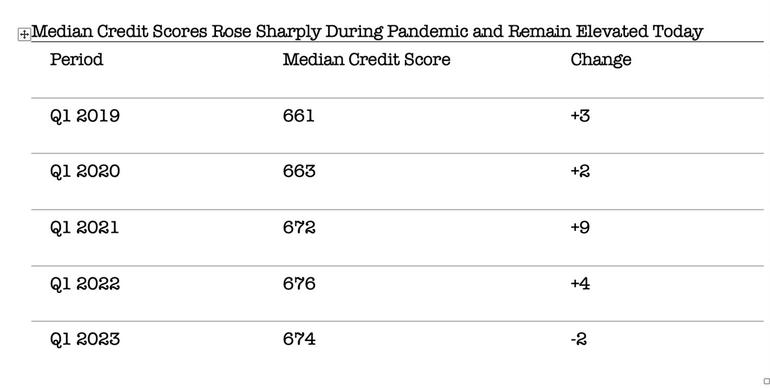
TransUnion noted that against this backdrop of higher credit scores, consumer demand for credit rebounded starting in mid-2021, as many government assistance programs ended and inflation began to rise.
“Demand was especially strong for credit cards and personal loans, products that provide immediate liquidity to consumers,” TransUnion said. “At the same time, lenders’ willingness to provide such credit products increased. Credit card originations in 2022 increased 58.8% as compared to 2020, while unsecured personal loan originations were up 54.3% over that same period.”
According to TransUnion, the study revealed that many borrowers previously in riskier credit tiers who recently migrated to a higher credit risk range were more likely to fall back into some of the credit behaviors that they had displayed previously.
‘Delinquency Rates Not in Line’
“For some, this led to delinquency rates not in line with those of consumers aligned in prior years with that higher credit score, but instead, similar to consumers who typically had scores that were, in fact, lower,” the company said.
TransUnion noted, for example, the delinquency rate of the sub-segment of new unsecured personal loan borrowers in Q3 2021 who had recently migrated to a higher credit score more closely resembled that of borrowers with credit scores 25 points lower prior to the pandemic (Q3 2017 & Q3 2018). That same trend held true for credit card trade lines (25 points), while for auto loans, performance of recent migrators resembled that of borrowers with credit scores 10 points lower, the company added.
Advice for Lenders
“Credit scores continue to perform extremely well at their intended role of rank ordering borrower risk. That said, the temporary benefits brought on by pandemic-era government relief programs, and resulting consumer credit behaviors during that time, led to a rise in scores for many consumers, particularly those who previously had lower scores due to delinquent accounts and/or high credit utilization,” said Michele Raneri, vice president and head of U.S. research and consulting at TransUnion. “Lenders would be well-advised to take a more holistic look at score migrators using data-driven insights into additional trended credit behaviors to better determine which ones are likely to remain in their elevated positions as well as those who may perform more in line with their prior score levels.”
What’s Important to Understand
“It’s important to understand that our research indicates that credit scores remain fundamentally sound,” Raneri continued. “Many borrowers who have seen their credit scores rise are, in fact, performing as they should be. However, our study findings underscore the need for lenders to consider doing a deeper dive on credit score migrators beyond their initial rank-ordering – especially in the short-term as the pandemic’s impact is still being felt.”
What Some Lenders are Doing
TransUnion reported some lenders are already performing more due diligence on their portfolios by using solutions to complement traditional credit risk scores.
As an example, the company said some lenders are using its TruVision Premium Attributes solution to apply unique behavioral characteristics as an overlay to identify consumers who may pose an incremental risk and those more likely to perform well.
In addition, it said lenders are also using other alternative data solutions, such as the company’s TruVision Blended Data to identify borrowers who typically may not be considered for a loan when only using a traditional credit risk score because of their low scores or limited credit history.
For info on the “Score Migration Impact to the Credit Ecosystem,” click here.
It’s Called Fresh for a Reason. And We Offer Home Delivery. For Free!
The biggest, best and freshest news reporting in credit unions remains free in ’23! Each morning CUToday.info delivers its daily Fresh Today news update offering the latest headlines and breaking news right to your email, with the easy-to-read headlines format allowing you to click on the stories that interest you most in order to learn more.
If you haven’t yet signed up for the new email solution on which CUToday.info has partnered with ResponseGenius, you can do so here. Signing up requires less than one minute of your time—and it’s free!
Please note that after signing up you may need to go to your Spam/Junk folder and mark the morning headlines email as safe. CUToday.info does not provide its list of readers and emails to outside parties, and we will not be contacting you to sell you an extended warranty or sending you any links so you may cash in on an inheritance you didn’t know was coming.
And did we mention it’s free?
Please note and/or make your IT department or email administrator aware the emails will be coming from the domains CUTodayinfo.com and CUTodayinfoReply.com