OMAHA, Neb.–It isn’t just real estate prices but average rental rates that are also at record highs, with both types of housing costs far outpacing income growth, according to a newly released analysis.
“After declining by as much as 20% in some urban metros at the height of the COVID-19 pandemic, rent prices have rebounded — doubling the 2% growth rate that was common across the U.S. in 2019, according to our research,” stated Real Estate Witch in releasing a new report. “A lack of affordable housing is driving these staggering rate hikes. Home values increased 17% in 2021, pricing many would-be homeowners out of the market. As a result, demand for rental units has spiked. But with vacancy rates falling to 5.6% in 2021 — the lowest rate since 1984 — landlords have the power to mark up prices for a limited number of available units.
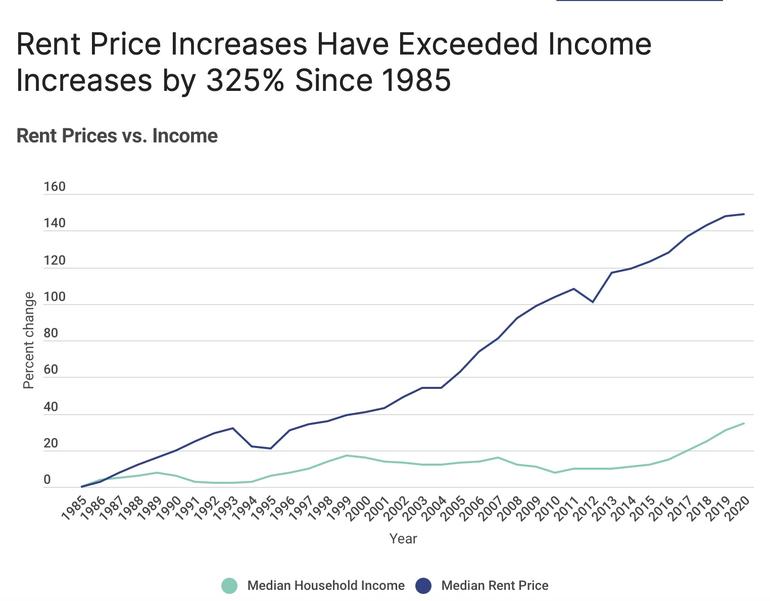
Meanwhile, the report notes, income growth has not been keeping pace with rising rent prices, and 58% of renters are currently living paycheck to paycheck.
To determine how the economic shifts have been affecting Americans, Real Estate Witch said it analyzed publicly available data from the U.S. Department of Housing and Urban Development, the Federal Reserve Bank of St. Louis, and the U.S. Census Bureau.
Crisis is ‘Widening’
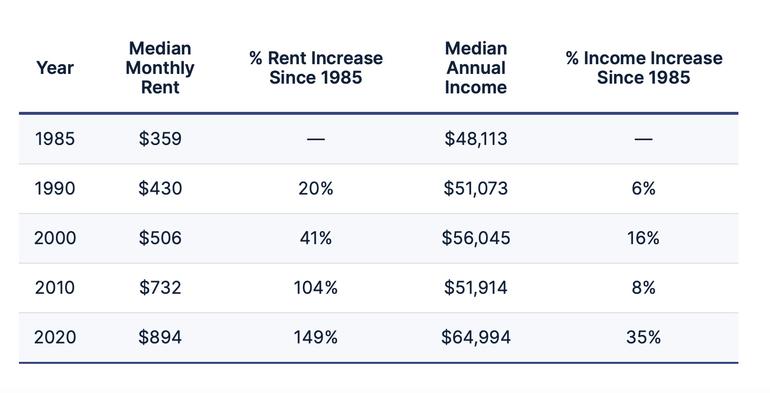
“We found that the affordable housing crisis in the U.S. is widening the growing divide between rent prices and income. From 1985 to 2020, the national median rent price rose 149%, while overall income grew just 35%,” the company said. “With rent rising about 4x faster than income since 1985, Americans are forced to move to cheaper, subpar units or spend significantly more of their earnings on rent.”
The company further noted financial experts advise spending no more than 30% of gross monthly income on housing, but the rent-to-income ratio exceeds that recommendation in 10% of the 50 largest U.S. metros. Furthermore, 92% of those metros have a rent-to-income ratio higher than the national ratio of 17%.
The Findings
Among the findings in the research:
- From 1985 to 2020, rent prices increased 149%, while income grew just 35%. Rent prices have increased about 4x faster than income during that time period.
- If rent prices grew at the same rate as income since 2000, the median rent in 2020 would cost about 34% less — $586 per month instead of $894.
- From 1985 to 2020, the median U.S. rent-to-income ratio nearly doubled from 9% to 17%.
- The rent-to-income ratio is 89% higher for Millennials than it was for Baby Boomers at the same age in 1985. The average Baby Boomer in their 30s earned $48,113 and paid $359 for an apartment in 1985, a 9% rent-to-income ratio, Real Estate Witch stated. The average Millennial in their 30s earned $64,994 in 2020 and paid $894 for a rental unit, a 17% ratio.
- Since 2000, median rent prices have outpaced inflation by 29%.
- Median rent prices grew 90%, while inflation grew 70%.
- From 2000 to 2022, median home prices increased 156% nationwide, while median rent prices increased 90%.
- Rent hikes outpaced home price gains in seven metros: Detroit, Chicago, New Orleans, Birmingham, Ala., Richmond, Va., San Antonio and Nashville.
- Five of the 50 most-populous metros have a rent-to-income ratio higher than the recommended 30%: San Francisco (48%), San Diego (40%), Miami (33%), San Jose, Calif. (32%) and Los Angeles (31%)
- Metros with the lowest rent-to-income ratio include St. Louis (12%), Oklahoma City (13%) and Cincinnati (16%).
For the full report, go here.