

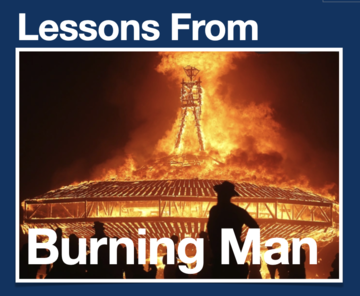
NEW YORK–Credit unions may be surprised to learn they have a lot in common with an arts festival in the desert that for one week becomes a city and concludes with the burning of a giant “man.” But they do, according to one person.
Speaking to day three of Filene’s three-day virtual research event, “Delivering Exponential Growth Through Member-Centered Innovation,” Katherine Chen offered remarks themed, “Plan Your Burn, Burn Your Plan: Lessons from Burning Man about Creativity despite Constraints,” adding there is much credit unions can learn from the event that focuses on community, art, self-expression, and self-reliance, but which is better known for the quirkiness of some of its attendees and attractions, such as a bar for people who walk on stilts.
Chen, professor and chair of the Department of Sociology at The City College of New York, specializes in observing organizations and their activities, and focused her remarks on how credit unions can support cultures of creativity and experimentation by using the Burning Man Festival as her example.
But first, a quick explanation for those unfamiliar with Burning Man, which began as a Labor Day weekend bonfire in San Francisco in 1986, it has now grown to a temporary arts community of almost 80,000 people who come together at in the desert at Nevada’s Black Rock park.
“Burning Man is not a typical festival or concert,” said Chen. “Attendees called ‘participants’ because they must co-create the event,” Chen said.
Chen told the Filene event that there is much to be learned from Burning Man on how groups organize and how can they support creativity.
“Despite Burning Man being an organization of temporary arts communities, it faces many of the same challenges as your organizations, such as attracting and retaining members and motivating members to provide time and energy,” Chen suggested. “It must coordinate with numerous entities, just like you.”
Unstable Responses to Instability
Chen, who has been doing research on Burning Man since 1998, cited how beginning with 9/11, global events have created more uncertainty than in the decades before that tragic event.
“Most organizations are designed to operate with stable conditions and may be less well prepared to deal with the kind of uncertainty we are seeking now,” said Chen. “Organizations now must be prepared to deal with less stabile environments. It’s plan your burn and burn your plan. It’s delusional to think we can return to the conditions in the past. You will want to take note of what kind of condition your organization is in and address this issue.”
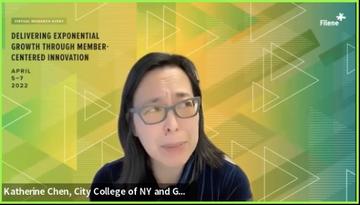
Katherine Chen speaking to Filene event.
Tools are Lacking
According to Chen, many organizations are entering into new markets and lack the capabilities needed to respond. In those cases, she said members often don’t know what to do and don’t have the resources they need, and employees may burnout or withdraw.
She called those types of organizations “under-organized.”
“Organizations can also be over-organized,” Chen explained. “This often happens when organizations have to comply with a lot of regulations, or leaders aren’t ready to give their members the agency to take action. Ideally, you want your organization to be an enabling one. Especially now, people feel more compelled to question what they would have accepted in the past. They might feel dissatisfied about the old ways of doing things and are receptive to change.
“They may be seeking more agency to allow them to take action, including creative actions to address needs that are unanticipated or unaddressed,” Chen continued.
Resolving the Issue
Chen said the best resolution lies in organizational creativity, which she said has traditionally been defined as a “novel and useful practice, process or output” in which people have focused on utility.
“We need to expand this narrow definition that goes beyond emphasizing usefulness in a conventional sense,” Chen said. “We should view creativity as omnipresent and available in all types of organizations.”
The Benefits of Constraints
Chen acknowledged smaller and moderate-size organizations face constraints, which is why they also have no choice but to be more creative.
“They turn so-called worthless items into valued resources,” she said. “Because of their size and need to survive, they may feel pressured or tempted to replicate what bigger organizations are doing and use these as benchmarks. The challenge is how to defend against these pressures.”
Chen said organizers of Burning Man have to “fight off” similar pressures, such as from one person with the IRS who wanted the barter deals that take place at Burning Man reported as income. In response, the Burning Man reps put the tax man in a golf cart and give him a tour and showed him examples of the kinds of things he was proposing to tax, such as naked people playing mini-golf. The tax man gave up the chase.
“Burning Man used its values and practices to help fend off external entities’ demands for certain types of practices,” said Chen.
Rethinking Creativity
Organizations such as credit unions, also need to rethink creativity for different kinds of activities, according to Chen.
“It doesn’t have to be big C creativity,” Chen said. “Instead, creativity is central to all aspects of an organization. Creativity can be in everyday actions. You also need to think about how creativity develops soft sales that build relationships.”
Chen said CU leaders should expand their understanding of what makes for creativity.
“Community and connection is a form of creativity. People can combine in ways that help other people and organizations. Organizations can foster these relationships, for example, by having departments and units that don’t typically work together placed together
The 10 Principles
Chen said Burning man is organized around the following 10 principles:
- Radical Inclusion
- Gifting
- Demomodification
- Radical Self-Reliance
- Communal Effort
- Civic Responsibility
- Leaving No Trace
- Participation
- Immediacy
How does Burning Man communicate principles? Chen said that instead of making lots of rules or creating a huge rulebook, as many leaders do, the organizers of Burning Man illustrate the principles through storytelling.
“It helps people imagine what they can do. People like to join in on activities that are meaningful. Laboring together deepens relationships. Sometimes a story is just about listening and being present for other people. I think that a lot of members are facing this.”
The Challenge of Creativity
Chen quoted Burning Man organizer Michael Mikel as saying that when it comes to the organizing challenges of creativity, “Our event is just on the edge of chaos sometimes. With that, there is a tremendous amount of creativity and a tremendous amount of freedom, but we as organizers try not to be overbearing in our control period we try to give people as much freedom (as possible).”
Burning Man, said Chen, practices “duocracy,” which is defined as “a relationship of function which deconstructs into a duality of momentum.”
“(Participants) can take their own actions, which is a form of decision making. It’s not dictated from above. Oftentimes, this types of decentralization means leaders have to support their staff and believe in them. The danger is leaders want to know if they need to take a heavier hand. Burning Man encourages experimentation.”
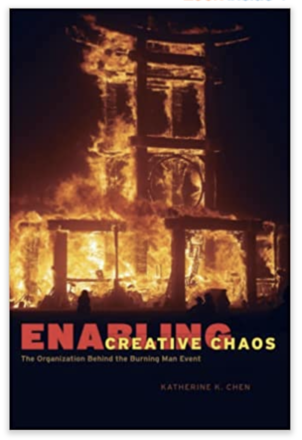
Chen said leaders must be prepared to stop employee burnout, which she said the pandemic has made very clear. “Leaders would stop people from working and not allow them to return until after they have had a rest,” said Chen, who is the author of “Enabling Creative Chaos: The Organization Behind the Burning Man Event.”
Other Takeaways
Other takeaways from Burning Man that Chen said would benefit credit union leaders:
- “Burning Man tries to train people for unexpected events, rather than protect them from them.”
- “A lot of Burning Man is about creating connections with people. Relationships are important for helping people move to the next step. Customers are often-time overwhelmed and paralyzed by the choices to the point they resist. What we find is they just need someone, usually a front-line marketer or a professional, to usher them through that process. This is about the acts that build trust.”
- “If your organizations employ people who will listen, this is how you identify new markets and niches.”