

SAVANNAH, Ga.–The gender wage gap very much remains a “persistent problem,” according to one expert, who offered credit unions here some deeper insights into the issue as well as some ideas for helping to close that gap.
Dr. Beth A. Livingston, the Ralph L. Sheets associate professor of industrial relations at the University of Iowa’s Tippie College of Business, began her remarks by polling her audience at the CUES’ TalentNEXT meeting here for how much women earn vs. men for the same jobs. When audience members responded with “77 cents on the dollar” and “82 cents on the dollar,” she said both were right, as data around the issue depends on which metrics are used.
As an example, she shared the graphics below.
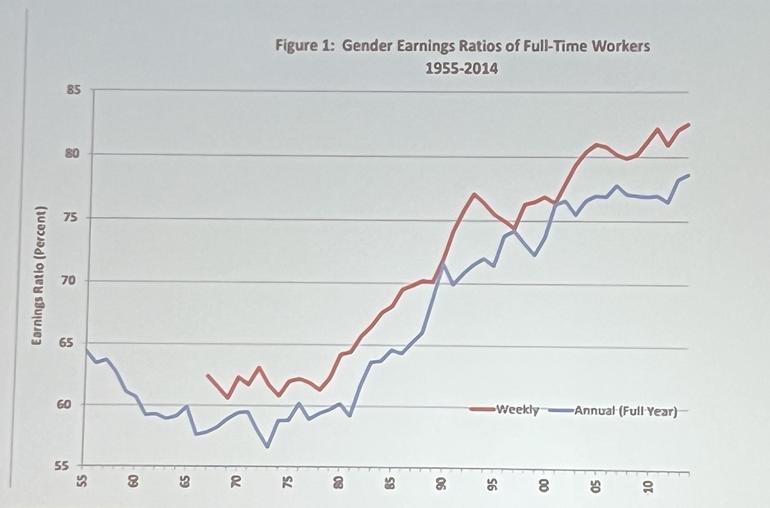
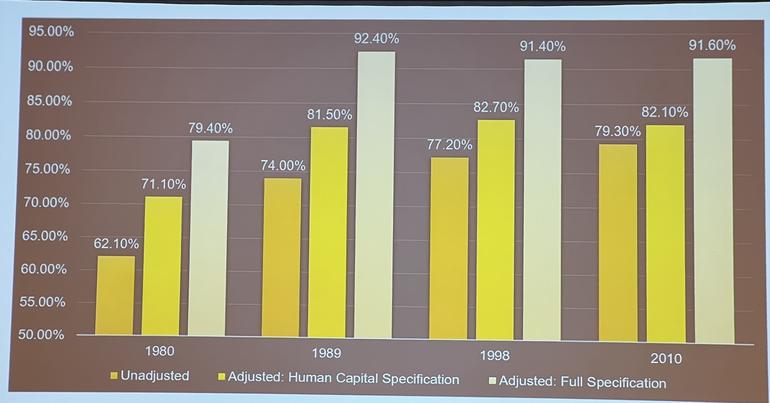
“Explanations of gaps are shifting over time,” said Livingston. “That means it is incumbent upon us to look across our organizations at what might be contributing to pay inequity.”
In 1980, for instance, men had more education than women, but now, women on average are more educated, and yet the pay gap has widened. Experience is also a driver as are unionization, race, industry and occupation, when it comes to the wage gap she said.
In addition, one-third of the gap today is the result of the fact men and women tend to be sorted into different occupations, raising new questions around what is “equal work” when the issue of “equal pay” is discussed, she said.
Women used to be told to get more education and experience in order to close the gap, Livingston noted. But that hasn’t been the case. Today, women are being told to move into new occupations, and yet she predicted 30 years from now the data will show that also didn’t close the gap.
Personality Traits
Meanwhile, another factor in the gap is personality traits, but that data is also fluid and open to interpretation, she said, noting that “Traits may explain between 3%-16.2% of the gap between men and women’s wages.”
Self-esteem, competitiveness, willingness to take risk, and values all also contribute to the wage gap in some ways, said Livingstone.
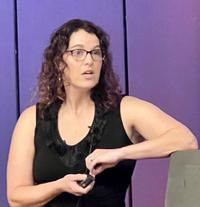
Dr. Beth A. Livingston
Economics Plus Psychology: Gender Roles
The gender gap only gets more “complex” from there, as Livingston explained.
For example, “(Researchers) found a gender wage gap among men in terms of their attitudes and whether they were more egalitarian or more traditional in their views.”
When men are more humble, agreeable and nicer, they get paid a lot less than those who are more aggressive, she said, but the same isn’t true of women. In fact, it’s the opposite.
How Perceptions Play Out
Perceptions and bias around men and women play out in many ways, as Livingston illustrated with numerous examples. She noted, for instance, that men who are college graduates and who have A-equivalent GPAs are way more likely to get called back for job interviews than women with similar grades.
“When we think about women as being competent we also often think of them as being cold,” said Livingston.
When a female isn’t known to an organization, such as a job candidate, hiring execs may resort to a bias when it comes to high-achieving candidates that “maybe she’s a bit too big for her britches,” she added.
Another example: “Women with children get paid less, while men with children tend to get paid more. A bias here is often that women with kids are seen as working for extra money, while men are seen as supporting a family,” Livingston said. “This has never been the case in the United States. Women have always worked to support their families, but that kind of tradition has continued and permeated. Men who make it to executive positions often have stay-at-home wives, which makes it more difficult (for them) to understand a different perspective.”
Appraising Job Appraisals
Meanwhile, with many in the audience indicating their credit unions do have narrative sections in their performance appraisals, Livingston said such views can be “very dangerous.” For example, she noted 100% of the time the word “abrasive” was used to describe women, the research shows. Such “gender labels” are frequently used in such appraisals, she added.
Closing the Gap
Livingston noted there are efforts around the U.S. and the world to close that gap. In the E.U., for example, 85% of employers address pay equity directly, vs. 63% in the U.S.
In the E.U. laws have also been enacted or introduced related to gap reporting at a company-wide level, including pay transparency. In the U.S., those efforts have been primarily in California.
“People freak out about pay transparency, but it actually doesn’t have as many negative effects as you would think,” said Livingston. “Employers are uncomfortable with it, but employees don’t react poorly to it. Typically, it produces more equity and doesn’t decrease employee satisfaction. We’re not seeing the huge backlash we thought we would see.”
Overall, said Livingston, thelaw can be a leading or a lagging indicator. “Businesses can always do more. We’ve come a long way, but we still have a long way to go.”
Not an Objective Datapoint
Returning to her opening remarks, Livingston reminded that the gender wage gap is not some objective piece of data. Instead, it depends on what is being measured and on numerous inputs.
“Gather data and learn how to understand it,” she advised. “Don’t be afraid to run cross tabs. I know organizations are reluctant to do that because they loathe what they find. But if you find something out and fix it, employees tend to be more satisfied, as opposed to them finding out through the whisper network. Young people especially will share their pay. If you have a culture where that is taboo, be careful.”
Preventing Gender Bias: Thoughts to Consider
When it comes to preventing gender bias in pay, Livingston urged credit unions to ask themselves the following:
- How do you match performance goals to rewards.
- How do you make sure your values/vision matches your actual strategy?
- How does bias seep into strategic decision-making around rewards and how can you prevent it.