

WASHINGTON–CUNA’s chief operating officer and chief of staff, Rich Meade, is leaving the trade association. Meade joined CUNA in 2014 along with Jim Nussle when he was named president/CEO. Meade had worked as a senior aide to Nussle while he was in the House of Representatives representing Iowa. Below, Meade shares his thoughts with CUToday.info:
CUToday.info: Jim Nussle has acknowledged his own lack of familiarity with credit unions prior to joining CUNA, including while in Congress. What was your level of familiarity when you joined CUNA, and how did you go about best getting up to speed on a pretty diverse credit union community?
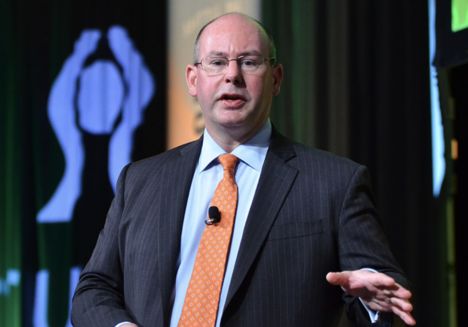
Rich Meade speaks to credit unions earlier this year.
Meade: Jim and I had the same experience with credit unions in Congress. We were credit union members and were lobbied by CUNA and the Iowa League when I worked with him on Capitol Hill. I did not appreciate the diverse and complex credit union system. The best way for me to get up to speed was to tap into the rich history of so many of my colleagues at CUNA. There are many at CUNA who were helpful, but I want to thank Jill Tomalin in particular for her efforts to guide me during my journey. I also reached out to a number of league presidents to tap into their experiences and perspectives. I enjoyed meeting with (Wisconsin CUL CEO) Brett Thompson when I was in Madison and taking in a baseball game with (Cornerstone CUL CEO) Dick Ensweiler to help me try and get up to speed. I also learned a lot talking to various credit union leaders, including those who I’ve had the opportunity to work with on the CUNA board of directors as well as Benson Porter, Tom Dorety, Dave Mooney, and Tim Anderson, just to name a few.
CUToday.info: Since joining CUNA, you’ve been involved in the management reorganization within the trade association. What do you believe a fresh set of eyes brought to CUNA and its management structure, where did you see deficiencies, and what have you sought to achieve?
Meade: One of the things that I brought to the table when I arrived at CUNA was familiarity with trade associations and how they are organized. A majority of my clients at my old firm were trade associations, which allowed me to tap into best practices from other industry associations as we reorganized CUNA. Our goals in our reorganization were to gain efficiencies, breakdown silos, improve communications, and be more responsive to our members. We have made a lot of progress in each of those areas. Of course, there is always room improvements, and I know Jim and his leadership team will constantly seek to enhance and grow CUNA’s operations.
CUToday.info: You have a strong familiarity with Capitol Hill: there has been some frustration within CUs over the lack of any real progress on CU issues within Congress. Is that legitimate, what have the roadblocks been, and what are your thoughts on what’s ahead with the new Congress?
Meade: Credit unions most certainly are not alone in their frustration with Washington and Congress’s inability to move legislation. There are plenty of other industries in the same boat. The roadblock for credit unions recently has been the dysfunction of divided government and the hyper-partisanship that seems to have permeated this entire town. Having said that, if credit unions want to increase the volume of their voice on Capitol Hill there are some things they must do. First, credit unions need to talk about their issues in the voice of their members and advocate for policies that can help their members. Second, credit unions must engage their members on public policy goals and try to activate an army of credit union members who can help motivate Congress to advance the credit union agenda. Our power comes from our 100-million members – they need to be informed and engaged to activate on grassroots. I hope they will consider utilizing CUNA’s MAP tool to do that.
CUToday.info:You have been leading the effort at CUNA on the blockchain technology platform? For those unfamiliar, why is this important, where does the effort stand, and what’s ahead.
Meade: Blockchain technology presents an interesting opportunity for credit unions. This technology has been compared to the introduction of email and the internet to businesses. If you think about the evolution of the internet, the first generation was the internet of information.
The next generation, which we are in now, is referred to the internet of things. Blockchain represents the internet of value. That is why CUNA has partnered with the Mountain West Credit Union Association to launch the CULedger project which is a proof of concept of a permissioned credit union shared ledger. We hope we can prove that credit unions can create a network that is of sufficient scale and enhances security. If we are able to do that, we think we demonstrate to credit unions a path forward to use the blockchain technology to create a network where many possible applications can be used to increase the efficiency and speed of transactions at credit unions.
There are many possible use cases that are being explored using this technology but there seems to be the most promise among member identity, titling, and indirect lending. We hope to make a full report on the CULedger proof of concept project this spring.
CUToday.info: Two years later, how do you assess the credit union community, where do you see potential threats (including outside of regulation/Congress), and what do you take with you from the experience?
Meade: I am very optimistic about the future of the credit union movement. I am excited to see a renewed commitment between CUNA and the leagues to serve credit unions in such a collaborative way and to see continued growth in credit union assets and membership. I am also excited about the opportunities credit unions have to talk about the credit union difference to help increase awareness of the movement.
There are also challenges ahead. I think one of the biggest issues facing credit unions today is advancements in technologies, which is one reason why CULedger is so vital. If credit unions can develop their own network on their own terms and not have that dictated to them, it will be very powerful. And who better to come together to form a collaborative effort than credit unions? Look at the seven cooperative principles, including cooperation among cooperatives. Credit unions can do this again because they have done this before: Credit unions built CUNA Mutual, CO-OP and its ATM network, and the shared branches network.
I have had a great time over the past two years at CUNA and feel very fortunate to have had the chance to work with so many great people on so many meaningful projects. As a credit union member, I am looking forward to what the future will bring.