

WASHINGTON–According to Carmine Gallo, in one short sentence, former Supreme Court Justice Ruther Bader Ginsberg taught one of her law clerks the secret to strong writing. Ginsburg's advice: "Never use four words when three will do."
Writing on Inc.com, Gallo, a keynote speaker and author of “Five Starts: The Communication Secrets to Get From Good to Great,” quoted UC Berkeley law professor Amanda Taylor as saying Ginsburg was a precise editor. Although Tyler worked for Ginsburg in 1999, the two kept in touch.
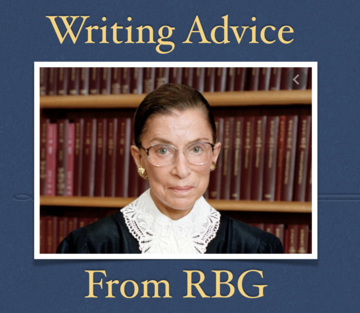
"She was still teaching me about the craft of writing--how important precision is," Tyler was quoted as saying. "Every word had to count."
Gallo shared these three strategies she said made Ginsberg a great writer:
Set Up Constraints
Writing will fill the space it's given, noted Gallo, explaining attorneys are given 50 pages for their opening briefs at the U.S. Supreme Court.
"It's not necessary to fill the space allotted," Ginsburg was quoted as saying. "In some cases, it can be said in 20 pages."
Gallo said constraints will improve your writing. “The classic example is Abraham Lincoln's speech at Gettysburg. At 272 words, the Gettysburg Address took Lincoln just two or three minutes to deliver--with interruptions for applause. A newspaper reporter who covered the speech revealed that Lincoln had worked on the speech for weeks, because writing a short speech is harder than writing a long one.”
Gallo urged writers to remember that most presentations start with the written word. “Impose limits on how much you write. There's a reason why all TED Talks are limited to 18 minutes. By placing a time limit on each speaker, the presentation is clearer and more compelling,” Gallo said.
Start Writing and Edit Ruthlessly
Start writing. You can edit later, Gallo said.
“I've written 10 books. The original drafts of my books have 90,000 words or more. The final manuscript must be cut to 70,000 words,” said Gallo. “Eliminating extraneous information or unnecessary words is easier than adding. That's why it's important to just start writing.”
After the writing comes the editing, said Gallo.
“Editing comes next. In 1914, British author Arthur Quiller-Couch used a phrase that almost every writer knows today: ‘Murder your darlings.’ He meant that good writing requires ruthless editing,” said Gallo.
Read It Out Loud
Ruth Bader Ginsburg would often read her opinions out loud to make sure her words sounded clear and compelling. She called it the "read aloud" test, according to Gallo.
“Reading your words aloud is a good tip. If you run out of breath when reading your sentences, they're probably too long,” wrote Gallo. “In business writing, most sentences should be short and declarative. Most sentences that contain more than 25 words are hard to read and difficult to digest, and so it's best to keep each sentence to 15 words or less to help the reader.
The previous sentence contains 33 words, several clauses, and unnecessary words.
“Let's try it again. This time I'll break the sentence into two and delete several words,” continued Gallo. “Sentences with more than 25 words are hard to digest. Keep your sentences to 15 words or less. The two sentences are easier to read because I reduced the word count by 45%. Good writing is hard, but it's a skill worth building.”