

FARMINGTON, Utah–America First Credit Union recently held its 3rd Annual Pumpkin Carve at Station Park here, where VP-Marketing Zach Winegar meticulously carved the largest pumpkin ever grown in the state of Utah, weighing in at 1,974 pounds.
The record-breaking pumpkin was cultivated by Matt McConkie from Mountain Green, Utah.
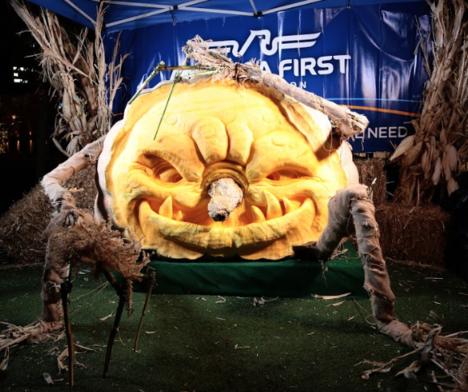
What does it take to carve a nearly two-ton pumpkin? How does one develop pumpkin-carving skills? Below, Mr. Winegar shares his responses to those questions and others as posed by CUToday.info.
CUToday.info: How did you come to be involved in pumpkin-carving and develop your skills?
Winegar: I have two friends and neighbors, Tyler Quigley and Matt McConkie, who are part of the Utah Giant Pumpkin Growers Association, and grow Atlantic Giant Pumpkins. I became involved in carving with them back in 2011 when Tyler Quigley asked me to carve a 994-pound pumpkin that he had grown. He had it on display at the local elementary school, and thought it might be fun to have the school mascot, an eagle, sculpted into the side. I had never done anything like that before, but decided to give it a shot. It turned out okay, and I’ve been sculpting one of their giant pumpkins almost every year since then.
CUToday.info: How many of these giant pumpkins have you sculpted, and how has your artistry evolved?
Winegar: As you can imagine, giant pumpkins are hard to come by. The growers I work with usually start four pumpkins, and are lucky if they get two of them all the way to the harvest time. There are many things that can go wrong during the growth process and they take a tremendous amount of time and care to help them reach their weight potential. I usually carve one giant pumpkin a year, because that’s all I can get ahold of, and because it’s all my arm can handle! These giants have taken me anywhere from seven to 12 hours to sculpt. This year’s giant pumpkin was the sixth one I’ve ever carved. It was a new Utah state record at 1,974 pounds - just shy of one ton - and took me about 10 hours to sculpt. I do feel like my skills are improving each year as I gain more experience. I feel a little more confident with each opportunity that we’ll manage to create something fun for people to see.
CUToday.info: What is different about carving a nearly one-ton pumpkin vs. the average store-bought pumpkin? (And what happens if you make a mistake?)
Winegar: The best part about carving giant pumpkins is that their walls are so thick. There’s a lot of material to work with so you can obtain a good deal of depth without poking through to the inside. Giant pumpkins do also pose a few challenges. First, is obviously their size. It’s a lot of surface to carve, and the outside skin can be pretty firm. They can also be challenging to transport and set up. Second, they always grow on their side, so the stem is never at the top of the pumpkin. When they’re a little smaller, you can sometimes stand them upright, but you usually have to carve the pumpkin while it’s laying on its side. Third, their shape is unpredictable and often times very odd. They can also have very deep ribs which can create an uneven surface and limit what you are able to carve.

Zach Winegar
I usually have to go “meet” the pumpkin and see what kind of challenges or opportunities are going to influence the sculpture - it’s never truly a blank canvas. One year, I could literally see a dragon shape in the pumpkin, so that’s what I went with. This year, we had a giant stem to deal with, so I decided to utilize it as a nose. You really have to figure out what the pumpkin is supposed to become. There will always be mistakes as you work through the carve, you just have to hope there’s enough pumpkin wall to take things a little deeper, or you have to make the best of it and adapt your vision.
CUToday.info: What type of tools do you use and any advice for other would-be one-ton pumpkin carvers in the credit union community?
Winegar: I primarily utilize traditional clay sculpting tools called “ribbon cutters” to carve my giant pumpkins. The ribbon cutters almost feel like vegetable peelers as you scrape and pull off little strips of pumpkin with each pass. I’ve never used power tools because I’m afraid they’ll go too deep, too quickly. Once you’ve poked through the wall of the pumpkin, there’s no going back. I’ve found that the gradual process of removing pumpkin with ribbon cutters takes a long time, but it allows you stay in control of your options.
I think the best advice for would-be-carvers is to relax, be patient, and enjoy the process. I think you also have to understand that your first attempts might turn our horrible, and that’s OK. Let’s face it; there aren’t many places out there to learn the art of pumpkin carving, so you have to be willing to experiment and work through mistakes as you build your experience and confidence.
CUToday.info: How long has America First been involved in this spectacle and can you tell us more about it?
Winegar: America First Credit Union has been sponsoring the annual giant pumpkin carve for the past three years. We work to secure a location with great visibility so our members and the community can come and watch the process. We also get really involved with our members on our social media platforms by holding a pumpkin carving contest where members can post their creations and vote on their favorites. Finally, we create and post photos and a time-lapse video of the giant pumpkin sculpting process right before Halloween so our members and followers can watch the process unfold. Our members are beginning to anticipate it every year now. Our first pumpkin carve video received around 6,000 views, and so far, this year’s video has received over 30,000 views on Facebook alone. In the end, it’s the photos, video, and interactions with our members that survive as the pumpkin is an organic, temporary object that will be gone about a week after it’s carved.