

With so many people new to working from home, one veteran of that work environment is offering six tips to help make it “awesome.
Writing on Forbes.com, Doug Aamoth said that while many have unwillingly found themselves out of the office, “I’m here to tell you that the WFH life is not so bad. In fact, it can be downright great.”
Aamoth, who said he has spent 80% of his working career working remotely, said one key is to be big key is to be comfortable, as it makes one more productive. But beyond that, he also offered these six tips to improve the work-from-home experience.
Figure Out How You Want to Work
“If you play your cards right, you don’t need to work like you’ve been used to working your whole life. It’s OK to keep working that way, but ask yourself: Do I want to stick to a structured block of time—say 8 a.m. to 5 p.m. each day? Or do I want to condense my work?” observed Aamoth. “Removing your commute, an hour for lunch, and the idle chit-chat that would normally fill your day in the office, you might find that you can actually get your work done in five or six hours thanks to fewer distractions, shorter breaks, and a greater ability to focus. Make yourself available for meetings during regular hours, but then look for ways to work outside the confines of a nine-to-five if it means that you’ll produce better work. It benefits you, and it benefits your company.”
For those who prefer a more standard schedule, Aamoth suggested using time that would eat up a morning commute, for example on professional development, instead.
“And then when it’s time to call it quits for the day, use the evening noncommute to wind down. Annoying as it might be, the conventional commute home actually helps you decompress from the workday and shift into nonwork mode. So read. Play some video games. Listen to a podcast. Tidy up. Stop working, but don’t leave your workspace and jump directly into domestic life right away.”
Earning Trust Isn’t Rocket Science
Aamoth noted the virus has forced many employers to be far more trusting than perhaps they generally are.
“And under normal circumstances, it’s one of the biggest stigmas of remote work: The fear that you’re just going to sit on the couch watching TV all day. If you’re working for someone who isn’t completely comfortable with overseeing off-site workers, see if you can structure your actual job so that it builds trust on its own,” he wrote. “One easy way to do that is to deal in deliverables if you can.
Aamoth said his company also has a task list (the company uses Asana) that’s viewable by anyone in the company and includes the current status for each project. “Whatever your job entails, see if there are additional ways you can provide transparent tracking of your projects.”
Customization is King
While for many working from home is just a temporary situation, Aamoth said for him the “single greatest part about working from home is being able to set my office up exactly how I want it. If your company will foot the bill for some new gear while you’re working remotely, great. And if you’re thinking of making a case for working from home more often, calculate how much you’ll save by not commuting and don’t be afraid to spend a bit of what you’ll pocket to create an inviting workspace. I’ve done it relatively inexpensively.”
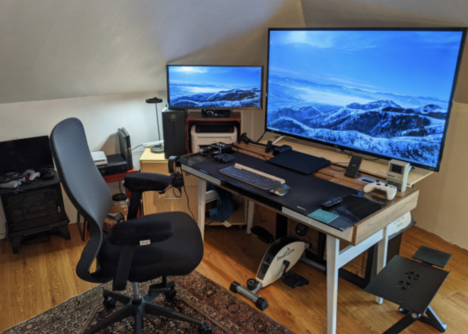
The author's at-home workspace.
Aamoth has a 55-inch 4K smart TV as his main monitor that he got for between $300 and $400 that he said allows him to have multiple windows open at once without having to constantly switch back and forth between them. Since it’s a smart TV, he also uses it for nonwork stuff as well, such as streaming video and playing video games. “My workspace is half office, half lounge,” he said.
“’d also recommend an ultrawide monitor for around $200. I use both a big TV and an ultrawide monitor: the TV is for working on stuff, while the ultrawide is for email, Microsoft Teams, and general communication with coworkers,” he continued. “The extra horizontal workspace you get with an ultrawide monitor is great no matter what you do for a living and doesn’t cost all that much more than a regular skinny monitor.
“Don’t forget about the little things too. Buy the best mouse, keyboard, and headset you can get: They’re your work weapons. Pay for the strongest internet connection you can afford: Don’t ruin a video chat because your kids are streaming Netflix.
And for the love of all things pure and good in this world, do not—under any circumstances— skimp on your office chair. You don’t have to spend a fortune…”
Blurred Work-Life Lines are ‘Bogus’
Aamoth said another common fear about working from home is that it can never be shut off.
“This problem—if you want to call it a problem—is more a reflection on the environment fostered by your company than anything else. Look around the office and watch how many people stuff their laptops into their bags so they can do work after hours at home. It’s the 21st century, and we can work from anywhere,” he wrote. “If you feel like acting upon an email late at night, then go ahead. If not, let it wait until morning, assuming there’s no expectation that you respond right away Conversely, sometimes it’s awesome to have a proper work setup mere steps from the couch so that you’re able to turn things around quickly during off-hours. Maybe, like me, you’re more creative at 10 p.m. than 10 a.m., so it’s nice to be able to do your best work at odd times.”
Multi-tasking is Real, and It’s Fabulous
According to Aamoth, one of the most noticeable side effects of working from home is that you’ll feel less like you’re trying to cram a million things into each day. “Do take this time, however temporary, to get things done that you wouldn’t be able to get done while in the office. Don’t not work, of course: Just look for ways to maximize the benefits of having most of your belongings in your general vicinity at all times,”
For example, Aamoth has a recumbent bike that sits under his desk to help burn calories.
There are No More ‘Sunday Sickies’
Aamoth recalled that once, during one era of his career when he commuted to an office, he was sitting around with a group of friends who also commuted.
“It was late on a beautiful Sunday afternoon when one of them asked, ‘Do you guys ever get a weird feeling in your stomach on Sunday night? Like, you know you have to go back to work tomorrow, but you don’t want to go into the office?’ We all agreed that, yes, we had this feeling. As a result, the term ‘Sunday Sickies’ was born.”
Aamoth said when he shifted to remote work that feeling went away.
“It wasn’t that I didn’t like my job. I just hated commuting, and I never felt comfortable in the office once I got there. Almost overnight, I felt more energized, I did better work, and I was generally much, much happier,” he said.