

CHICAGO—As credit unions grow, especially as the result of mergers, it’s becoming increasingly important to manage growing numbers of employees. But the idea that “management” is just an HR function is a “myth,” according to several people.
Credit unions and financial institutions need to recognize that there is a next generation of workflow management that includes not just software solutions, but requires new thinking if the next generation of both consumers and employees are to be adequately served.
James Cook, industry principal with Kronos, Inc., stressed that workforce management is often mistakenly thought of as also meaning human capital management.
“That’s a myth,” said Cook. “Everyone thinks time tracking is the responsibility of HR. That model is wrong and needs to be changed.”
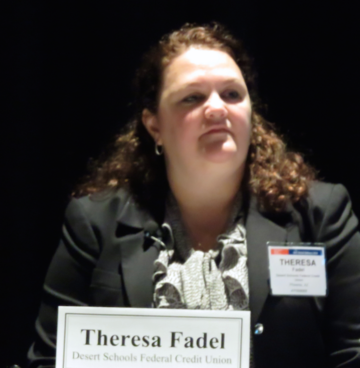
Theresa Fadel of Desert Schools FCU speaking at BAI RDS in Chicago.
There is a wide variety of sophistication within credit unions when it comes to staffing, ranging from expensive vendor solutions to simpler Excel spreadsheets to even pieces of paper. While that often depends on asset size, what every organization needs to understand, said Cook, is that managing a group of employees is about more than just scheduling and involves divisions between HR, Operations, and Workforce Management.
“HR owns organization strategy, hiring and benefits, compensation and payroll, performance management, succession, time polices, and attendance polices,” said Cook. “Operations owns compensation optimization, performance measurement, skills development, time tracking, overtime management, attendance tracking and compliance, and schedule-to-demand compliance. Workforce management owns workforce optimization strategy, demand forecasting, schedule-to-demand, skill-based scheduling, schedule development, and metrics management.”
What workforce management is all about, said Cook, is optimizing skills of various employees to their fullest—including the times thos employees are available, and where.
“Workforce management can easily be isolated from human capital management,” said Cook during remarks at BAI’s Retail Delivery Show here. “There are plenty of solutions to choose from. But don’t combine those two. You will stop your workforce management solution from working.”
Noting that “none of this is important if you don’t tie the solution to value,” Cook said the ROI can be found in solutions that should provide about a 1% savings in the HR budget, a 2%-3% value in operations in terms of payroll leakage, time/overtime management and more, and a 4%-6% savings in workforce management, which includes scheduling-to-demand, employee self-service, process optimization, and more. With the latter, Cook recommended bringing in a consultant.
Cook, who moderated the discussion at BAI, was joined on a panel by Theresa Fadel, AVP-operations at Desert Schools FCU in Phoenix, and Jay Dreibelbis, COO with Woodforest National Bank. Cook posed these questions:
Q: Do you see WFM breaking away from the HR suite and being driven more by operations?
Dreibelbis: HR used to be in operations. We only came to an HR suite and a formalized HR program to take care of this six or seven years ago. And we have spent the last five years moving those things out of the HR suite and back into operations. We have 5,000 employees across multiple states, so driving the actual management of employees on a day-to-day basis works better with scheduling through operations. We have kept the legal stuff in HR.
Q: What’s the value you expect from WFM initiatives?
Dreibelbis: Employee expense is our largest individual expense. Happy employees make great employees. They want a perfect paycheck.
Fadel: Ours is in combining the time card with the scheduling system. For a few years we had disparate systems and we had a hard time extracting data to see if the schedules that were recommended were actually adhered to. Now we can see what was scheduled and what has actually worked.
Dreibelbis: We tried two or three minor scheduling pilots, and they took more time than the Excel spread sheets or ouija boards or whatever they were using that are actually more effective. We already have customer data on transaction volumes, etc. Year over year we’re seeing increased customer visits, increased contact with members. We think long term if we’re going to maximize utilization of our customer base we’re going to have to take that big data and maximize efficiencies.
Q: What do you see as the biggest challenges for banks in aligning workforce with the branch of the future?
Dreibelbis: Flexible scheduling. We have a lot of mobile-environment people, young people, people with young families, people who want a flexible schedule but also want to know about it in advance. We’re also trying to provide the customer support when people want it, which is now and immediately. We need to schedule the right number of people to maintain the quality of customer feedback.
Fadel: As members’ expectations continue to evolve, it’s about meeting them. It’s about having that expert available when the member walks in. We want to make sure we’re hiring the right people and staff who can handle change. I think change management is huge.
Q: What about investments in mobile and tablet and how does it apply to WFM?
Fadel: We’ve talked a lot about the member’s experience and what they are wanting, and I think we often overlook our employees and how important they are to the organization, and they are wanting and expecting the same things. For years we were sending out the schedule as a Excel spreadsheet, for instance. They want to be able to make requests now, to change schedules. We’re putting vacation requests right into the same mobile system.
Dreibelbis: We don’t have a system in place like that. We’ve been very focused on tablet and mobile tech for our customers, but not on the employee side. We looked at them, but didn’t feel the controls were robust enough to manage the types of demands we have, such as an office in a Walmart location. We want to get our customer delivery opportunities maximized first.