

SAN DIEGO– Credit unions that have plan to grow and move forward will need to practice “creative confidence.”
That’s according to Tom Kelley, partner with the consulting firm IDEO, which has worked to help numerous brands around the world to drive growth, often by tapping internal talent that had been going untapped. Kelley has also helped IDEO as it has grown from a staff of 20 to more than 600 today.
IDEO’s core philosophy, according to Kelley: You don’t have to be a genius to have a great idea, and companies that encourage this creativity, will excel.
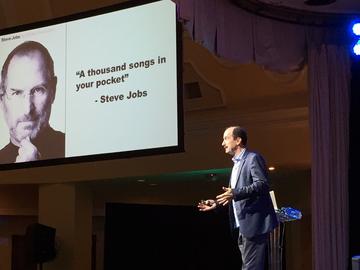
Tom Kelley speaking to CO-OP THINK 16 meeting.
Kelley shared his own ideas and insights on creative confidence—he is the author of a book of the same name, along with two others—during CO-OP’s THINK 16 Conference here.
Kelley said creative confidence comes in two parts, each in almost equal measures:
- It is the natural human ability to come up with a fresh idea, and everybody has can do it. “We do not have to bestow creativity on anybody. Our job is to unlock it, to unleash it.”
- The courage to act. “We have discovered this is equally important. When I was interviewing people on this topic, especially young people or people low on the organizational chart, they said they would be in a meeting and will have an idea for meeting a tough challenge, and they will start to raise their hand and then they will stop. They believe if I raise my hand people might think I’m different. If I raise my hand, people might make fun of me or I might attract attention of that devil’s advocate person. In short, they might damage their career, so they don’t raise their hand. We as organization, as a nation, need all the ideas we can find.”
What 'State of Create' Survey Revealed
Kelley said that creativity, which was until recently shunted off to the marketing department to take a back seat to data, has now emerged to become the “heart” of the business world.
“We like data to support our points of view, so I was very pleased when Adobe Systems conducted a survey of 5,000 people across five countries called the ‘State of Create Survey.’ The first question was bout centrality: Is creativity still off at the kids’ table?, and the answer was clear: 80% said unlocking creativity was critical to economic growth. The next question is a lot harder: Do you have a chance to live up to your creative potential? Do you have a chance to bring your whole self to work? Sadly, only 25% of people said ‘yes’ to that. That is really scary. In a world of scarce resources, shame on us for letting this resource go wasted.”
Kelley observed that many people will say they are just not creative, but he believes that everyone had the capacity to do so. He urged everyone to find those moments when they are most creative, such as in the shower (no e-mail).
“When you’re in a mode to take advantage of that time, protect that time. It’s not daydreaming, it’s when you are at your creative best, and then use some capture mechanism,” said Kelley. “It’s not about being magically creative. It’s about capturing the yield of your current creativity. Short-term memory gives you 30 to 60 seconds to capture and save it. And anybody can do that.”
At IDEO, Kelley said the company approaches all challenges with the question that begins, “How might we…?”
“In this case, it might be, ‘How might we unlock the potential of the other 75%?’ Think about that. That is a source of very long-term, sustainable competitive advantage if we can find a way to do that. My wish for you and for everyone on your team is that sense in your head that ‘I am the kind of person who can make progress’ on this challenge you are facing.”
IDEO, which is all about what’s known as Design Thinking,” is based on a three-legged stool, or what Kelley called the “tools of the designer”: Empathy, Experiments, and Storytelling.
Empathy
“Always start with empathy,” said Kelley. “We have really based our firm based on this principal. But I am not talking about empathy in its purest form. For you, as a practical matter, it might mean blending technology with humanity, or it might mean thinking more deeply about members or team members.”
As an example Kelley shared the story of how an executive in GE’s medical instruments division thought he and his team were doing great work with the developments in medical scanners. But then, while visiting a hospital, he discovered the machines badly frightened children. Using a budget of zero and the input from volunteers from multiple organizations, that executive led an effort to create “skins” for the machines that made them appear like pirate ships and other fun activities, so that children were no longer frightened. One result was a steep decrease in the number of children who needed anesthesia prior to entering a scanner.
“Where can we add that humanity into our business?” asked Kelley. “You can observe and ask questions and your members will not give it up right away. Empathy happens face to face and goes beyond the first level of data. We love to get data at our desk. You have to keep your eyes wide open.”
Experiments
Kelley urged credit unions to “treat life as an experiment.”
“We don’t like the F-word, failure,” said Kelley. “If you’re going to do more experiments, it’s not OK to go to your boss and say ‘I’m going to do 5,000 experiments.’ You have to find ways to do your experiments faster and cheaper than others do.”
And when there is pushback, Kelley advised, “When people don’t embrace your idea, you need to paint a picture of the future with your idea in it.”
And when there is acceptance? “If you can get to ‘yes’ in an hour, don’t spend that second hour, and for God’s sake don’t spend a day. You want to be the fastest, cheaper proto-typer in your organization. Think how many ideas you could float out into the world.”
Storytelling
Kelley said he could feel the skepticism in the room on the subject of storytelling, and he recommended to credit unions that they read the book “Made to Stick.” That book outlines the steps to telling stories effectively, beginning with the acknowledgement that “simple is the hard part, because you know too much about your subject.”
“So think about your world,” urged Kelley. “You have the technology and it continues to evolve, but what is the story that takes your overall message and brings that story to life.”