

NEEDHAM, Mass.—One credit union CEO says it’s hard to argue against the benefits of a low-overhead, almost virtual operation, as his own CU demonstrates, posting asset growth of 12% in 2015. It’s seeking to increase that figure to 15% this year.
“We have a very specific business model, I know it is not unique, but it is atypical in the credit union industry,” said Joe Walsh, CEO of Direct FCU. “We are $500 million in assets and we do that with one branch and less than 60 employees. Our bricks-and-mortar and staff infrastructure is small. Our operating expense ratio is 2.5%, which we will get back down to 2% or below in the next four years.”
Contrary to what some might think, that kind of cost discipline is being credited for helping Direct Federal to grow its assets from $411 million in 2015.
“Because our operating expenses are so low we are able to beat the market on virtually every product we choose to offer, whether it be a first mortgage, home equity or an indirect auto loan,” said Walsh. “Our deposit rates are great, which allows us to raise the money we need to make all the loans.”
1.5% CD
Direct FCU recently offered a 1.5% APY 15-month CD, which Walsh said is 25 basis points above the local competition, and attracted $40 million in new money in four months.
Walsh explained that the low overhead also allows the credit union to budget more for marketing.
“We are able to spend twice on marketing and business development than a typical credit union of our size,” said Walsh. “A comparable credit union or community bank spends about ten basis points of its assets on marketing and we spend double that.”
On the loan side, Direct FCU offers 2.29% APR for up to 66 months on new, used and refinanced auto loans. Home equity is priced at prime minus 75 basis points for the life of the loan, which Walsh said is 25 basis points better than the most competitive home equity product in the area.

Joe Walsh
“Our Visa product is a great deal,” said Walsh. “Most issuers either offer rewards or a competitive rate. We have both—you get 1% cash back on all purchases and a 9.25% rate.”
Jumbo Growth
Direct FCU’s pricing on jumbo mortgages, which Walsh said have played a big part in the credit union’s recent growth due to ongoing low rates and a strong local housing market, typically beat the next best market rate by an eighth of a percentage point.
The overall mortgage portfolio stands at $170 million, with $140 million in fixed-rate loans and $30 million in ARMs. Most of the jumbo loans are fixed, and represent just over $30 million of the portfolio.
Auto lending has also paced growth, most of it indirect.
“We didn’t do any indirect a year ago,” said Walsh. “Now we have $65 million in the portfolio. Retail auto is $25 million.”
Looking back, Walsh said the credit union, chartered in 1953, has evolved from serving a single SEG, Polaroid, to becoming community chartered about 15 years ago. Direct FCU used to have nine offices inside Polaroid locations, with those fading away like aging photographs as the credit union expanded its field of membership, first by turning to multiple employee groups.
1 Million Potential Members
Today Direct FCU serves people who live, worship or go to school in Norfolk County—28 cities west and southwest of Boston.
“We figure our field of membership area covers about one-million people,” Walsh said.
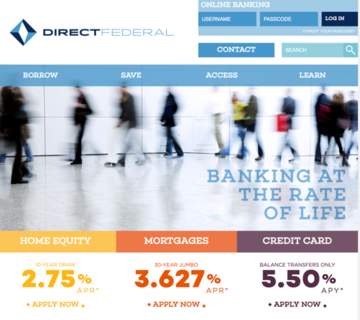
Changing its name from Polaroid Employees FCU in 1990 to Direct not only paved the way for the CU’s focus on digital product delivery, Walsh said it also handed the CU a great URL.
“Direct.com is one of the best URLs out there, in my opinion,” said Walsh. “it’s simple, easy to understand and conveys that we want to provide our products and services directly to our members,” said Walsh. The credit union has robust online and mobile banking solutions that allow for remote signature and online lending and account opening, as well as a call center.
Walsh acknowledged that growth didn’t always come this easy, as the credit union, like others, suffered through the Great Recession.
“Lending was tough when the bubble burst,” said Walsh. “But when we realized that real estate values were coming back, unemployment numbers were improving and the economy was stabilizing, we began to construct an aggressive plan for growth. Our current strategic plan that extends out several years indicates we should be able to keep this growth pace, if not increase it.”