

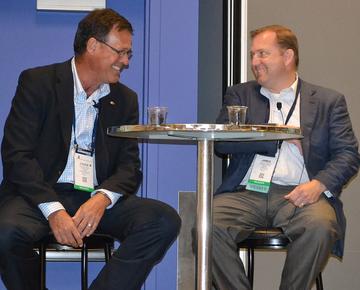
Chuck Purvis (left) and James Schenck
MONTREAL—Credit unions may disagree on whether they should build more branches or close them, but whatever approach is taken, technology has to be a key part of the equation.
At NAFCU’s annual meeting here that message was delivered by leaders of Coastal FCU and Pentagon FCU, who offered opposing views on the future of the branch. PenFed CEO James Schenck believes branches are dying, but Coastal CEO Chuck Purvis contends they are here to stay, only evolving.
Schenck emphasized that no matter the route taken, there is no one right answer for all credit unions.
“It can work both ways. But it depends on the strategy of the credit union and the needs of the membership,” he said.
Decide Where To Compete
He told a standing-room-only breakout session that to branch or not to branch “depends on where you want to compete. In PenFed’s world, BofA owns the world of branch convenience. So we want to go after convenience, but virtual convenience.”
For PenFed, with 29 offices to serve its 1.3-million members globally, it believes what members need are lower loan rates and higher deposit rates, which the economies of digital banking deliver, emphasized Schenck.
Instead of investing in offices, Schenck said PenFed puts its money into the best systems to deliver seamless service remotely—something needed by its widespread military membership—that allows members to do all of their banking on the fly. “They don’t care that our offices don’t have fancy pictures on the wall. They care about a low auto loan rate.”
Schenck said that 10 years ago the now $17.9-billion PenFed, based in Alexandria, Va., set out to do 80% of its business online (including mobile), 15% via its call center, and 5% in branches. Last year the CU reached that objective.
Savings Mean Better Rates
“Has this worked for us?” said Schenck. “We drove our 187 basis points of operating expenses down to 100. We take that money and give it back to members in our rates.”
Schenck noted that the average PenFed branch might bring in $40 million in deposits, but that a high-rate CD—such as PenFed’s 1.30% one year certificate, brings in much more.
Meanwhile, the $2.6-billion Coastal, based in Raleigh, N.C., operates in one of the most highly competitive and growing markets in the country, said Purvis. He pointed out that while the CU offers a great deal of remote connectivity that lets members not only interact with their accounts but open any product online, members say they still want to use a branch.
“They say we may never come in to a branch, but we like knowing one is nearby, to either talk to someone about a problem or address a complicated financial matter,” said Purvis.
However, the CU’s 17 offices that serve 200,000 members have evolved, moving away from a place to meet with a teller to perform transactions, to centers for consultation and sales. Coastal was one of the first CUs in the country to deploy high-tech video teller machines—two in each office—that are backed by a 24/7 call center. There are no tellers at Coastal offices.
Some of the benefits include reducing teller staff—now centralized in the call center—while transactions increased, and there has been a 73% increase in accounts opened per employee. All the while, Coastal CU’s Net Promoter Score has grown to exceed 70.
Lower Teller Turnover
Purvis added that since there are fewer tellers, the CU now pays call center staff a higher wage. That has reduced annual 40% to 50% teller turnover to 15%, which has led to better service.
Schenck added that while the two credit unions have taken different approaches to serving members, both show ROA that hovers near 80 basis points.
“So both ways work,” Schenck said.