

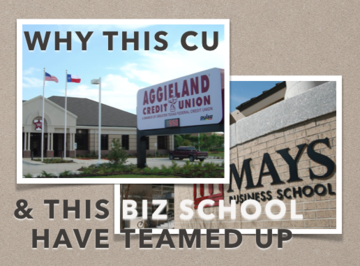
COLLEGE STATION, Texas—Aggieland CU is partnering with Texas A&M University to give students real-life experience in starting and running a small business.
The program, which began in September 2016 and ran the semester, produced five businesses that turned more than $6,000 in profits during the project.
“This is the first year for the program,” said SVP/COO Jason Goodman. “We were approached by the university’s Mays Business School. They explained their concept for a new educational program and asked if we would partner with them.”
As part of the partnership Aggieland Credit Union contributed $10,000 to the school’s Integrated Business Experience course, which would serve as seed money—loans to the new companies.
In the first eight weeks of the program, graduate students identified a product or service they would sell, conducted market research to determine how their product would be received, developed a business plan for a new company and requested up to $2,000 in start-up funds from the CU.
Student-Run Companies
During the remainder of the semester, the students implemented their business plans and ran their companies. Each company then donated all of their profits to a non-profit organization of their choosing. The teams also dedicated service hours to their charities.
“There were five teams,” explained Goodman. “Team Endure developed a clothing line. Team Flourish focused on promoting positivity and being a friend to the environment—they developed a jewelry line that came with environmentally friendly packaging. The packing was made of seed paper that could be planted for wildflowers.”
Then there was Team Hang N’ Chill, which created a line of customized drink koozies that hang around a person’s neck. Pack-tical Essentials sold individual boxes in which families could load items, such as groceries and school supplies, to send to students far away from home. Sknz developed a reusable sleeve to slide over stainless steel drink containers to provide a better grip.
Each team turned a profit, with the group’s total coming to $6,200. More than 300 service hours were donated to charity, as well.
The $10,000 donated by the credit union to the program funded the loans. Any income above the loan, which covered each team’s expenses for their business, was considered the profit. The loan money was returned to the program to fund seed money for the next course. which begins in the spring.
Goodman said a big contribution the credit union made was helping students gain first-hand experience in applying for a business loan with a financial institution.
“Each team met with one of our business loan officers,” said Goodman. “They came in with their business plan and supporting documentation and applied for their starter funds. They went through an interview and we asked them questions.”
The teams left the credit union and each began building a presentation to be given at “Presentation Day,” a meeting run by a panel made of credit union staff and professors from the business school. At the meeting each team made their final, formal presentation about their business.
“We asked them a lot questions—there was a lot of back and forth,” said Goodman. “It was sort of like Shark Tank. We looked to find any areas in which a team might be weak. Then, the panel got together and decided if each loan would be funded, or if a team needed to go back and do more work. Each team got their money.”
The program ended at the close of the semester with “Showcase Day,” where each team presented in front of credit union staff and officials from the chamber of commerce. Teams went through their business plan, how they got started, what they experienced when they ran their business and then where their money was being donated.
Crash Course
Goodman said the program was a crash course in how to start and run a business.
“The timeline was very condensed,” he said. “But within that period the teams learned the basics of starting a business, how to produce a plan, develop marketing and sell products. Teams, too, learned all about the lending experience—how to apply, what they need to bring to the loan meeting. They also learned the importance of leadership and how to work with together as a team, which a good business has to do. The students on the teams were from many different areas of the college.”
Goodman said the program was very successful and that Aggieland plans to continue to be a part of it. He said that the effort was rewarding for the credit union.
“This is part of our ongoing efforts to give back to the community,” said Goodman. “We have a strong relationship with the university and have worked with them on many programs over the years. What we really liked about this is that we did not just hand the university a check and walk away. We worked with these students to show them business lending. We are looking forward to the next program.”
Aggieland is part of the $580-million Greater Texas FCU, based in Austin, Texas.