

ANAHEIM, Calif.–Is this the end of ALCO?
“I’m sorry to break it to you, but ALCO is already sick and dying. And in some cases it’s dead,” said Tony Ferris, managing partner of Overland Park, Kan.-based Rochdale Paragon Group.
What’s replacing it, said Ferris is a new abbreviation credit unions will be hearing much more about: GRC, or Governance Risk and Compliance. It’s all about everyone in the credit union seeing the operation in a much larger and, as a result, more efficient context.
Chief financial officers, said Ferris, have traditionally been and remain “very reactionary positions.” What has changed, he said, is the responsibility of the position. When he asked how many CFOs had responsibilities beyond just accounting and finance, nearly every hand in the room was raised.
“Why do we get that? Perspective. We are able through our processes to see a lot of information that others can’t within our organization,” he said “That allows us the context to make decisions. The question is, is our context really that good? Is it as good as it could be? Even CFOs are human, and we have biases. But we do have a baseline that we can drive organizationally that others don’t.”
'See What I Don't Know'
Ferris shared that he had recently met with a CEO who said to him, “‘I just want to see through the minutiae and see what I don’t know. I want to see a way to prioritize our efforts. I want to see the opportunities. I want to see what am I not doing.’ She was spot on. We’re trying to drive to an organization. How do we take hold of the organization and align it and control what we can control? That sounds great. It sounds easier than it is. And then we go back to our office and do the exact same thing.”
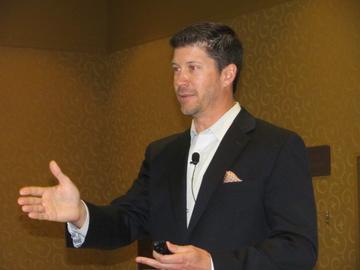
Tony Ferris speaking to CFO Council meeting.
Ferris said 30% of the typical credit union’s operating budget is expenses related to compliance and risk management.
“Does compliance mean effectiveness? Not even close,” he said. “Vendor management is a great example. We’re asking third parties 200-300 questions, but how much of that information is being used to drive value in our organizations. Or is it just a weighted test to provide to NCUA? We need to be able to drive value out of this moving forward.”
Ferris urged CUs to begin making structural changes that will allow seeing the organization in a broader context as well as assist in getting people on the same page. “We have to make it OK to see certain opportunities and seize them,” he said.
The conservative mindset of credit unions is natural and necessary, said Colvin. What that means is a CU must be smart, and that includes the board, management and staff.
“In some cases, what are our biggest barriers? The board,” he said. “Often, the board is the biggest strength and the biggest weakness we have when we talk about doing things differently. The mindset of the board can be hard to change.”
Three Pieces to the Revolution
Ferris further observed:
- CUs have not traditionally done a great job around project profitability, and need to invest in the talent to determine project P&L.
- CUs have evolved the teller job description, especially around cross sales and driving member behavior. But what has not evolved is how tellers are recruited and compensated. “The majority still recruit the old tellers, and then we say, ‘You know what, we need you to do this whole different job.’”
The “revolution” that is required of credit unions, said Ferris, has three pieces:
- Improved effectiveness
- Reduced risk
- Strategic optimization
“Where does a vendor management issue differ from a risk issue or from a business impact issue or an IT issue?” he asked. “They are all intertwined. And lots of people may be looking at this from different perspectives. People in an organization aren’t trying to do something different, they are just looking at it from different perspectives. They have a risk/reward profile in their heads. They will do exactly what you incentivized.
“We have to marry all this together. To support an effective program, in addition to the board, C-suite and other management, auditors and supervisory committee need to be on board, as well,” continued Ferris. “Audit and supervisory are our backstops to making sure what we think is happening is really happening, and in many cases it is not.”
It Sounds Counterintuitive, But...
Although it sounds counterintuitive, Ferris suggested one way to ensure an organization is moving in the right direction is to encourage those who question the direction.
“We need some people going rogue, some people who can see alternatives and identify how we can do more,” he said. “The number-one reason for doing nothing is our bias for experience. What does that mean? Everything we have done to date has worked. De-biasing becomes much, much easier once you start quantifying, as you’re no longer talking about guts or feels. We need to debate these things and listen to the person who’s not on the bus. They may be the only right person in the entire room.”
What all of that means, said Ferris, is the evolution and extinction of the long credit union tradition of ALCOs.
“What we’re starting to see is organizations taking ALCO and starting to flow all of that up through the CFO or the chief risk officer. Whether you have that chief risk officer or it reports to the CFO or somebody else, at the board level it’s still starting to come together as one,” he said. “It’s no longer plausible for a volunteer to be following all of this. We’re seeing organizations replace the finance committee or board level ALCO with risk committees.”
Preparing for 'GRC'
What credit unions need to prepare for, said Ferris, is a new abbreviation, GRC, for governance risk and compliance.
“GRC is enterprise risk management’s big brother and you’re going to hear more about it.”
Ferris defined GRC as a discipline that aims to integrate information and activities across the various departments and functions of an organization to provide a realistic risk profile, and to identify any potential problems that could hinder steady growth and a healthy business.”
There are four steps credit unions need to begin taking, said Ferris:
- Sharpen focus
- De-bias decisioning
- Create collaboration
- Drive relevancy
“The organization is going to have to act as one, and it hasn’t had to to date. Information is key,” Ferris said. “The real issue is we don’t have a culture and a process to bring those silos together. We need to drive relevancy. What we’re really talking about is getting away from ad hoc processes. Why are we asking the same departments the same questions three different times? And then where do all those answers go? We need to centralize and coordinate the intelligence of the organization. We need to find a way to bring it into a scalable, digestible, intelligent form: dollars and cents. Eventually, everything comes down to dollars and cents. We need to find the talent that is capable of looking at something, interpreting it, and bringing to our attention the real things that matter.”
The Supervisory Committee of the Future
Ferris said the credit union supervisory committee of the future is being asked to look at management and board decisions and ask are they consistent with the direction and theory the credit union intended.
“That’s scary, because to date we’ve just asked the supervisory committee to oversee the financials and the audit, and don’t touch anything else,” he said. “This one tends to raise the hairs on the backs of our necks. But they have a role to play, and it’s an important role.
“In the end what we’re looking for is a maturity of the organization to operate in the environment in which we are in,” continued Ferris. “Looking at the financials from yesterday is not good enough. The only question is do we proactively change, or do we let change happen to us? This GRC thing really is that same evolution when we went from the credit committee to the ALCO. This isn’t going to happen overnight, but it’s already started.”
.