LOMBARD, Ill.—Are fintechs, which can steal away a financial institution’s business piece by piece, reducing the value of being a consumer’s PFI?
That’s a question explored by Raddon Financial Group in its latest edition of the Raddon Report.
“Is there still value in being a consumer’s designated primary financial institution,” asked Pat Bator, senior market and product development analyst. “If there is value, what opportunities are there to increase customer wallet share?”
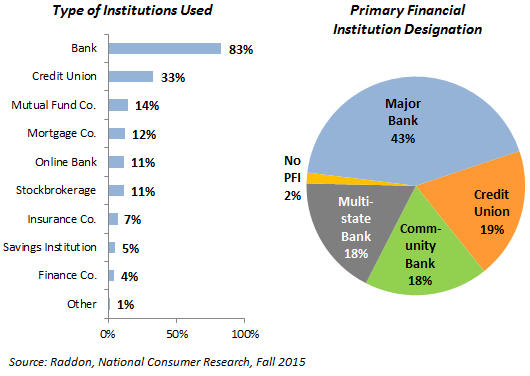
Research from Raddon shows eight-in-10 consumers conduct their banking business – deposit accounts, investment services, loans or credit cards – with a bank, while a third of all consumers use a credit union. Smaller numbers of consumers have financial relationships with online banks, stockbrokerages, savings institutions, and/or mutual fund, insurance, mortgage or finance companies.
Younger Consumers Choose Banks
Forty-three percent of all consumers identify one of six major banks as their primary or main financial provider – Bank of America, JPMorgan Chase, Wells Fargo, Citibank, PNC Bank or U.S. Bank – Raddon data shows. The remainder of consumers’ PFI designation is evenly split among credit unions, community banks, and multistate banks. Younger consumers (ages 18 to 34) are more likely to use a major bank as their primary or main financial provider and are significantly less likely to specify a credit union as their primary financial provider. Consumers over age 55 are more likely than their younger counterparts to designate a community bank as their main financial provider.
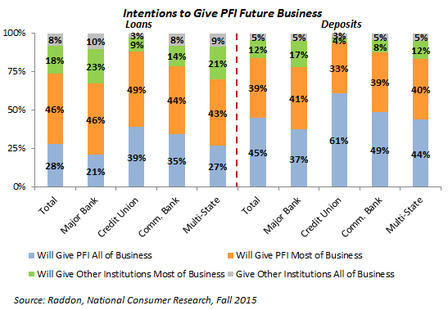
“When asked to describe their anticipated future use of their primary financial institution for loans, nearly a third of all consumers indicate they would give all future loan business to their main financial provider, while almost half would give their PFI most of their future loan business. A quarter of all respondents would give other institutions – not their PFI – most or all of their future loan business,” noted Bator.
Moving to the liability side of the balance sheet, 45% of all consumers would give all of their future deposit business (other deposit accounts excluding the checking account) to their main financial provider. Thirty-nine percent would give their PFI most of their future deposit business. Unlike future loan business intentions, a smaller portion – just 17% – of all consumers would give other institutions most or all future deposit business.
“From a historical standpoint, the PFI relationship’s value has remained constant,” said Bator. “In 2008, Raddon’s research found 71% of all consumers would give their primary providers all or most of their future loan business; 74% of consumers would do the same today.”
Bator said the deposit scenario is similar.
Extant Demand
“In 2008, 86% of all consumers would give their main financial providers all or most of their future deposit account business, compared to 84% today,” he said. “It will likely be easier for PFIs to grow deposit wallet share than loan wallet share. Remember, in the current low-interest rate environment, deposit accounts are unprofitable. As a result, financial institutions looking to grow deposits must exert caution when they price their liabilities. Unprofitable growth is not good growth. In the same way, there is still value in increasing customer deposit wallet share from a fixed cost standpoint. If funds can be loaned out, higher balances in one account, more than offsets the fixed costs incurred for the same balance amount in multiple accounts.”
Bator added that if loan demand exists in their franchises, it may be somewhat easier for credit union PFIs to increase wallet share than their major bank, community bank, and multi-state bank counterparts.
“Extant demand is the key issue,” he said. “Consumers under age 34 display a greater demand for loans in the next 12 months than older consumers. If there are fewer younger customers at a financial institution, the organization will have to double its marketing and promotional efforts to grow customer loan wallet share.”
Although the value proposition of the primary relationship remains steady, financial institutions must continually work to grow wallet share, concluded Bator.
“Accordingly, financial institutions are strongly encouraged to leverage the business opportunities presented by their primary customers,” he said.