

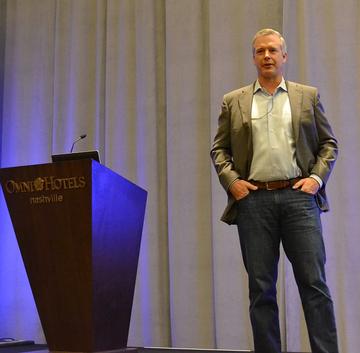
Peter Donat
NASHVILLE, Tenn.—From fintech startups eventually declining in number to the possibilities for blockchain, one analyst addressed emerging trends in payments and banking during PSCU’s 2016 Member Forum.
A key point made by Peter Donat, SVP of new ventures at First Data, is that while there is reason for credit unions to be concerned over fintechs, their numbers will likely shrink and they are also looking for FI partners, suggesting that CUs consider an opportunity to work with a fintech if the need fits.
“I expect there will be a reasonable shakeout of the fintech players,” said Donat. “A percentage of them in the next year will be unable to raise money at the valuations they are setting.”
Donat emphasized that many of the startups, too, that had been looking to “eat the lunch of financial institutions’’ are now looking to partnership solutions with banks and credit unions. “So maybe there is an opportunity to partner with some of these startups.”
Among the examples of startups cited by Donat were MineralTree, which handles accounts payable automation for medium and small businesses; Bento, which employee expense cards for small businesses; and CUneXus, which handles risk-based lending for credit unions.
Fintechs Not Just Competitors
To broadly state that alternative lenders are simply competitors is a mistake, according to Donat. “We have seen partnerships emerge from companies that can help you do things faster and assist you with decisions.”
Turning to bitcoin, Donat said the blockchain technology that underpins it has the potential to lower costs “for a variety of parties in a variety of different scenarios. I’d say if you are a credit union today you should look to your partners like PSCU and First Data to evaluate whether there is a blockchain solution that can help you save money on the way you run your business.”
Donat asked attendees if they had handled a bitcoin transaction, and among a group of about 100 three raised their hands.
“That did not surprise me,” Donat told CUToday.info. “Bitcoin is still trying to get a critical mass of users. I think you could see more adoption of bitcoin if the regulatory environment was more certain and if it had broader network effects than it does today in terms of places you can use it and consumers who have it. Bitcoin needs to solve some of the network effect challenges that are out there before it becomes mainstream.”
Asking for a show of hands again, this time from those who have processed a mobile wallet transaction, many more attendees responded—80% of the audience. Yet despite the CU interest in mobile payments, Donat said it is uncertain if 2016 will be a year in which mobile payments take off.
Some of the issues facing mobile payments, especially for online purchases, is that the screen is small and does not make shopping, and getting a really good look at the item, easy, he said. Donat addressed the high shopping cart abandonment rates among mobile users that have turned up in media reports.
“I am not certain if the shopping cart abandonment rate is as high as is often stated,” he said. “I tend to think many of the people who are abandoning their shopping carts from their mobile devices are simply browsing with no intention to buy. They may be in a store and have three websites open, going through the checkout process up to completion just to compare prices that they see in the store.”
Mobile Issues
Other issues regarding mobile payments: It is not logical for companies to think they can replicate the results Starbucks has had with its mobile payments solution, as that is a difficult task to accomplish, and consumers are not willing to carry that many mobile apps from retailers on their phones.
What is working in favor of digital wallets is that many companies are coming up with creative ways for mobile to reduce friction at checkout, such as Exxon, whose app allows someone to pump gas without having to tap a phone or swipe card, with the receipt sent to their phone.
Also, the majority of merchants have not yet deployed POS terminals that are NFC capable. But many are now getting terminals to handle mobile payments as they upgrade to EMV. Donat reiterated what many analysts have stated—that the new EMV terminals being shipped come with NFC capability, so mobile adoption will pick up as EMV rolls out.
“To project whether this year or next year we will see the digital wallet tipping point, that is difficult to say,” concluded Donat. “But I do expect to see continued growth for mobile in every segment—more consumers using it, more places offering it, and more functionality.”