

WASHINGTON–How can credit unions shift the end-game in the debate over the future of four critical areas: CEO succession, lost purpose and mission, CRA for credit unions, and private vs. federal deposit insurance?
Those diverse issues were all part of the discussion at the UNDERGROUND Conference here and it was, in turn, the subject of some spirited debate itself. The UNDERGROUND Conference was hosted by Mitchell Stankovic & Associates, and CUToday.info is providing coverage of the unique meeting as part of UNDERGROUND Week. The meeting, held at the Newseum in Washington, sought to create a forum where executives to get together and share ideas that were outside the mainstream.
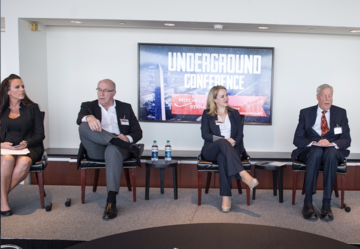
At UNDERGROUND Conference, from left: Brandi Stankovic;Dennis Adams, Kathryn Davis, and Chip Filson.
The first four installments in this series can be found Other coverage can be found here, here, here and here
Here is a look at each of the four perspectives shared:
Private Share Insurance Vs. The NCUSIF
Dennis Adams, president of the Dublin, Ohio-based American Share Insurance, said that since the company was founded in 1974 it has sought to focus on innovative deposit insurance programs, with an emphasis on the separateion of account insurance from statutory regulation.
“That's a complicated way of saying that insurance and regulation are two very different business issues,” said Adams. “We believe credit unions should have the choice to manage them separately to better adapt to the needs of their individual markets. This philosophy sets ASI apart from a federal system that promotes a one-size-fits-all approach.”
Adams said that during the economic crisis the company acted as a credit union partner to its members as represented by the company’s support of Silver State Credit Union in Las Vegas, which was hit hard by the downturn in that Sand State. Instead of shuttering Silver State, ASI provided financial assistance, with the final repayment being made during Q1.
“Thousands of teachers and their families still have their credit union because of this partnership,” said Adams.
Among other points made by Adams:
- The company is planning a new campaign called, “Mind Your Own Business” to focus attention on how it allows credit unions to run their own shops.
- “Living in a political world and it is your responsibility to question the regulator,” said Adams.
- Credit unions have choice and options.
CRA Or CU Difference
The best—and only—way to demonstrate there is a credit union difference is to always act in the best interests of a member’s financial well being, according to Kathryn Davis, CEO of BALANCE.
“BALANCE speaks with hundreds of credit union members monthly to educate, rebuild and provide consumer counseling services,” said Davis. “BALANCE’s goal is to empower two-million people by 2020. We are investing in communities and striving to develop grant opportunities to work towards financial empowerment.:
Davis urged credit unions to constantly ask themselves questions, including:
* Are we meeting our mission and achieving the credit union difference?
* Why were CUs formed?
* Why the appeal of Lending Club, and why have consumers turned to it to refinance $100 million in bank credit card debt? Lending Club did $2.5-billion in loans during the fourth quarter of 2015.
* Why are credit unions not taking that kind of loan business that from the fintech companies when there is minimal risk--less than 1% don’t pay back those loans.
“The tools are available to mediate credit union risk and the rewards can be high in terms of membership loyalty,” said Davis.
Davis said she believes there is real opportunity to serve “B” risk tier members and to offer consumers an alternative. “How many ‘second chance,’ consolidation, and ‘starter loans’ do you offer?” asked Davis. “How many low- to moderate-income members do you serve?”
Davis also said:
- It is time to address the student loan crisis as it impacts entire families, not just the kids. One in three phone calls to BALANCE are about student loans. “There is a sense of despair.”
- Credit unions need to ask themselves if they are focused on their membership or chasing Millennials?
So What’s The Issue? Is A New End-Game Possible?
Chip Filson, the CEO, co-founder and chairman of Callahan and Associates, notes that credit union community’s 2015 financials look solid across the board, and yet…
“By any standard the financial results are remarkable—and have been on upward trend since 2008, the only year in the modern credit union era in which the industry reported a collective loss,” said Filson. “So what’s the issue? it is this: there is a growing divergence between our institutional success and the needs of our members. Many have lost the vision of our purpose, some call it our social mission. Instead we have taken the regulators’ comfort that financial success and lots of capital is its own endgame. The question becomes, is a new endgame possible? Regulators, and to some extent boards/managers, are using scorecards for the wrong game—for how many in this room is your personal compensation based on meeting members needs as described above?”

In foreground, Frank J. Diekmann, Cooperator-in-Chief at CUToday.info, who moderated session at UNDERGROUND Conference.
Filson, a former executive at NCUA, said the regulatory mindset from the crisis continues to drive NCUA’s rule making, regulation and examinations. He noted that meeting member needs is nowhere to be found as a component of the CAMEL rating.
“Not only are cooperative metrics missing, but their absence undermines the strength of the coop model and its interdependent systems,” said Filson.
Filson said there are three questions the credit union system must address if it is to fulfill its “special role” in the American economy.
- How can we better balance Purpose with Performance? According to Filson, the following factors have caused financial performance to become the dominant metric in presenting CU success:
- The crisis, the recovery and the mental hangover of boards, managers, regulators.
- Easier to measure financial performance than purpose
- Comp plans for managers based on financial criteria
- Regulatory focus on RBC, risk management, and growth
2. What evidence is there that purpose/mission matters or can make a difference? Or isn’t financial success a sufficient validation of that a firm has a “purpose?” Filson offered these points:
- The number-one issue in presidential election is financial inclusion: income inequality, middle class lack of growth; focus on financial health as an institutional priority.
- The member-owner model, if lived, causes member-centric tactical and strategic priorities.
- Regulatory reassessments: “The answers must start from recognizing that financial capitalism is not an end in itself, but a means to promote investment, innovation, growth and prosperity,” said Filson. “ Banking is fundamentally about intermediation—connecting borrowers and savers in the real economy.”
- The legacy design that created today’s coop system of $1.2 trillion in assets and 100 million members; coop model is a competitive advantage
3. How can NCUA’s policies and actions be better aligned with cooperative purpose and system safety?
Filson suggested that:
- NCUA’s primary drivers today are CU financial results and bank-like rules. Independence from credit union or independent assessments-fail to recognize changed context.
- The co-op model enhances NCUA’s safety and soundness responsibilities
- The co-op model is uniquely constructed on financial and operational interdependence.
- Bank regulatory policies are inappropriate for the member-owner model and undermine cooperative advantages, especially when responding to a crisis