

LIHUE, Kauai—Just about every credit union talks about the need to innovate. But many are confused about how to innovate, what the process means exactly, and what steps can be taken to spark real innovation, according to one person, who has offered some strategies for changing all that.
And who would be more qualified to do just that than someone whose title is chief innovation officer?
George Hofheimer, who holds that title with the Filene Research Institute, told the Volunteer Leadership Institute meeting here that “at the end of the day, innovation is about solving problems for real people in real organizations.”
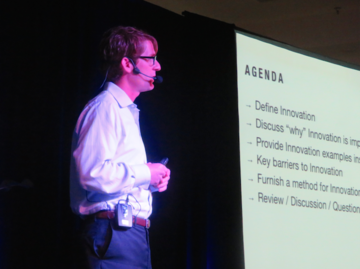
George Hofheimer speaking to Volunteer Leadership Institute.
In remarks themed “Demystifying Innovation,” Hofheimer asked an audience made up primarily of CU board members for their definition of innovation, and received a variety of standard responses.
“What is innovation?,” asked Hofheimer, before answering, “Innovation meets new needs, unarticulated needs, or old needs in new ways.”
Innovation is often thought of as being related to or driven by technology, but that is not the case, he said. “The one that has the most opportunity is this concept of unarticulated needs,” he said. “If you talk to most consumers about financial services, they don’t really want to talk about it. It can become very difficult. But there are different ways of finding out what those unarticulated needs are.”
As an example, he pointed to recent JD Power consumer research that found customer satisfaction with banks is at an all-time high, yet which also discovered there are “areas of weakness” that signal “competitive vulnerability.”
“This is why from a competitive standpoint we need to constantly react, or even lead,” said Hofheimer, before acknowledging, “It’s not easy for credit unions to do that.”
What Drives Innovation
New market competition is a primary driver of the need to innovate, and as an example Hofheimer pointed to the number of credit unions that are profitable only because of fee income, much of which comes from card programs. “But now we have Apple Pay. That may have an impact on our business model, which is why we need to think about your business model.”
In its work with credit unions, including its i3 Group, which is all about creating new innovations and testing them in real world environments, Hofheimer said Filene has found there are three types of innovation: incremental, architectural, and disruptive.
“We recommend to credit unions that 70% of innovations be incremental. These are slight tweaks. These can include looking at internal operations and board operations.”
Architectural innovation, which is about 20% of innovations that take place, are things like product line extensions.
The remaining 10% of innovation is disruptive, those things that “really change the game,” he said.
Hofheimer noted the widely held perception is that all of financial services, not just credit unions, are not particularly innovative. Why? For several reasons, he said, including the “we’ve always done it that way” mindset, and the people and personalities who work in financial institutions.
“There are all kinds of people in credit unions,” he said. “There are some who put up the roadblocks a little bit more than others. It’s not just CFO and compliance types, it takes all types. But there is a tendency for people to put the kibosh on innovation.”
Another reason frequently cited for the lack of innovation is lack of funding.
“But it isn’t that there is no money available; often it’s just that organizations haven’t budgeted for it,” Hofheimer said. “One of the first questions we ask organizations we work with is how much have you budgeted for innovation, and typically the answer is not much. Quite honestly, some of the most successful innovations didn’t need much funding to get off the ground. Instead, it’s often what gets measured gets done.”
Tremendous 'Aversion' To Risk
Hofheimer said another innovation crusher in credit unions is the “tremendous aversion to risk,” a mindset often driven by regulators. “And there are lots of reasons not to take on lots of risk. CUs don’t have lots of incentive to grow rapidly.”
Despite all that, Hofheimer said people want to innovate, “they just don’t know how to do it.”
To that end, he shared with the meeting Filene’s six-step process for innovation: insights, ideation, prototype, test, reporting, and implement.
“We spend a tremendous amount of time on the first step, which is insight gathering. If you think you know what the problem is, you probably don’t,” said Hofheimer, who urged CUs to do informal interviews as part of this step. “People love to be asked.”
Step two is ideation, which is the step he said represents what most people think of when it comes to innovation.
“Typically, most organizations put everyone into a room and say, ‘we’re having a brainstorming session.’ That’s not how human creativity works,” he said. “Some of the ways we try to spark human creativity is through a silly process we call unrelated stimuli. For instance, on the bottom of each piece of a Jenga game we write a noun or verb, and have everyone pick a piece. The concept is so get two words that have nothing to do with one another and nothing to do with the problem.”
With the first two steps complete, comes a pause to review what’s been done so far.
“Once you do all that, you have to do some fact checking. This is one credit unions are really, really good at. Fact checking is where the compliance people and the board and others come in.”
Testing Prototypes
Step three is the prototype phase. “This is the one where credit unions, like most organizations, are not very good,” he said. “In this one you have to build the product or service, show it to people, and test it in the real world. Once you do that you have a better idea of what should version 1.0 look like.”
Test prototypes with a limited number of people; you don’t have to offer it to your whole population. With one test right now we are using 200 people. Sometimes you just want to show people, ‘This is what we’re working on, give us your reaction.’ “
Hofheimer cautioned that before a credit union moves on to testing, it needs to go through a stage he called “death threats,” in which “you ask what are all the things that are going to destroy this idea?”
By their nature Hofheimer said credit unions tend to be very good at the reporting step. If the first five steps are done well, it leads naturally to the sixth step, implementation.
Hofheimer reminded credit unions that the “six-step process always looks nice and tidy at the beginning, but in reality, it’s messy. It takes flexibility.” He urged credit unions looking to innovate to start with what is desirable, not what is feasible or viable.
Hofheimer urged board members interested in driving innovation to begin with simple steps. As an example, he said, “I’m sure all of you have small, medium or large problems with how board meetings are run? So can you put the board meeting process through the innovation method?”