

SAVANNAH, Ga.–The overlooked component in the people-helping-people business?
The hiring-the-right-people piece. Credit unions here were offered some strategies for rectifying that problem.
With an enormous wave of Baby Boomers retiring for the next decade-plus, combined with growth and just turnover in general, making good hires will be at a premium and will need to be about a lot more than “just getting somebody in here,” according to two experts.
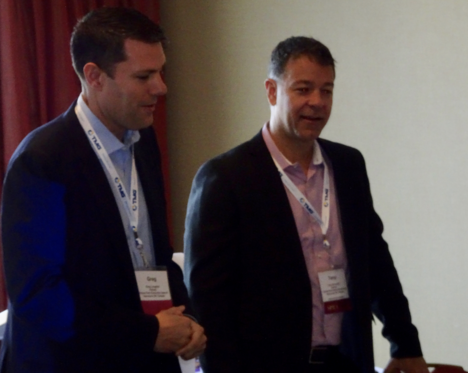
From left, Greg Longster and Tony Kirschner at CUES meeting.
Speaking to the CUES’ CEO/Executive Team Network here, Greg Longster and Tony Kirschner, both partners in Vancouver, B.C.-based Davies Park Executive Search, addressed what they called the “War on Talent: Why Credit Unions Struggle to Hire A-Level Talent.” Winning that war, they suggested, involves practices every CU should have in place, as well as the long-term view.
The first step, said Longster, is recognizing where CU weaknesses lie, including:
- Candidate risk aversion and probationary periods. “This happens every time there is a down business cycle.”
- Candidate confidentiality. “Every organization should view every applicant as someone who is applying in confidence.”
- Inadequate HR resources. “It’s easy to get people who fit certain criteria. It’s more work to get the A-level talent.”
- Lack of employer brand. “Credit unions are not widely known and thought of as a top employer. Not many people go through school and at the top of their list is ‘I want to work at a credit union. That’s my goal.’ People almost have to stumble into credit unions to understand what great opportunities they are.”
'A No-Brainer, But...'
Kirschner said that while human resources is fundamental to attracting and engaging talent, there is much more at play in order to be successful in getting the very best people on the CU’s payroll.
“There is a basic expectation that we all need to do more with less,” Kirschner told the CUES meeting. “But I would argue throwing money into HR is not the long-term solution. It must come from the top down. A progressive HR program is the key to attracting and retaining great talent. Forward-thinking companies that take culture seriously and think about it as a key driver for their business tend to do better. It’s a no-brainer, but we all know it’s now always the case.”
Kirschner cautioned credit unions to remember that while having the “right people in the right seats is important,” the inverse is equally critical. “Having the wrong people can be exponentially destructive,” he observed.
While Longster and Kirschner work for an executive recruitment firm, both stressed at several points they don’t believe hiring such firms or that throwing money at HR is necessarily the best approach.
“Similarly, just applying external programs is not great HR,” said Kirschner. “It must come from the actual organization.”
One Inexpensive Option
For credit unions with limited budgets for HR—which is nearly all CUs—Kirschner recommended one “inexpensive option,” which he called “strategic monitoring.”
“This doesn’t cost a whole lot of money, but it does cost a whole lot of time,” he said. “It can’t be an HR program; it’s a business program.”
The pieces of strategic monitoring include:
- Recruiting. “This is the long horizon and developing the employer brand. Strategic mentoring allows the hiring of under-qualified staff who are really smart and motivated, but who are then able to develop real-world skills. It’s really an investment of time and energy. They will develop five-fold value to the organization.”
- Succession Planning. “This is not just an org chart. It’s investing in the person who will be replacing the other. There’s a personal development plan.”
Kirschner urged credit unions to “play the long game, build organizational HR capacity. To address the war on talent you must address recruitment, retention, engagement, succession planning and personal development. There must be a strong platform embedded in the C-Suite and then made part of the culture.”
Developing an Employer Brand
Developing an employer brand is a challenge for credit unions, said Longster, noting they will never have the sexy profile of an Amazon or Google or Facebook as a place to work. But that doesn’t mean CUs can’t be attractive employers.
Similarly, it’s not about winning Best Employer Awards, said Longster, adding that he has worked with the winners of such awards and “found them to be among the most dysfunctional of companies—they’re just really good at filling out award applications.”
Instead, it’s about a basic premise: “Treat employees well and seek referrals from existing employees for vacancies,” he said.
How a credit union treats applicants in the recruitment process is critical, according to Longster.
“When someone creates a resume that really becomes their life’s work, so how could that not be treated seriously?” Longster asked. “So how they get treated and how they get communicated with in that process is so important. The more you can communicate, the better. As long as candidates have an experience where they feel informed and engaged and valued, that helps to create an employment brand.”
He also urged CUs to remember candidates who may not have been a good fit for the position that was originally open may be ideal for a new position that could become vacant. Those candidates won’t want to be considered if they weren’t treated well the first time around, he said.
An Overlooked Aspect
An often overlooked aspect of creating a good culture may seem counter-intuitive, but it actually can be critical: the treatment of employees who leave the credit union.
“It’s not hard to feel bad when an A player leaves for another organization,” said Longster, noting the best organizations celebrate those who are moving on to new employees. Some companies even create alumni networks.
“At a lot of organizations, when you resign you’re persona non grata,” observed Kirschner. “The pack-your-box organization is not what you want to see. The best organizations help people to move on. That will pay back five-fold. That exit interview is so critical to building good will and getting information. Once again it’s the long game, as opposed to ‘You have betrayed us, get out of here.’”
The gold standard of respecting departing employees, said Longster, is Deloitte, which has a formal program for former employees, whom it often ends up hiring again.
Longster urged every CU to leverage social media thoughtfully and proactively, as potential candidates will almost certainly be looking to social media to better gauge the culture of an organization.
Best Practices
Longster offered these best practices for building internal hiring capacity:
- Anticipate needs and develop a talent pipeline. “When you look for talent shouldn’t be when there is a vacancy.”
- Know what you are looking for (engage stakeholders). “Once there is a vacancy it’s so important to engage all the stakeholders who will be involved in this new position.”
- Leverage your network to find talent.
- Differentiate between active and passive candidates. “In our world, an active candidate is someone who wants or needs a job. A passive candidate is someone who doesn’t think they want a new job and are busy in their current job. The active candidate is the one who often comes to mind when filling a job, but we don’t say ‘Who’s looking?’ we say, ‘Who’s good?’”
- Be picky and take your time. “This is the adage ‘Fire fast, hire slow.’”
- Take reference checks seriously. “This often gets overlooked or rushed.
Longster said his firm uses a multi-layered approach that involves multiple meetings to create an assessment of job candidates. Among the best practices in that area:
- Conduct screening calls. “Do they have the basic qualifications and can they really fit the job?”
- Qualifications and career progression review and interviews. “It’s so important to know the story: how did you get the job, why did you leave your old job?’ On paper it might not add up, but there might be a fantastic story there or a good explanation.”
- Culture and fit behavioral assessment. “This is where once you have a smaller pool you want to know how they are going do the job. This is where you can assess ‘Is this person like us? Do they fit our culture?’”
“We believe the more interaction with various stakeholders, the better,” said Longster. “It can be stakeholders inside and outside the organization, people they might engage with on a regular basis. When this happens the better it is for both parties. Candidates also want to meet the team, want to know what their suppliers think of (the credit union) when they are making a career move. This reduces the risk on both sides and increases likelihood of success.”
References Checking Tips
When it comes to checking references, Longster and Kirschner offered these tips:
- Dictate who you would like to see for references—don’t let the candidate dictate it. “Don’t rely on the candidate’s ‘three buddies.’ Use anecdotes from behavioral questions.” It should be six-ten sources, according to Kirschner.
- Seek a 360-degree perspective: supervisors, peers, customers and direct reports.
- Create a reference checking guide that is customized to what you learned in the interviews.
- Take the time to be thorough.
- Request permission to call back and do so if there are still some unanswered questions.
Longster acknowledged there can be roadblocks in companies that will only agree to confirm that a person worked at a company for a specified amount of time. In those cases, his firm puts it back on the candidate to provide additional references.
Time For 'ABC'
Borrowing from David Mamet’s Glengarry Glen Ross, Kirschner said that when it comes to hiring a credit union should “Always be closing."
“You close from the very first contact with the candidate,” said Kirschner. To close the deal, he recommended:
- Internal Alignment Around the Role. “If you don’t do the work upfront, you know how it will turn out. The person will either turn you down, or not be a fit once hired.”
- Getting to Know the Candidate. “You bring them in, put them through your tried-and-true HR questions, and then you make the offer. And then they turn you down, because they feel like they never got to know you well and you don’t know them. Once you get to know them a bit you have to have the courage to say no. You need to do all your vetting about culture early in the process. Rather than being the used car salesman, you become their trusted advisor. You should be working together in alignment. Then it’s an easy yes. If it’s a no, it should come much earlier in the process.”