

LAS VEGAS—It’s one of the best-known credit union brands in any market in the United States; and that awareness is no accident.
The $13.5-billion BECU has spent almost a decade asserting its brand and stressing its value, which is all about what a credit union is.

Stephen Black of BECU speaking at CU Direct's DRIVE 15 conference.
During the CU Direct DRIVE 15 Conference here, Stephen Black, VP-marketing with BECU, shared BECU’s brand promotion and market positioning strategy, including the story behind how it has become a top financial brand in the greater Seattle market, and a significant player across Washington State..
In 2002 the then $4.4-billion Boeing Employees Credit expanded beyond its founding field of membership to a statewide field of membership. A year later it took advantage of an offer from Safeway Supermarkets to move into 30 of its stores with cashless branches. In 2004 it began to simplify its branding as BECU. But it was still working on just what that brand was all about, an element that’s critical, Black said.
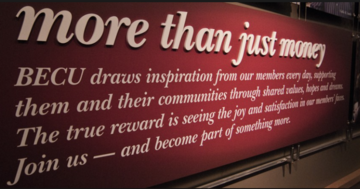
In 2005 the credit union adopted the tagline, “More than just money.”
“That allowed us to set BECU in the industry, because if you don’t know what BECU is, it could be anything,” said Black. “Our brand platform was all about the inspiration our members give us.”
Asserting 'Distinctiveness'
With that brand platform set, BECU began to “assert our distinctiveness,” according to Black, and that included “projecting the values and ideals of the credit union movement, embracing our Northwest roots, and talking more about what BECU is rather than what banks are not, and giving members ownership of the brand through image and story.”
Since that time all of BECU’s marketing has featured its members, including TV commercials.
But a competitive development in its market in 2006 taught BECU that it still had some work to do.
“There were rumors in the market that (major market presence) Washington Mutual was for sale, and we explored a strategy to absorb runoff of customers in event of a sale,” he said. “But we found out we weren’t in a position to absorb those consumers, as most people believed we still served employees of Boeing.”
The BECU marketing team went back to work, rolling out an inaugural brand launch that deployed targeted messaging and a social media strategy. New ads were themed, “You can keep your money in a bank. Or you can belong to something more. BECU. It’s more than just money.”
“I recognized right away if we weren’t measuring people’s awareness and understanding of BECU: wouldn’t know if effective at all,” said Black.
To that end, BECU began doing biannual measurements. It’s first baseline number: 9% of consumers said they would consider BECU as an option if switching financial institutions.
BECU moved to rebrand its branches as “Neighborhood Financial Centers” and also sought to deliver a consistent member experience, as well as align the brand and the culture. It was ready when two years later, as the recession was going into high gear, Washington Mutual was forced into conservatorship and sold to Chase Bank. BECU bought a full-page ad in the Seattle Times to reassure its members of its safety and soundness.
“This was the credit union moment in time when all of a sudden people were talking about the distinct differences between banks and credit unions,” said Black. “We became a lot more vocal about our differences. We wanted to inspire confidence in our market.”
Chase moved into the market with a major media campaign themed, “You’re about to experience real banking for the first time.” It was a message that didn’t sit well with many people, said Black. Still, BECU took the high road.
“We never dissed WaMu. We admired the way they conducted themselves for a while,” he said.
'Move Your Money'
The WaMu/Chase transition became part of a large and steady migration of consumers to BECU. In 2009, with social media really beginning to explode, the credit union began interacting, sharing, listening and learning on social channel, said Black. By 2011 its social media strategy was introduced to all employees with live and online training sessions (including guidelines for their participation). BECU remains active in social media.

“In 2010 we launched the Move Your Money campaign. It was a once in a lifetime effort,” said Black. Like credit unions nationally, membership was propelled by 2011’s Bank Transfer Day campaign. “In October and November of 2011 we were adding almost 30,000 members per month,” he said.
Emerging from the recession, Black said BECU added a new twist on testimonial-led advertising campaigns. Fueled by a wealth of BECU member feedback on social media channels, it used actual members comments in a campaign BECU called the “Share” campaign. “Our brand was all about authenticity,” he said.
Today the key measures BECU uses to track success are all up: awareness, consideration, choice and PFI share. Its unaided awareness is now 63%, up from 9%. Its 59% “consideration rate” is double that of any competitor. Nineteen percent of its members in its core, six-county market area make BECU their PFI, which is about even with Chase.
Its goal for 2016: to hit one-million members.
The challenge before BECU now? “How do we continue to differentiate from our competitors,” said Black. “The last thing we want to be is perceived as more bank-like. And for us it’s about strongly communicating our values. That’s what most people cite when they talk about an ongoing relationship with a brand. We work to connect the superior benefits of our values to the membership. And we put those values into action. We reprice a credit card if a member’s credit score improves, for instance.”