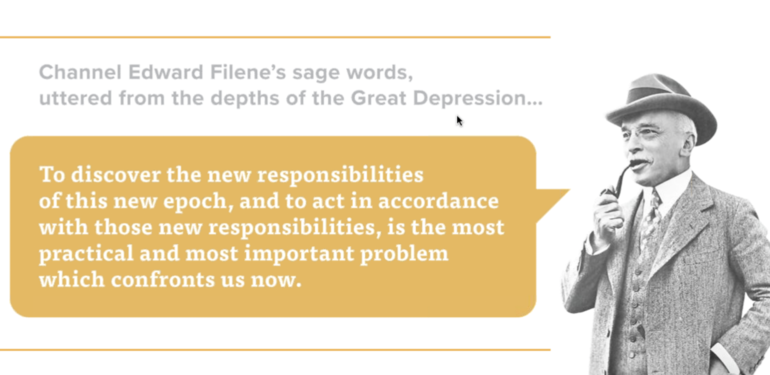
MADISON, Wis.–Credit unions were given insights into what a new Filene Research Center that is launching at a particularly appropriate time will be offering in terms of actionable insights.
During a webinar titled “Navigating New Forms of Economic Fragility: Consumer Financial Lives in Transition,” Dr. Lisa Servon, the Kevin and Erica Penn Presidential Professor Department Chair at the Weitzman School of Design at the University of Pennsylvania and who is heading the new Filene Center for Consumer Financial Services in Transition, said the Center is a four-year research project to study the changing financial lives and livelihoods of consumers, new forms of economic struggle and financial fragility and how these changes impact the North American credit union system.

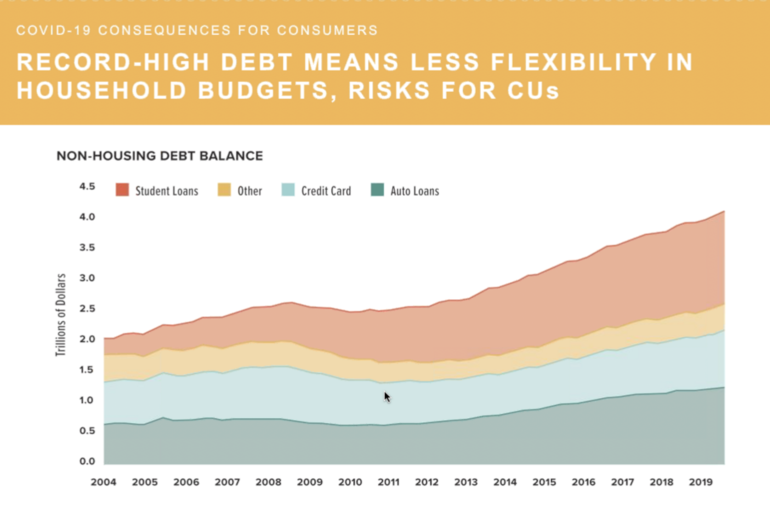
According to Servon, financial instability is being felt by many more people than may be commonly accepted, making it harder for many to borrow, save and plan—and just as hard for CUs to serve them.
Servon said there are numerous trends shaping realities for many people, including declining wages and income, and fewer benefits that help people to deal with risk, such as health insurance and retirement packages.
Those are some of the reasons the new Center has been organized to study those types of financial transitions, she said.
Can’t ‘Cope’
When an emergency happens, such as the global pandemic, “We see people not being able to cope with it. We have this bootstrap culture that people should be able to make it by working, but we’re seeing people not making it,” said Servon.
Servon said one of the primary roles of the new Filene Center will be to provide examples of how credit unions are helping people to make it through those challenges.
“We’re trying to start with what people do and their situations and then figure out what are the interventions that are needed to make financial services work for them to achieve financial health and well-being,” said Servon.
Two Types of Challenges
There are two types of transitional challenges that are shaping and reshaping people’s lives that will be at the center of the new field of study, according to Servon:
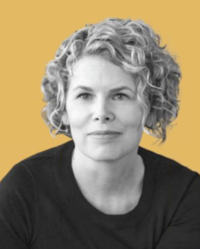
Dr. Lisa Servon
- Shifts in the economic and political environment, such as increasing income volatility, growing indebtedness and new kinds of work
- Lifecycle/lifestyle changes as people transition from school to working, single to married, childless to parent or caregiver, working to retired, employed to unemployed, healthy to unhealthy and more
“We’re trying in the center to put these big economic changes together with the other things that happen in a lifecycle,” said Servon.
Servon began studying consumer financial services approximately seven years ago, initially by studying why people use check-cashers and payday lenders even when those businesses were known to be bad for consumers.
As part of her study Servon worked as a teller inside a check-casher, where she said customers told her banks and credit unions weren’t working for them (although to be fair, she said, more people were fans of CUs).
Three Drivers
From her studies and work at the check-casher, Servon said she found customers had made the choice for three reasons:
- Cost and liquidity. Servon noted that when people talk about check-cashers they often cite how expensive the services are even though comparable services are free through a financial institution. But customers say the primary issue is speed; they need a check cashed quickly.
- Transparency. Customers of check-cashers say banks are not transparent and felt like the banks they were using were not transparent and that leads to cost problems. Customers, for instance, say they can cash a check to pay bills, but if they mis-time payments, the financial institution will hit them with overdraft charges that add up quickly. Those customers told Servon the fees were clearer and more transparent at check-cashers.
- Relationships and services. Servon said at the check-casher at which she worked in the South Bronx in New York people would return because they felt the business was “on their side” and they were getting good service.
What Unemployment Numbers Mean
On the same day as the Filene webinar the Department of Labor released new figures showing another four-million people had filed jobless claims, bringing to more than 22-million the number that have done so in the last month.
People are being “devastated” right now, said Servon, especially those who are low-wage workers, who are paid on commission or who are gig workers.
“Many people we talk to aren’t using payday loans and don’t want to use them again,” she said. “I think what’s tough about this situation is rainy day funds aren’t going to work; most Americans live paycheck to paycheck. That six-month buffer isn’t there. I talked to some people who have gotten stimulus checks and they spent them quickly, and not frivolously. These times are so abnormal; it’s really hard to know how people will survive and move forward without some major government intervention.”
Servon said even check-cashers and payday lenders have reported they are tightening their own underwriting.
Two Other Trends
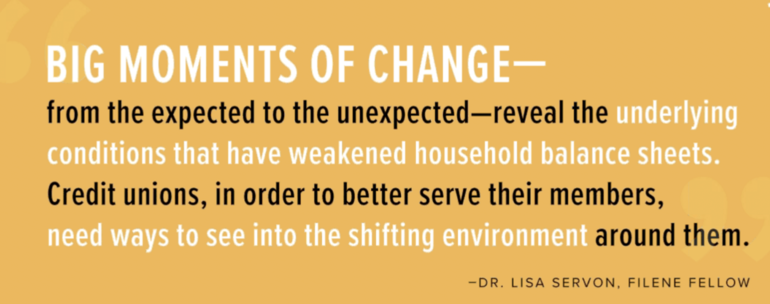
Servon said the new Filene Center will also be examining two other trends as part of its work:
- The shifting of risk to individuals and families, which means greater uncertainty and danger
- Access to paid sick leave and access to health insurance
“Research has found lots of people taking out payday loans were doing so as a result of medical-related expenses, even those with insurance,” said Servon. “People are making choices: do I pay the rent or pay for these prescriptions. That is being exacerbated. We want to dig more deeply into how people are managing health expenses and if looking at that will help us to understand what some tools might be.”
Servon said the Center will additionally focus on the criminal justice system and the changing nature of work. In addition, Servon said several projects are planned or forthcoming on healthcare costs and income volatility, the costs of incarceration, vulnerable entrepreneurs, and trauma-informed financial service.