

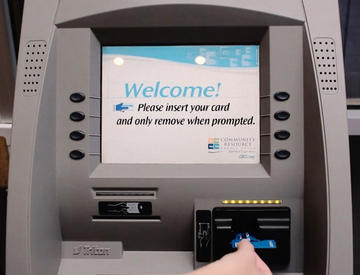
HOUSTON–As credit unions work through migrating their mag-stripe plastic to chip cards, they can’t overlook the deadline for transitioning their ATMs to EMV, reminds Dolphin Debit.
Not only do credit unions need to upgrade their ATMs so they are EMV-ready by October 2016, CUs are going to need to educate members on the change.
“There is still a good amount of lead time for ATM companies to handle all the various aspects of changing these machines over in the face of the biggest change to cards since the addition of the mag stripe in 1971,” said Dolphin Debit Co-Founder Gary Walston. “The transition involves upgrading and certifying every card reader and its associated software, and making sure that when a member inserts an EMV chip card that it works as it is supposed to.”
The new EMV readers will still work with the mag stripe, but Walston emphasized that CUs should be developing programs to educate members on how to use chip cards in the improved ATMs.
“Credit unions have explained to their members how the card is presented in terms of inserting the card into the POS terminal reader and leaving it there so that the chip can be read,” said Walston. “A similar education and training program is worthwhile when a credit union changes over its ATMs.”
Video Training
Videos are a good training option, said Walston, who noted that Dolphin Debit has created a video to help consumers understand how to use chip cards at ATMs.
“Training doesn't have to be a major undertaking,” offered Walston. “Just a bit of communication with members about the change and the differences, perhaps some helpful information on the credit union's website, and leveraging video demonstrations.”
One aspect that credit unions should emphasize to members is that as they use foreign ATMs, there may be slight differences in the way their card is read.
“They may get frustrating error messages because their customary way of inserting the card doesn't line up with that ATM's process,” said Walston.
Once the EMV chip card penetration and the ATM changeovers are complete, the best general rule is a simple one, Walston said.
“That is, insert the card into the ATM and leave it in place until a message on the screen instructs the user to take it out,” he said.
Prepare Members
Even if a credit union hasn't issued its own chip cards, there are still some ATM terminals that will operate differently with the traditional mag stripe card. Members need to be prepared for any situation, Walston said.
“As we upgrade ATMs, we are adding instructional signage on the ATM itself, and using on-screen graphics to indicate to users that the machine is chip card capable,” said Walston. “It's likely, but not guaranteed, that most other ATM operators will do something similar. That's why communication with members, to make sure they are prepared for any option, is so important.”
Walston added that in educational efforts work best when the term ‘EMV” is not used.
“Those of us in the industry have been talking about EMV cards for years, but members—especially those who aren't tech-savvy—won't understand the term very readily,” Walston said. “The term ‘smart card,’ or ‘chip card,’ especially since the chip will be right there on the card and visible, seems to be the most common and user-friendly name.”