

PORTLAND, Ore.–Credit unions meeting here got an introduction and a reminder that they are not the only cooperative act in town. For many, it was a first-time introduction, even if one of the co-ops is a large, well-known brand name.
During the Northwest Credit Union Association’s Amplify meeting here, four different types of cooperatives talked about what they do, their missions, how they operate and more—including turning the tables and asking credit unions to tell them more about themselves.
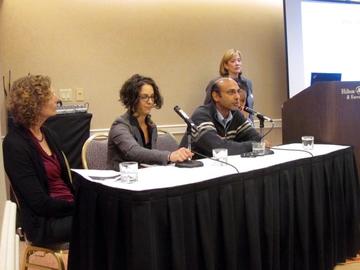
A panel of representatives from various co-ops addresses NWCUA's Amplify meeting.
Here’s a look at each, along with their representatives:
The People’s Food Cooperative; Shawn Furst, Development Manager.
Opened in 1970 in southeast Portland, the co-op has become a “trusted source” for organic produce and groceries, according to Furst. The co-op is open to everyone, but does have a “working member” option. In the 1990s it opened the first year-round farmers market.
In 2000, the People’s Food Cooperative doubled the retail square footage of the store, and expansion accomplished with the help of neighbors and supporters.
Today the co-op has 4,200 active member-owners, a nine-member board, and 45 staff members. Like credit unions, People’s Food Co-op is feeling new competitive pressures.
“Sales have been OK, but we are definitely feeling the market,” said Furst. “We are still a trusted source, but...” In this case, what the food co-op is feeling is numerous other providers including even Walmart, expanding into organic foods.
People’s Food Cooperative had sales of $5.6-milion in 2013, and has $1-million in reserves. Furst said it is now crafting a 10-year plan for putting that money to work.
“We are trying to reach out to people we don’t currently serve, those we think of as our future members,” said Furst, before adding, “We might have to make some tough choices in the future.”
Our Table Cooperative, Narendra Varma, Founder
Varma said the genesis of Our Table Cooperative came in recognizing just how little of the price of food actually goes to the farmer.
“If you spend $1 on an apple, less than 14 cents goes to the farmer,” said Varma. “Others add value, but are they 86% of the value? We asked where is the value in the food chain and why do farmers get such a small part of it. There are no farmers on the New York Stock Exchange, but are food companies. I am not for a second arguing that those other functions are not important. But we wanted to look at what a more even distribution would look like. And we decided only way to know was to be involved in each step of that value chain.”
So with what Varma called the “hubris of the ignorant,” the cooperative “jumped in.” “We knew we wanted to grow food on a farm. We also knew we needed to sell food in all the different ways people acquire it: subscription service, sell to groceries and restaurants, and also do retail,” Varma told credit unions. “So where does the co-op come in? We were trying to model a community scale food system. We realized our limitations, so we are focused narrowly to community. We are a multi-stakeholder co-op, meaning instead of one group of people—consumers and producers—owning the co-op, we have all come together. Our model is field to belly.”
There are three stakeholders in the co-op, said Varma: workers, independent businesses, and consumers. It has investors who hold preferred stock and are paid a premium in years when the co-op turns profit.
REI, Sue Sallee, VP-Accounting and Finance
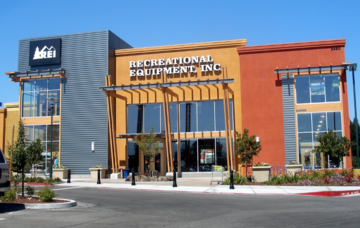
Nearly everyone is familiar with outdoor retailer REI, although not many realize it is a cooperative. The Seattle-based co-op was founded in 1928 by a group of mountain climbers looking for quality ice axes at a good price.
“At REI, our mission is to inspire, educate and outfit for a lifetime of outdoor adventure and stewardship,” said Sallee.
Today, REI has 5.5-million active members, 142 stores in 34 states (plus REI.com), 2014 sales of $2.2-billion, and 10,000 employees. It also has an elected board of 11-13 seats, each board member serving a three-year term, with a 12-year term limit.
“We feel term limits are a best practice,” said Sallee. “Our board is accountable to the co-op’s membership for the long-term visibility and success of the co-op.” Board members are compensated, although Sallee declined to say how much.
The company does hold an annual member meeting to which everyone is invited at its Seattle flagship store. It also streams the meeting online.
“We’re a big co-op and some people wonder do you still feel like a co-op and do your members have a voice? We do. Our members can still reach out to our board and management,” according to Sallee.
Part of the REI mantra is what the company calls “stewardship.” That involves curating sustainable products, creating access to the outdoors, catalyzing experiences (“we are very focused on getting people outdoors”), and a strong focus on the environment. “We expect the same from our vendors,” said Sallee.
One of its programs is called “Every Trail Connects.” In that campaign members voted on 10 trails to which REI donated a total of $500,000.
“It took less than two days for all of that money to be allocated to these 10 trails,” said Sallee.
The Portland Housing Center, Felicia Tripp Folsom, Deputy Director
The Portland Housing Center was formed in 1990 because African-Americans were being redlined in northeast Portland, according to Tripp Folsom. Lenders would only make loans on home valued at more than $50,000, and there were no homes in the area that met that criterion.
“ Many people said this is unacceptable, we have to do something, and out of that came Portland Housing Center,” said Tripp Folsom. “Our mission is that everyone deserves access to home ownership. That doesn’t mean everyone should be a homeowner.”
Twenty-five years later the Portland Housing Center is operating in three counties, has 15 financial partners—including OnPoint Community CU, for which she had much praise–and did $78-million in business in 2014.
“Our job today is to make sure that anybody, especially from marginalized communities, knows they have right to purchase a home. It sounds like a simple concept but for many homeownership is not a given. It’s something we have to tell people day in and day out, that you have a right to live in a safe place.”
The cooperative also provides assistance with financial education and down payments.
“OnPoint Community CU has been a HUGE supporter of the PHC. We have the individual development account program that we developed with OnPoint five years ago,” she explained. “They go and apply to state of Oregon for funds to help low-income people purchase a home. The CU says, ‘I agree to open accounts with communities I don’t normally do business with.’ The state of Oregon will match 3-1, up to $6,000. OnPoint helps us to track that program. Because of that collaboration, in the state of Oregon we have been able to help 250 low-income people to purchase a home. That means kids stabilized in schools. Single moms with the same mortgage payment month to month. We have generational wealth being created. And that is possible due to our credit union partner."