


Martinsville office
DANVILLE, Va.—Branches remain a viable way to grow, asserts URW Community FCU, which has nearly doubled its assets and more than doubled the size of its loan portfolio since embarking on an office expansion effort in 2012.
The $154-million CU says the success is also an example that a small CU can grow quickly, having embarked on its growth plan when it had $89 million in assets.
“Too many people say financial institutions don’t need brick and mortar anymore,” said CEO Cheryl Doss. “We have all of the other delivery channels—home banking, mobile, ATMs etc. But branches still play, and will continue to play, a major role in our future.”
The community chartered CU has constructed three new offices since 2012, will add another this year, and plans to continue the pace in the coming years. The credit union expects it will pass $250 million in assets by 2020-2021. Membership has almost doubled, growing from 13,000 in 2011 to 21,000 today. In that same period, the loan portfolio grew from $63 million to $132-million.
Targeted Planning
But to grow via branching today, Doss acknowledges that it takes very careful and targeted planning, choosing new locations based on a close evaluation of current markets and their potential.
“While branch placement has always been important, it’s even more so today,” said Doss. Cincinnati-based DEI was chosen to create URW’s branch expansion strategy.
Mike King, VP of strategic planning with DEI, explained how the firm evaluated the markets before presenting growth opportunities to the credit union.
“Of course we evaluated all of the potential markets’ demographic characteristics, the competitive environment, and zip code distribution of the membership,” said King, noting that there were 16 aspects of each market that were analyzed. “We looked at the current market potential and the future potential and developed a strategy with specific recommendations about what markets the credit union should be in and how large each individual office should be.”
By “large,” King said he meant more than size and staff.
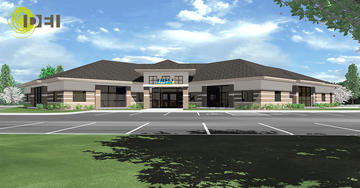
Danville office
“The first thing we did was project the deposit and loan levels, as well as account activity for each potential office in order to determine how many employees were needed in each location and how big of a space was needed,” he said.
Efficient Growth
That planning has not only led to growth, but efficient growth as well, with URW’s operating expense ratio standing at 2.12% at the close of 2015.
The CU’s expansion efforts began with a new headquarters location in its hometown here. The credit union then moved north in Virginia to open a branch in Chatham and then south in the state to South Boston. A location in Martinsville, Va., will open this year.
All of the new offices are “retail focused,” with “dialog banking” and no teller lines.
Doss said that while the choice of locations has been a boon to growth, the business would not be coming in if staff were not well trained, with an emphasis on cross-sales. She also noted that staff are coached to be active members in the community, as the credit union plays a large role in each of the towns it serves.
“When we ask our new members why they joined our credit union, the biggest reason is that they saw we were very involved in the community,” said Doss.